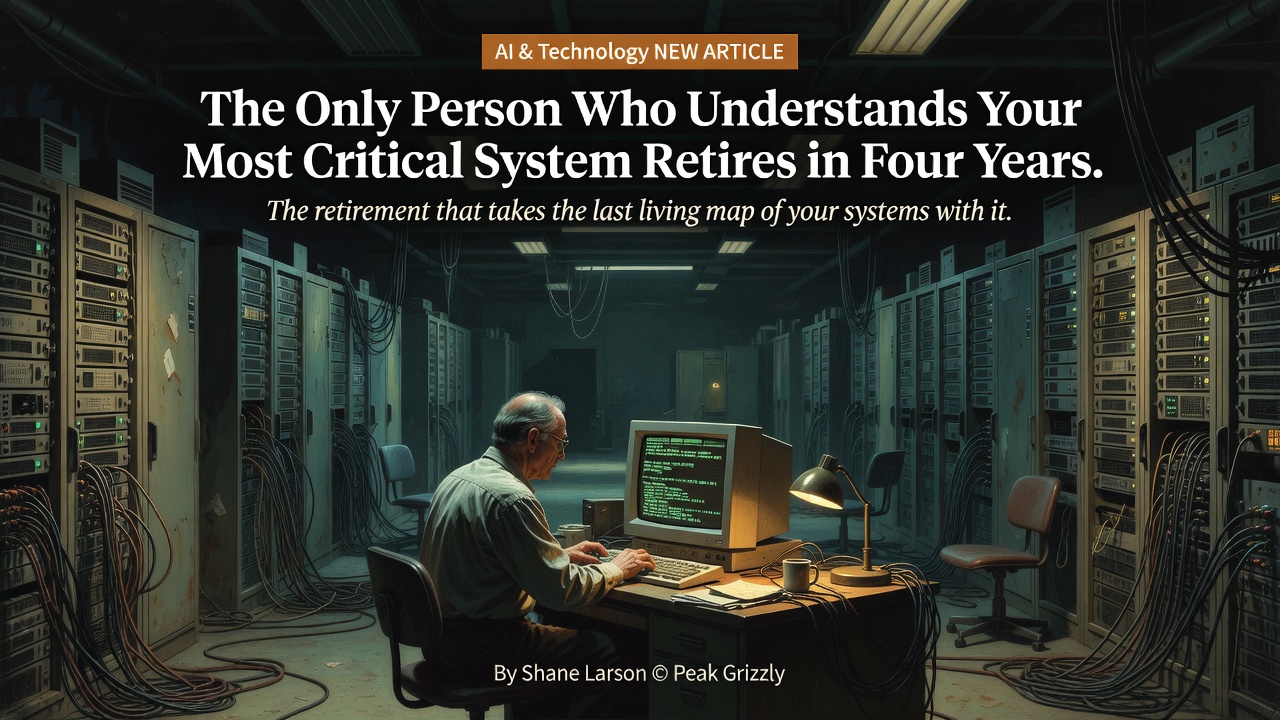
The Only Person Who Understands Your Most Critical System Retires in Four Years
August 5, 2026 · 6 min read
There is a retirement party happening somewhere in your company.
The person being celebrated has worked on your legacy systems for twenty-five years. They are the one everyone calls when the batch job dies at two in the morning. They know why that calculation looks wrong but is actually right. They remember the regulatory change in 2003 that produced the strange exception in the business logic.
When they leave, that knowledge leaves. It is not in the documentation, because it was never written down — it exists as the accumulated memory of one person who was present when each decision was made.
This is why legacy modernization stopped being a budget question and became a deadline.
The Math Nobody Wants on a Slide
Legacy systems ran on an implicit assumption: the people who understand them will continue to be available. For thirty years that was true enough to plan around.
It is no longer true. Roughly ten thousand Americans reach retirement age every day, and that has been the case since 2011. The population maintaining mainframe and COBOL systems skews significantly older than the software industry generally — average ages north of 55 are typical, and the specialists who can diagnose a novel failure rather than follow a runbook skew older still.
There is no pipeline behind them. Nobody graduating today is choosing to specialise in a platform whose job postings are all replacements for retirees.
So the resource that made deferral safe is depleting on a schedule you do not control. Every year the system becomes marginally harder to change, until you reach the state that actually kills organizations: a system that still works perfectly and can no longer be modified, because the cost and risk of any change exceed what anyone will authorise.
That is the real failure mode. Not an outage. Paralysis.
Why Rewrites Kept Failing
The industry has been attempting this for twenty years with a poor record, and the reason is specific.
The specification does not exist. The requirements document, if there ever was one, describes what the system was supposed to do in 1997. What it actually does now is thirty years of accumulated amendments — regulatory patches, edge cases, workarounds for problems in adjacent systems, and a large amount of behaviour that is technically a bug but that downstream processes have come to depend on.
The only complete specification is the running code, and reading it is enormously expensive. A large legacy application may be millions of lines, in a language most of your engineers do not know, with control flow that predates every structuring convention they have been trained on.
So the standard rewrite begins with a discovery phase, the discovery phase runs long, the estimate doubles, executive sponsorship changes, and the project is cancelled — leaving the organization with the original system plus a partial replacement it now also has to maintain. That pattern is common enough to be the base case.
Where AI Actually Helps
The expectation is that AI will translate the old system into a new one. That is the least reliable application of it, and leading with it is how these projects fail expensively.
What genuinely changes is comprehension, and that was always the bottleneck.
Reading at scale. The work of taking two million lines of unfamiliar code and producing an accurate account of what it does — the modules, the data flows, the dependencies, the actual business rules embedded in the branches — was previously months of expensive senior time. It is now dramatically cheaper. This is the single biggest shift, because discovery was the phase that killed the projects.
Escape Velocity
Extracting knowledge before it walks out. This is the urgent one. Instead of asking a retiring expert to write documentation — which nobody has time for and which comes out generic — you can put them in front of a system that has read the code and can ask specific questions. Why does this module bypass validation for this customer type? The expert answers in a sentence. That exchange captures something that would otherwise have been lost, and it takes an afternoon rather than a quarter.
Generating characterization tests. The hardest part of any migration is proving the new system behaves like the old one, and you cannot prove it without tests that describe current behaviour — bugs included. Generating those tests against the existing system, at volume, is now feasible. This converts "we think it's equivalent" into evidence.
Making the code legible to the people who will replace it. Annotated, explained, mapped to business function, so an engineer who has never seen the language can reason about it.
Notice what these have in common: they are all about understanding the existing system, not producing the new one. The generated-translation step is the part with the weakest track record, because a plausible-looking conversion of financial logic that is subtly wrong is worse than no conversion at all.
Cut Over Slowly or Not at All
The other reliable lesson is about the transition, and it has nothing to do with AI.
The most dangerous moment in any migration is the switch. Get it wrong and transactions fail, customers are affected, and the pressure to revert becomes irresistible — usually at the exact moment reverting is hardest.
The way through is to refuse to have that moment. Run both systems at once. The legacy system stays the source of truth while the new one processes the same inputs in parallel and its outputs are compared, continuously, against the system of record. Discrepancies are investigated as defects. Traffic shifts a few percent at a time, by customer segment or transaction type, with the ability to shift back instantly.
It costs more, because you are running two systems and building comparison infrastructure. What you buy is that confidence comes from accumulated evidence rather than from a testing phase and a hope, and that no single decision can take the business down.
Then decommission deliberately — verified, with the data retention worked out — rather than leaving the old system running "just in case" for six more years, which is how organizations end up maintaining both forever.
The Timing
The uncomfortable part is that these two things are on different clocks.
The tooling that makes comprehension cheap arrived recently and keeps improving. The people who can answer the questions it surfaces are leaving on a fixed schedule. The window where you have both is now, and it is not long.
Extract the knowledge while there is someone to extract it from. Everything else — the migration, the parallel run, the cutover — can happen later. That part can't.
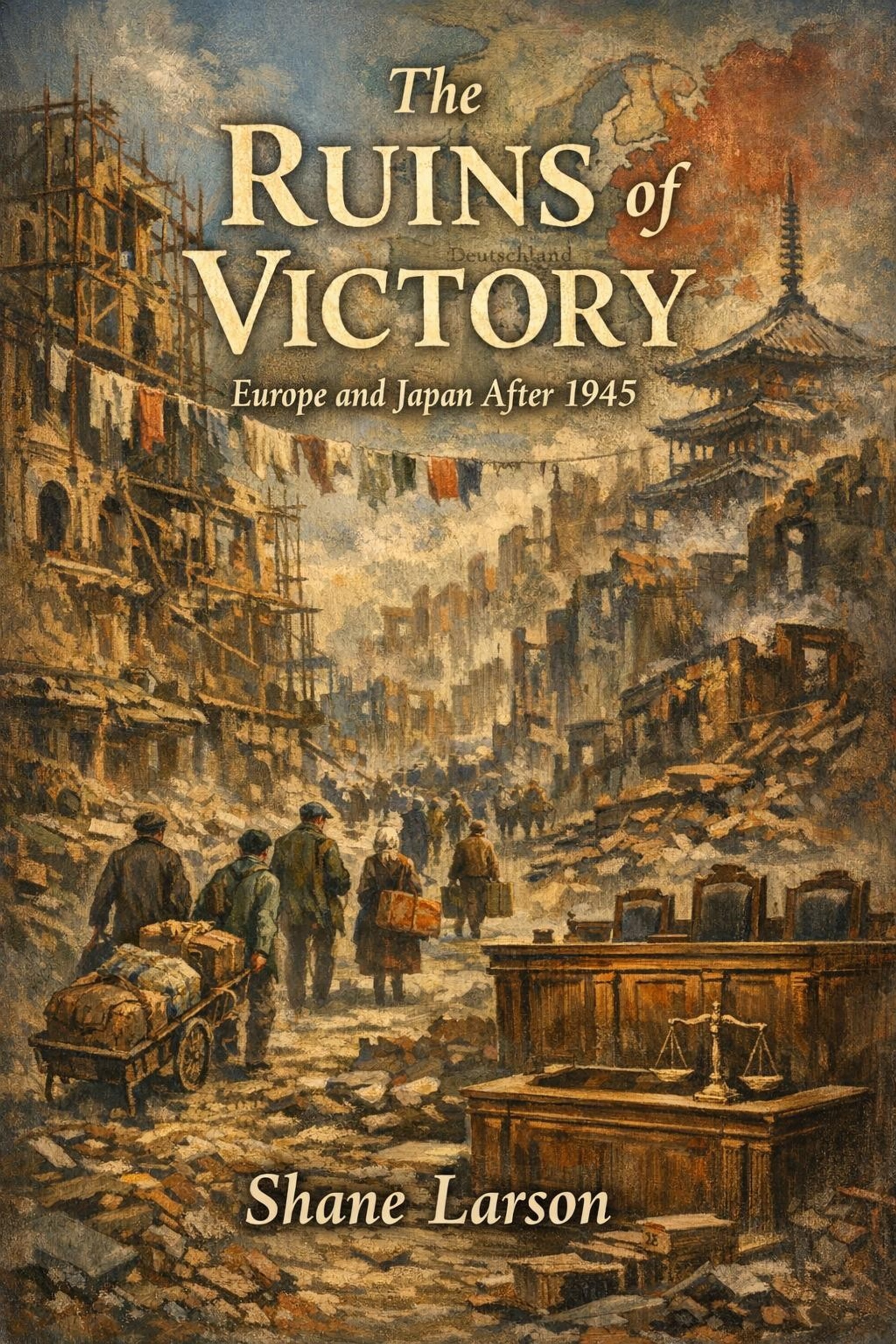
Escape Velocity: Using AI to Finally Modernize Your Legacy Systems covers the full path — the legacy trap, the knowledge cliff, AI-assisted analysis and knowledge rescue, migration patterns, test generation, data migration, the parallel path, and decommissioning done properly.
Escape Velocity
New posts and releases, straight to your inbox. No spam, unsubscribe anytime.