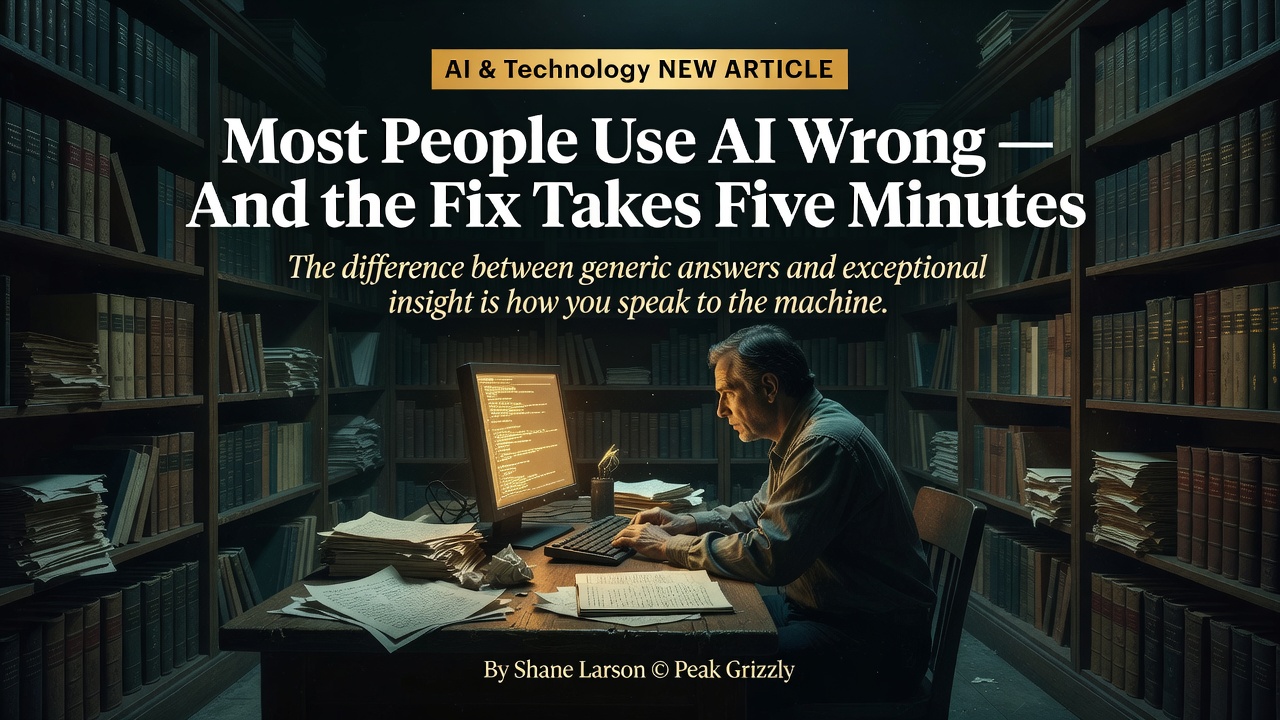
Most People Use AI Wrong — And the Fix Takes Five Minutes
April 1, 2026 · 7 min read
I watched a senior marketing director spend forty-five minutes fighting with ChatGPT. She wanted a competitive analysis of three SaaS products. She typed "Compare Product A, Product B, and Product C" and hit enter.
What she got was generic. Surface-level. The kind of output you could have written yourself by spending ten minutes on each company's website.
She refined: "Make it more detailed."
She got more words. Not more insight. Just the same generic points padded with qualifiers and caveats.
She tried again: "Focus on what matters for enterprise buyers."
Better. But still missing the specific analysis she needed — the kind that identifies which product has the best API integration story for companies with legacy systems, which one's pricing model falls apart at scale, and which one's customer success team actually picks up the phone.
After forty-five minutes, she declared that AI "isn't that useful for real work" and went back to doing the analysis manually. It took her three hours.
Here is what that analysis should have looked like as a prompt:
"You are an enterprise SaaS analyst with 10 years of experience evaluating project management tools. I need a competitive analysis of Product A, Product B, and Product C for a 200-person engineering organization. Evaluate each product on these criteria: API integration capabilities (especially with legacy systems), pricing at scale (200+ users with admin tiers), customer support responsiveness, data migration tooling, and SSO/security compliance. For each criterion, rate each product 1-5 and explain the rating. Present as a comparison table with a summary recommendation at the end."
Time to write that prompt: about three minutes. Quality of the output: dramatically better than what she spent forty-five minutes failing to produce.
The difference was not the AI tool. It was how she communicated with it.
The Communication Gap Nobody Talks About
There is a massive, mostly invisible gap between people who get mediocre results from AI and people who get exceptional results. It is not about which tool they use — ChatGPT, Claude, and Gemini are all capable enough for most professional tasks. It is not about technical knowledge — you do not need to understand transformers or neural networks to use AI effectively (though it helps, and I explain it all in plain language in my book).
The gap is in communication.
Most people interact with AI the same way they use Google: type a few words and hope for the best. "Write me an email." "Summarize this document." "Help me with my presentation." These prompts are the equivalent of walking into a restaurant and saying "bring me food." You will get something edible, but you probably will not get what you actually wanted.
The fix is not complicated. It is not a secret technique or a magic formula. It is a structured approach to communication that takes about five minutes to learn and transforms every AI interaction from that point forward.
The Four-Element Framework
Every effective AI prompt contains some combination of four elements:
Instruction — what you want the AI to do. Be specific about the action: summarize, draft, analyze, compare, rewrite, list. "Help me with this email" is vague. "Rewrite this email to be more concise, maintaining a professional tone, and ensuring the three action items are clearly listed at the end" is specific.
Context — the background information the AI needs. The AI has no context beyond what you provide. A colleague can fill in gaps based on shared experience. AI cannot. Everything it needs to produce your desired output must be in the prompt.
Constraints — the boundaries and requirements. Length, tone, format, what to include, what to exclude. Constraints are the difference between a generic output and one that fits your specific situation.
Format — how you want the output structured. Paragraphs? Bullet points? A table? JSON? Telling the AI the desired format eliminates guesswork.
That is it. Four elements. Most failed prompts are missing one or more of them. Add the missing element, and the output quality jumps dramatically.
Learning AI
Why This Works (And Why Most People Do Not Do It)
This works because of how language models actually generate text. They predict the most probable next word based on everything in the prompt. A vague prompt could lead in a hundred directions, so the model picks one — and it may not be the one you wanted. A specific prompt constrains the probability space, guiding the model toward your intended output.
Most people do not do this because it feels like extra work. Writing a detailed prompt takes two or three minutes instead of ten seconds. But those two or three minutes save twenty or thirty minutes of getting disappointing outputs, refining vaguely, getting slightly less disappointing outputs, and eventually giving up or settling for mediocre results.
The math is simple: invest three minutes in a good prompt, or waste thirty minutes on bad ones. Once you see the difference in output quality, you never go back.
The Technique That Changed Everything for Me
If I could only teach one advanced prompting technique, it would be chain-of-thought prompting: asking the AI to think through its reasoning step by step before giving its answer.
Instead of "What is the best pricing model for our SaaS product?", try "I am evaluating pricing models for a B2B SaaS product with these characteristics: [details]. Think through this step by step. Consider the unit economics, the competitive landscape, the customer acquisition model, and the expansion revenue potential. Walk me through your reasoning before giving a recommendation."
The difference in output quality is often dramatic. Chain-of-thought works because each reasoning step becomes part of the context that guides the next step. The model cannot skip to a conclusion without generating the intermediate reasoning — and that intermediate reasoning catches errors, surfaces nuances, and produces more thoughtful outputs.
I have seen chain-of-thought turn a generic "consider tiered pricing" recommendation into a detailed analysis that correctly identified the specific pricing tier boundaries, predicted the conversion rates between tiers based on the product's feature set, and flagged a pricing gap that the team had overlooked.
Three words — "think step by step" — transformed the output from useless to valuable.
The Real AI Literacy Gap
The marketing director I mentioned earlier is smart, experienced, and good at her job. She is not bad at technology. She just never learned how to communicate with AI effectively, because nobody taught her. The AI companies certainly did not — they want AI to feel effortless, so they do not advertise that there is a skill to learn.
But there is a skill. A significant one. And the gap between people who have it and people who do not grows wider every month as AI tools become more capable. A powerful tool used poorly produces mediocre results. A powerful tool used well produces exceptional results. The tool is the same — the skill makes the difference.
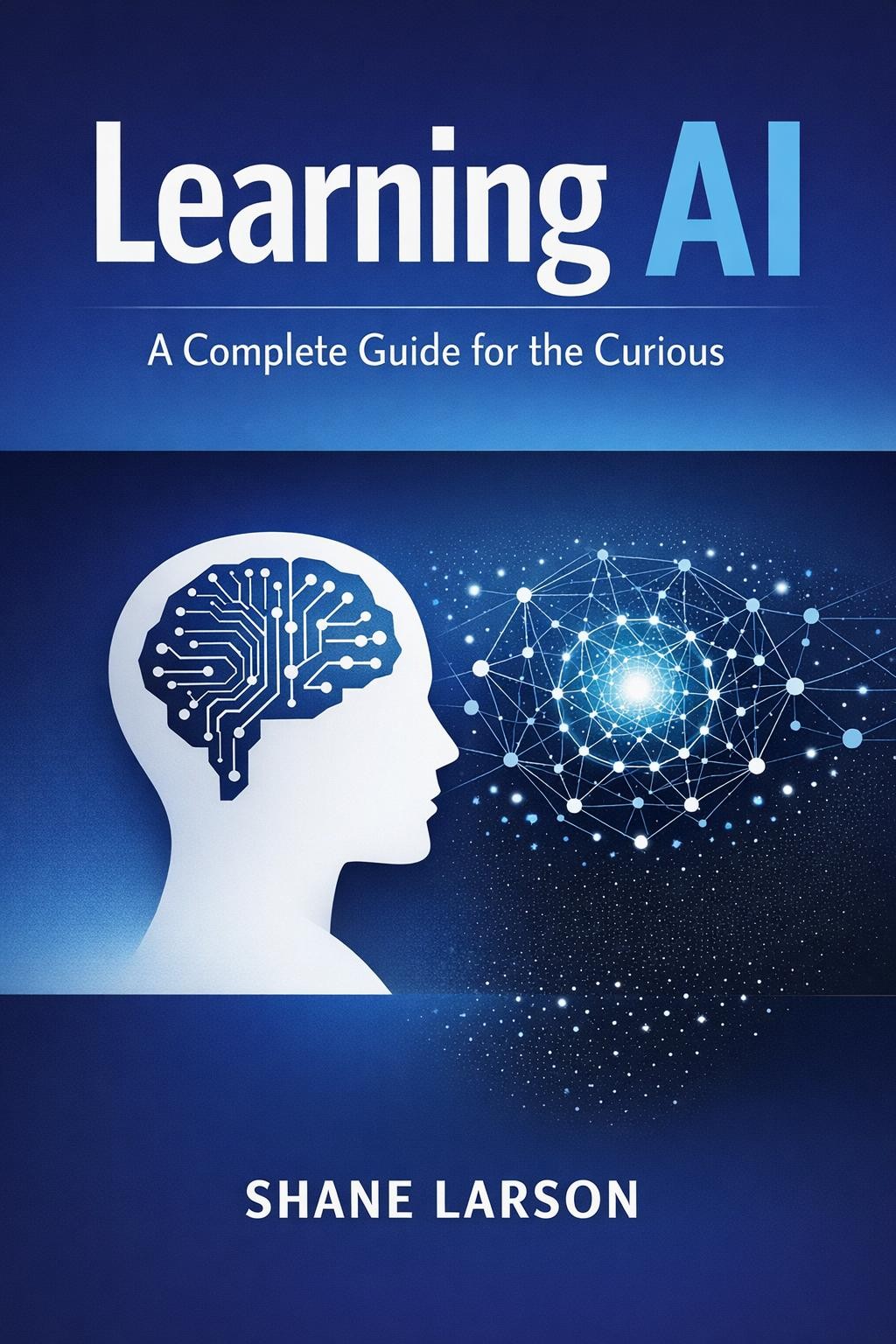
This is why I wrote Learning AI: A Complete Guide for the Curious. Not because the world needs another book about how exciting AI is. The world has plenty of those. I wrote it because millions of people are trying to learn AI and finding a landscape of incomplete, inaccessible, or impractical resources. YouTube tutorials that teach Python they do not need. University courses that assume math they do not have. Blog posts that are either too shallow or too technical.
What does not exist — or did not, until now — is a single, comprehensive, well-structured book that takes an intelligent adult from "curious" to "competent." That covers how AI works, how to use it effectively, where it fails, and how to keep learning. That includes exercises in every chapter so you are not just reading about AI — you are using it. That provides structured learning roadmaps based on your specific goals.
The prompt engineering material alone — two full chapters covering everything from basic structure to chain-of-thought, role prompting, decomposition, and meta-prompting — will transform how you interact with every AI tool. But the book goes far beyond prompting into the complete AI literacy landscape: building workflows, evaluating tools, understanding limitations, and developing the critical thinking that separates informed AI users from everyone else.
If you have been meaning to get serious about AI, this is where to start.
Learning AI
New posts and releases, straight to your inbox. No spam, unsubscribe anytime.