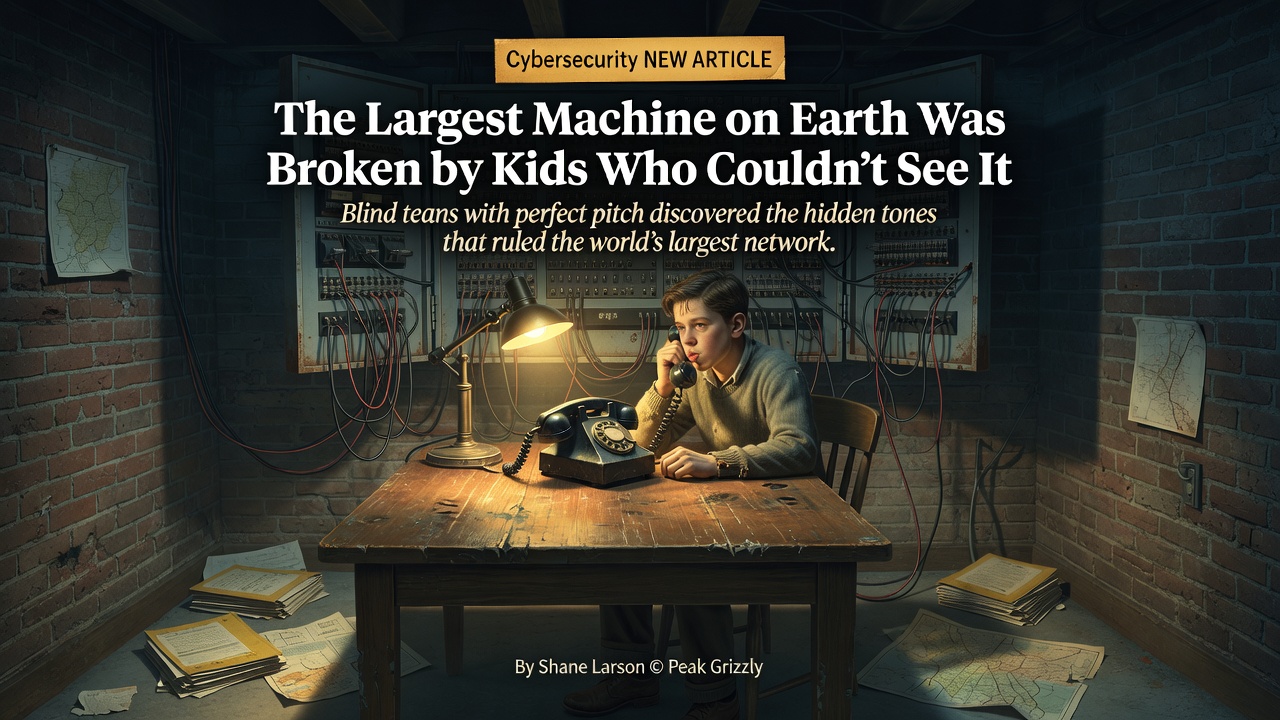
The Largest Machine on Earth Was Broken by Kids Who Couldn't See It
August 5, 2026 · 6 min read
In 1957, a seven-year-old blind boy in Richmond, Virginia picked up the telephone and whistled into it, and the phone system answered him.
Joe Engressia had no idea what he had done. What he had done was produce a clean tone at 2,600 hertz — the single most important frequency in the American telephone network. The line went quiet, then came alive with clicks and distant operators. Sometimes he ended up connected to numbers he had not dialed. Sometimes the line simply died.
He was a kid with perfect pitch and nothing to do but listen. He had just found the master key to the largest machine ever built, and it would be years before anyone, including him, understood that.
The Design Flaw Was the Design
AT&T's long-distance system in the 1950s ran on something called in-band signaling. The idea was efficient and, at the time, obviously correct: rather than build a separate control network, send the control signals down the same wires as the voice. The commands that told switching equipment what to do were simply audio tones.
The most important of them was 2,600 Hz. When a long-distance trunk line sat idle, the equipment at both ends transmitted a continuous 2,600 Hz tone, meaning: nobody is using this line. When a call went through, the tone stopped.
The consequence follows immediately once you see it. If you were on a call and could produce that tone yourself, the far-end equipment would conclude the trunk had gone idle and release the call on its side. Your side stayed connected — now attached to an open trunk line, in the network's own signaling mode, with no billing record attached. From there you could route yourself anywhere the network reached.
The system could not tell the difference between a command from AT&T's equipment and the same sound made by a human mouth. There was no concept of authentication, because the engineers who designed it had never imagined a caller who would think of the network as something to be talked to rather than talked through.
Why So Many of Them Were Blind
The striking thing about the early phreaking community is how much of it was blind, and it was not a coincidence. Three things stacked.
Sound was primary information. For someone blind from birth, the acoustic texture of a space is the space. That habit of attention transfers directly to a telephone line. The clicks, the hums, the faint tones under a connection — the things sighted callers filter out as noise — were legible. Blind phreaks could identify which type of switch was handling their call by the sound it made, and hear routing tones that no one else registered as present.
Several had perfect pitch. Genuine absolute pitch is rare and, for most people, a party trick. In a network controlled by specific frequencies, it was an instrument. Engressia's whistle is the famous case, but he was not alone; others could identify 2,600 Hz cold and reproduce multifrequency digit combinations by ear.
The telephone was where they were equal. In the 1950s and 60s, a blind teenager could not drive, was often at a residential school away from family, and was excluded from most of what teenage social life ran on. On the phone, none of that existed. Nobody could tell. For a lot of blind kids, the telephone was the only place they were an ordinary participant, so they lived on it — hours a day, every day, calling weather lines and time-of-day recordings and each other.
Put those together and you get the profile of a hacker before the word existed: someone who spends an enormous number of hours inside a complex system, notices patterns nobody else is positioned to notice, and experiments until the system makes sense.
They were not trying to steal long distance. Free calls were a side effect. They were exploring the most interesting thing in their world.
Phone Phreaks: The Original Hackers
A Network That Ran on Giving Things Away
The phreaks found each other through the network they were studying, which meant AT&T was involuntarily hosting the community that was reverse-engineering it.
What formed looked remarkably like an online community twenty-five years early. Someone found a new test number, or a switching quirk, or a technique — and told everyone they could reach. There was no gatekeeping and no attempt to sell anything.
That norm was not sentimental; it was structural. In a community connected only by phone calls, your standing was determined by what you knew and what you passed on. Hoard information and people stopped calling you. Share it and you became a hub. The result was a knowledge network efficient enough that a discovery made in one city could be common property across the country within days.
Explore the system. Understand it. Share what you find. Those three norms came out of this community and went straight into everything that followed — the homebrew computer clubs, the early software culture, the open-source movement. They were not invented by programmers. They were invented by people who could not see the machine they were mapping.
The Cereal Box
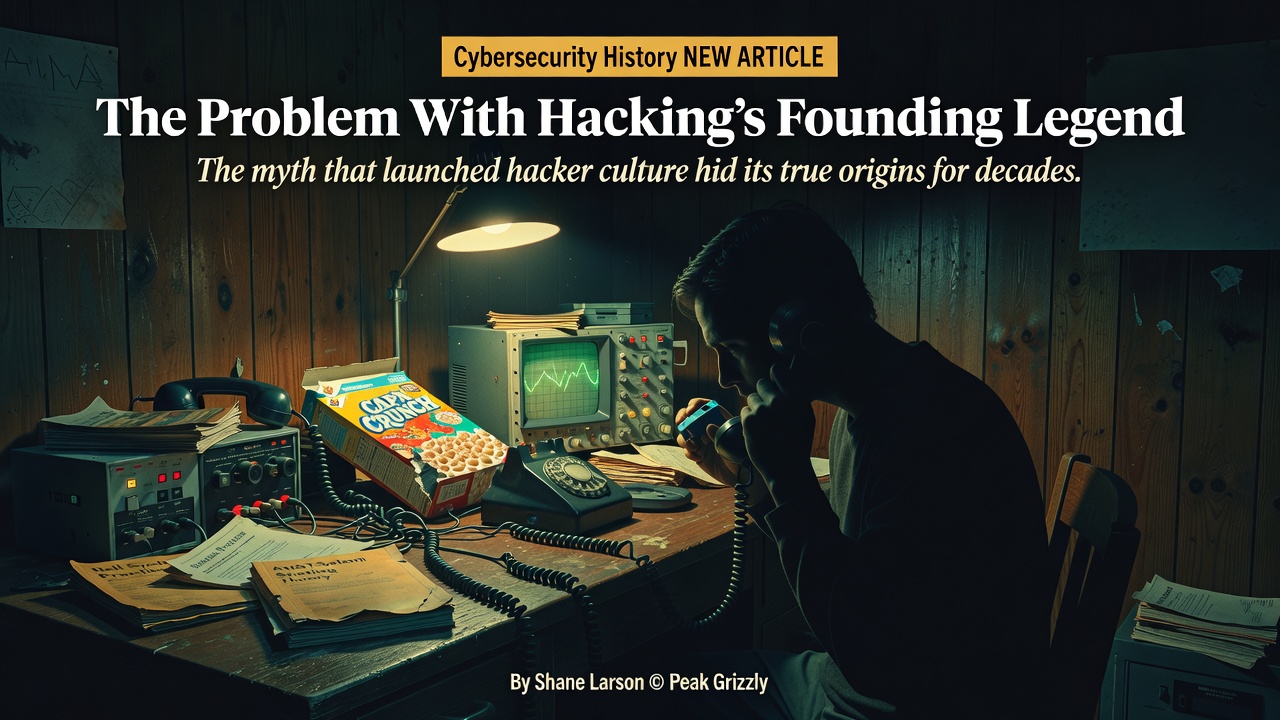
The movement's folk hero arrived by way of breakfast. A toy whistle packaged in boxes of Cap'n Crunch produced, when one hole was covered, a tone at almost exactly 2,600 Hz. John Draper — who took the handle Captain Crunch — became the best-known figure of the era, and the story is irresistible: a cereal prize that opened AT&T's network.
It also flattened the history. The whistle was a convenience, not a discovery, and it arrived well after the blind phreaks had already mapped the terrain by ear. What followed it was the real escalation: the blue box, a handheld electronic tone generator that reproduced the full multifrequency signaling set, so you no longer needed a rare musical gift to route your own calls.
The best-engineered blue boxes in the community were built by a Berkeley student named Steve Wozniak, who sold them out of dorm rooms with his friend Steve Jobs. That partnership — technical obsessive plus salesman, working on a device whose entire premise was that a system's rules could be understood and rewritten — is the direct prototype of Apple Computer.
How It Ended
The underground stayed underground until October 1971, when Esquire published Ron Rosenbaum's "Secrets of the Little Blue Box." The article was sympathetic and vivid, and it did what sympathetic and vivid articles do. Thousands of people learned that this was possible. Some of them were curious teenagers. Some were organized crime.
AT&T's response hardened, the FBI got involved, and a scene built on people who talked openly about what they had figured out turned out to be extraordinarily easy to prosecute. Engressia himself had been arrested that same year. Draper went to federal prison. What had been treated by its participants as exploration was, in law, toll fraud, and the gap between those two readings never closed.
The technical era ended for a duller reason. AT&T moved to out-of-band signaling — Common Channel Signaling System 7 — which carried control information on a separate channel the caller could not reach. No amount of whistling into a handset can command a network that isn't listening to the voice path. The vulnerability was closed by architecture, not by arrests.
But by then the people were already moving. The network worth exploring was becoming the computer network, and the crowd that had spent fifteen years learning how to think about a system from the outside walked straight into it.
The phone phreaks did not just precede computer hacking. They wrote its ethics first, on a machine they were never allowed to see.
Phone Phreaks: The Original Hackers tells the full story — Engressia and the blind pioneers, the blue box builders, AT&T's security war, the Esquire article that ended the era, and the culture it left behind.
Phone Phreaks: The Original Hackers
New posts and releases, straight to your inbox. No spam, unsubscribe anytime.