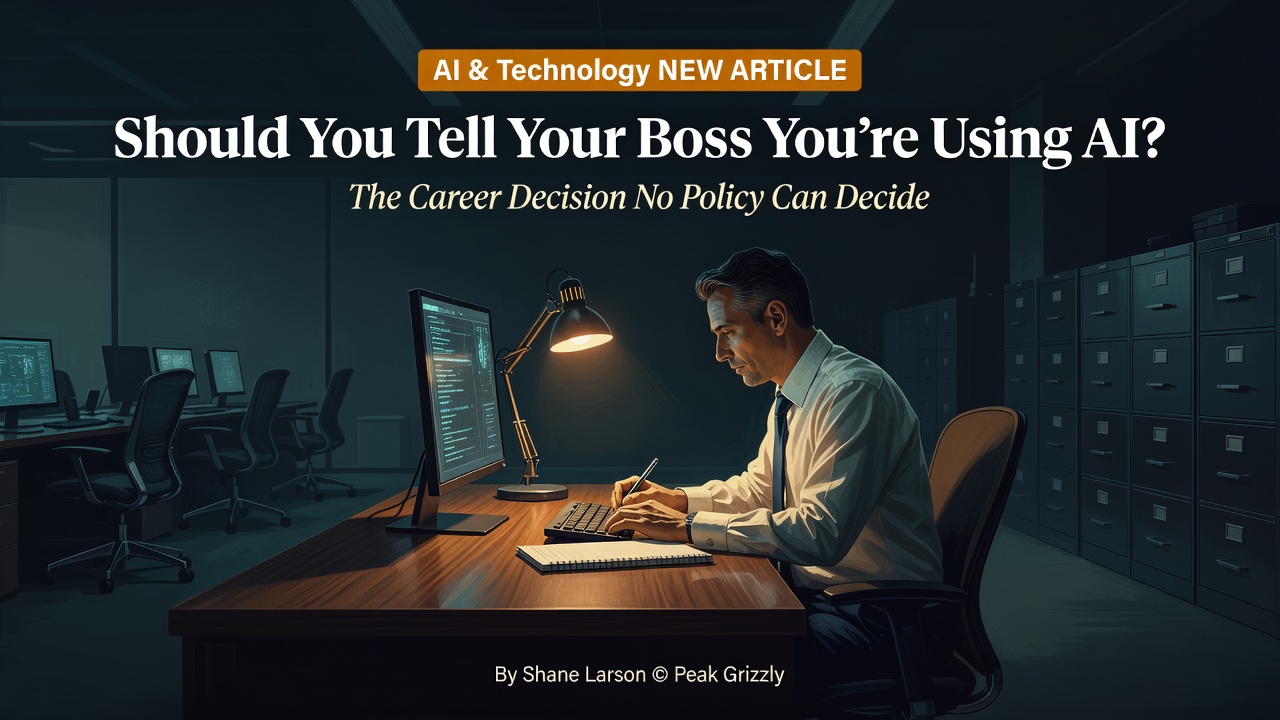
Should You Tell Your Boss You're Using AI?
August 5, 2026 · 5 min read
You have started using AI to do parts of your job faster. The work is good — arguably better than before. Nobody asked you to do this and nobody told you not to.
Do you mention it?
That question sounds like an etiquette problem and is actually a career decision, and the honest answer is that it depends on things nobody will tell you directly.
First, the Grey Zone Is Real
Most people are not working under a clear rule. Their employer has not approved AI tools and has not banned them. There is no policy, no training, no guidance — just silence.
Silence is not permission and it is not prohibition, and in that vacuum people go one of two wrong ways. Some avoid the tools entirely, waiting for an approval that may never arrive, and quietly fall behind colleagues who did not wait. Others use them for anything at all, including work they should not, and create genuine exposure for themselves and their employer.
A workable way to think about it: the question is not am I allowed to use AI. It is what am I putting into it, and what am I claiming about the output.
Almost nobody objects to you using a tool to draft, restructure, summarise, or check your own work. The objections cluster around two specific things — confidential information leaving the organization, and work being represented as something it isn't. Get those two right and most of the grey zone resolves.
Which means the practical rule is about inputs, not usage. Client data, personal data about colleagues or customers, unreleased financials, anything under NDA, anything you would not paste into a personal email — those do not go into a tool your employer has not vetted, regardless of how convenient it would be. That line is bright, and it holds whether or not a policy exists.
The Case for Being Visible
There are real advantages to being open, and they are not just about honesty.
You get credited for the capability. In organizations that are interested in this — which is most of them — being the person who demonstrably made a process faster is a reputational asset. That credit does not accrue if nobody knows.
You shape what the organization does. Leadership decisions about adoption get made on evidence, and the evidence available is whatever employees are visibly doing. Your working example is worth more than a vendor deck, and it is the mechanism by which sensible policy gets written rather than restrictive policy.
You remove the risk of being caught. This is underrated. If your method is known and accepted, it cannot later be characterised as something you concealed. Concealment is what turns a neutral fact into a problem.
And you can ask for things. Tools, budget, time, a role in the organization's approach. None of that is available to someone whose productivity has a source they will not name.
The Case for Discretion
The counter-case is not paranoia, and pretending otherwise does people a disservice.
Your output can get repriced. If you finish in two hours what used to take a day, some managers respond with more interesting work and some respond with more work. You know which kind you have. This is the single most common reason people stay quiet, and it is a rational response to a real pattern.
The AI Ready Employee
Some organizations still read it as cheating. Not many, and fewer every quarter, but in certain cultures — particularly where the craft is the identity, in law, in academia, in some editorial and design environments — disclosure invites a judgment about the legitimacy of your work rather than an assessment of its quality.
You can become "the AI person." This is a trap with a friendly face. It starts as recognition and becomes a support function: you are now the one everyone asks, doing unpaid internal consulting that displaces your actual job and appears nowhere in your review. If your goal is to move up in your discipline rather than sideways into enablement, this costs you.
Policy might arrive retroactively. In an organization that has no rule yet, a visible practice can become the case study that triggers a restrictive one — and the person who was visible is the person the rule gets written about.
How to Decide
The variables that actually matter are few.
How does your manager respond to efficiency? If the last person who automated something got recognition, be visible. If they got more work, be measured about what you disclose and specific about what you ask for in return.
What does your organization reward — output or effort? Some workplaces genuinely evaluate results. Others evaluate visible labour, and in the second kind, doing something in a third of the time is not obviously a win.
Is your field one where the method is part of the credential? In most jobs, nobody cares how the spreadsheet got built. In some, the process is the product.
Are you early or late? Being first is high-risk, high-reward. Being fifth is low-risk, low-reward. There is no general answer, only a read on your own tolerance and your organization's history with early adopters.
The Middle Path Most People Land On
In practice, the version that works for the majority is neither concealment nor announcement.
You do not hide it — if asked, you answer plainly. You do not lead with the tool either; you lead with the result, because "I cut the reporting cycle from three days to one" is the thing anyone actually cares about, and the method is an implementation detail you are happy to explain.
You keep a record of what changed. Specific processes, specific time saved, specific quality improvements, dated. This is worth doing regardless of your disclosure strategy, because it is what converts a vague sense that you have gotten faster into something you can put in a review or a negotiation.
And you never misrepresent the work. Not because of a rule, but because that is the one version of this that can actually damage you — and it is entirely avoidable, since the honest version is already impressive.
The tooling question resolves itself over the next few years. Policies get written, training arrives, this stops being a decision. The window where discretion is a strategic choice is temporary, and the people who navigate it well are mostly the ones who were clear-eyed about their specific manager rather than about the technology.
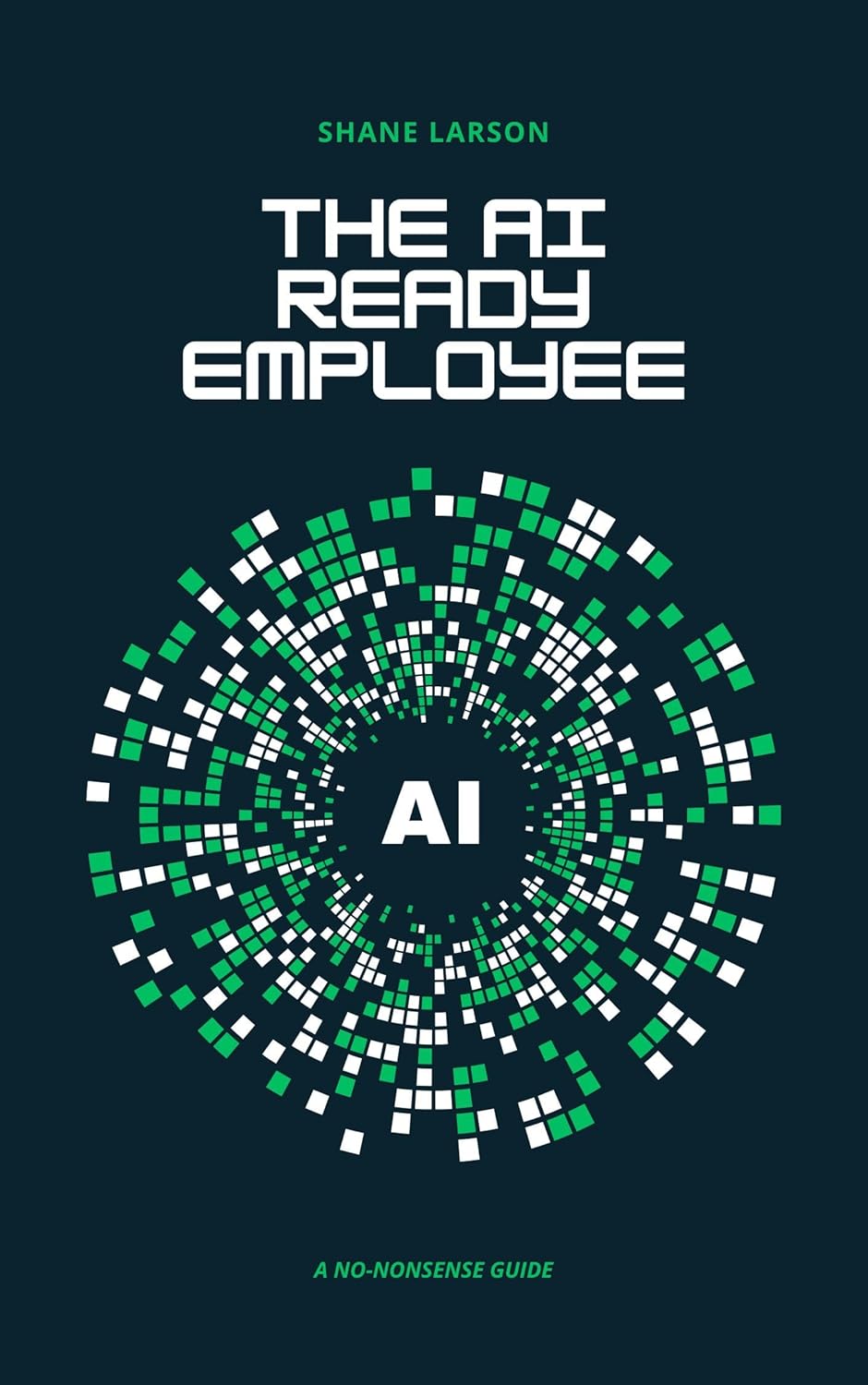
The AI-Ready Employee: A No-Nonsense Guide covers the whole practical picture — auditing your week, quick wins, the tasks that don't work, what's safe to put in, the visibility calculation, talking to your boss, documenting wins, and the skills that stay human.
The AI Ready Employee
New posts and releases, straight to your inbox. No spam, unsubscribe anytime.