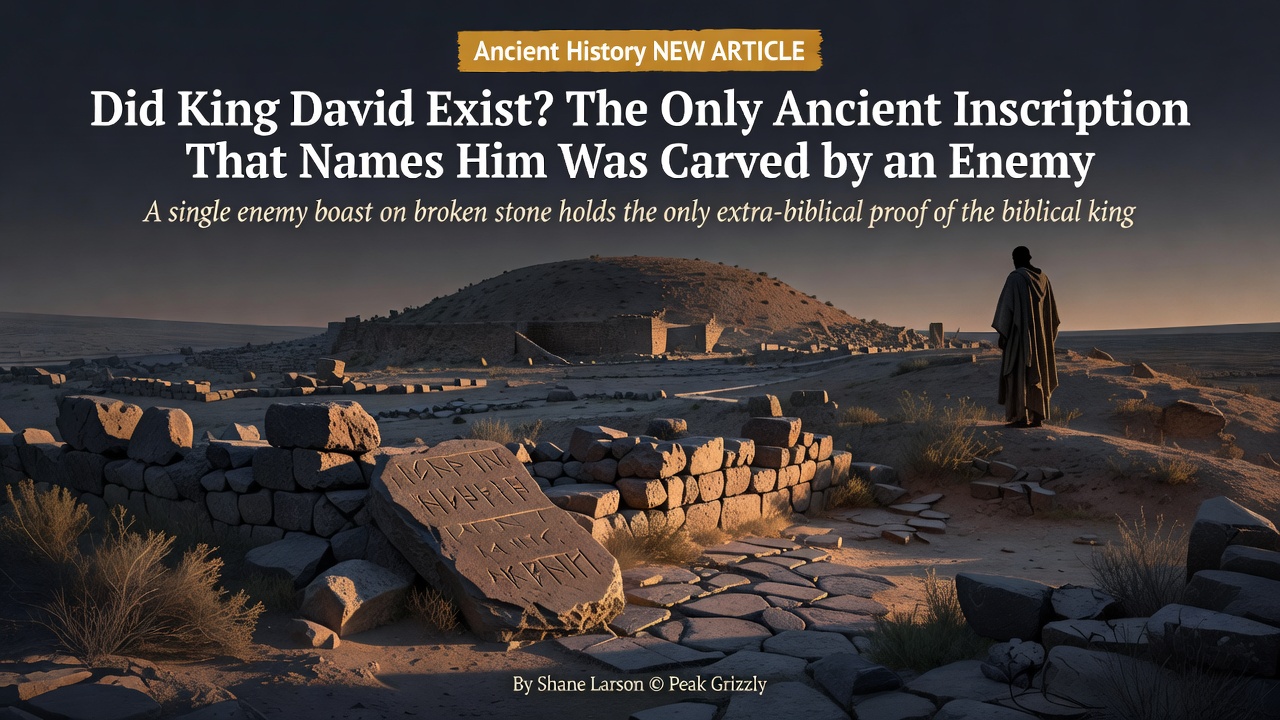
Did King David Exist? The Only Ancient Inscription That Names Him Was Carved by an Enemy
8 min read
Ask a search engine whether King David existed and you get two kinds of answer, both confident. One says archaeology has confirmed him. The other says there is no evidence he ever lived. The honest answer is narrower than either, and it rests on a single broken stone that was found by accident, had been reused as paving, and was written by a man at war with David's family.
A basalt stone in a wall
Tel Dan is a low mound at the northern edge of the land the Bible calls Israel, beside the springs that become the Jordan. Avraham Biran had been excavating it for Hebrew Union College since 1966, and by 1993 the dig had uncovered an Iron Age gate complex with a paved square in front of it, the sort of open space where a conqueror might set up a monument to say the city was his.
On 21 July 1993 the team was clearing the edge of that square. Gila Cook, the expedition's surveyor, noticed that one of the basalt stones built into a low wall beside the pavement carried marks that weather had not made. Lifted out, it proved to be a fragment of a dressed slab, somewhat larger than two spread hands, broken on every side, with parts of thirteen lines of writing. The script was the Semitic alphabet of the ninth century BC. The language was Aramaic, the language of Damascus, not of Israel. Two more small pieces turned up the following June, and Biran and the epigrapher Joseph Naveh published all of it in the Israel Exploration Journal. The joined fragments are in the Israel Museum today.
The text is a royal victory inscription of a familiar type, and it can be paraphrased in a few lines. A king speaks in the first person. His father has died. The king of Israel had earlier pushed into his father's territory. His god Hadad made him king and went before him in war. He defeated his enemies, and he claims to have killed a king of Israel and a king of something written as bytdwd. The names of the two dead kings are mostly broken away. The restorations most scholars accept are Joram of Israel and Ahaziah of Judah, who according to the book of Kings died in the same year, 841 BC. It is right to say plainly that those names are largely filled in from a few surviving letters. The claim, and the word bytdwd, are not.
The author is almost certainly Hazael, who took the throne of Damascus around 842 BC and spent the next decades fighting Israel. He appears in the Bible too: the prophet Elisha weeps on meeting him, foreseeing what he will do (2 Kings 8:12). The stone at Dan is part of what he did.
Six consonants and no dot
Scribes of this period wrote without vowels and normally separated words with a small dot. The word on the Dan stone is six consonants with no dot in it: bytdwd. It divides naturally into byt, house, and dwd, David. The House of David. That is exactly the phrase the biblical writers use for the dynasty ruling in Jerusalem; when the northern tribes break away under Rehoboam, "Israel rebelled against the house of David unto this day" (1 Kings 12:19).
The objections came within months, and they deserve to be stated rather than waved off. Because the two halves run together, could bytdwd be a place name, a Beth-David the way there is a Bethlehem? Could it be "house of the beloved," a title for a god or a temple? A few people even suggested the stone had been planted, an idea that did not survive the second season's finds. The reason the dynastic reading won is the Assyrian habit of the same century. Assyria's kings called the kingdom of Israel Bit-Humri, the House of Omri, after the founder of its ruling family, and they wrote that as one word too. Naming a kingdom by its dynasty's founder was the diplomatic language of the age, and a ninth-century Aramaean calling Judah the House of David was speaking it. That reading is now the consensus, held by scholars who agree on very little else.
To see why one word mattered so much, consider the silence it broke. The Mesha Stele of Moab had been known since 1868, and in a century and a quarter of study nobody had read David in it; a proposal to do so in its damaged thirty-first line came only in 1994, prompted by Dan, and it is still contested, with a different name proposed in 2019 and an imaging study the same year supporting "House of David." Shoshenq I of Egypt carved a list of the towns he claimed to have taken in Canaan, and it names towns, not kings. The Assyrian annals begin naming Israel's rulers with Ahab in 853 BC. Before July 1993, then, the sum of what any text outside the Bible said about David was nothing. By the early 1990s a serious body of scholars had argued that the silence meant what it seemed to mean, and that David belonged to literature.
The Disputed Kingdom
Where the stone and the Bible disagree
The Dan inscription does not simply agree with scripture, and the place where it does not is instructive. In 2 Kings 9 and 10, Joram of Israel and Ahaziah of Judah die in a single afternoon at Jezreel, and the man who kills them is Jehu, an Israelite army commander staging a coup. Hazael, on the stone, claims both deaths for himself. Scholars have offered three ways to read that: Jehu acted as Hazael's agent or vassal, so that the king of Damascus counted the deaths as his own; Hazael simply took credit, as kings on victory monuments did, for what a rebel accomplished; or the two were allies in the war and each told the story his own way. None of these is provable, and the book of Kings is itself a text with a point of view. But a monument and a chronicle disagreeing over who struck the blow, with the same two kings dead in the same year, is what the inside of real events tends to look like.
What the stone settles and what it does not
Here is the narrow, honest answer to the question in the headline.
By the 840s BC, a kingdom in Jerusalem was known to its enemies as the House of David. That means its ruling dynasty traced itself to a founder of that name, and that the enemy took the name for granted, within something like a century and a half of David's conventional dates of about 1010 to 970 BC. Those dates are counted back from the reign lengths in Kings, and they are approximate, but a century and a half is within reach of memory passed down a few generations. The view that David was invented in the Persian or Hellenistic period now has to explain why a king of Damascus was using the name of Judah's dynasty as ordinary fact four or five centuries earlier, and that explanation has not been produced. The view survives, and some serious scholars hold it, but since 1993 it has been held against the grain of the evidence.
What the stone does not say is anything at all about the David of the biblical narrative. It does not say he ruled from Dan to Beersheba. It does not mention Jerusalem, a palace, a temple, or the cities of Hazor, Megiddo and Gezer that 1 Kings credits to his son. A house can be founded by a chieftain in a hill town as easily as by the ruler of an empire, and a dynasty's name tells you nothing about the size of the kingdom at its founding.
That is where the argument actually lives now, and it is a very different argument from "did he exist." One school of archaeologists finds Solomon's kingdom in the great six-chambered gates of Hazor, Megiddo and Gezer. Another, since 1996, dates the same gates about a century later and gives them to Omri and Ahab, the ninth-century kings of the north, whose power Assyria and Moab both confirm. Radiocarbon was supposed to decide between them and instead narrowed the gap to a few decades, which is the whole fight: a gate founded in the 950s belongs to a king of Jerusalem, and the same gate founded in the 880s belongs to a king of Samaria. A fortified town at Khirbet Qeiyafa has been dated by burnt olive pits to within a generation of 1000 BC, and the date is accepted by everyone and the builder by no one. The honest state of the question is that David's house is real, and the scale of what it began with is open.
The stone deserves one last look, because it shows what evidence in this field looks like when it finally arrives. It was not found by anyone searching for David. It was not found in Jerusalem. It turned up at the far northern edge of the country, in a wall somebody had thrown together out of rubble, because a surveyor glanced at a stone. Hazael set it up so that everyone entering Dan would remember his victory. Whoever retook the city broke it up and paved a street with it, which is the only reason it survived. The victory lasted a few decades. The word lasted twenty-eight centuries, in the handwriting of a man who was trying to end the house it names.
The Disputed Kingdom: David, Solomon, and the Archaeological Debate Over Israel's First Kings begins with the stone at Dan and then follows the evidence site by site: the Mesha Stele and Shoshenq's list, Yadin's gates and the 1996 challenge to them, the radiocarbon campaign and the calibration curve that flattens in the wrong century, the ridge of ancient Jerusalem, the olive pits of Qeiyafa, the copper camps of Timna, and the forged inscriptions that taught the field what a purchase from the antiquities market is worth. Each camp is given at full strength, and the reader is left able to argue either side.
The Disputed Kingdom
New posts and releases, straight to your inbox. No spam, unsubscribe anytime.