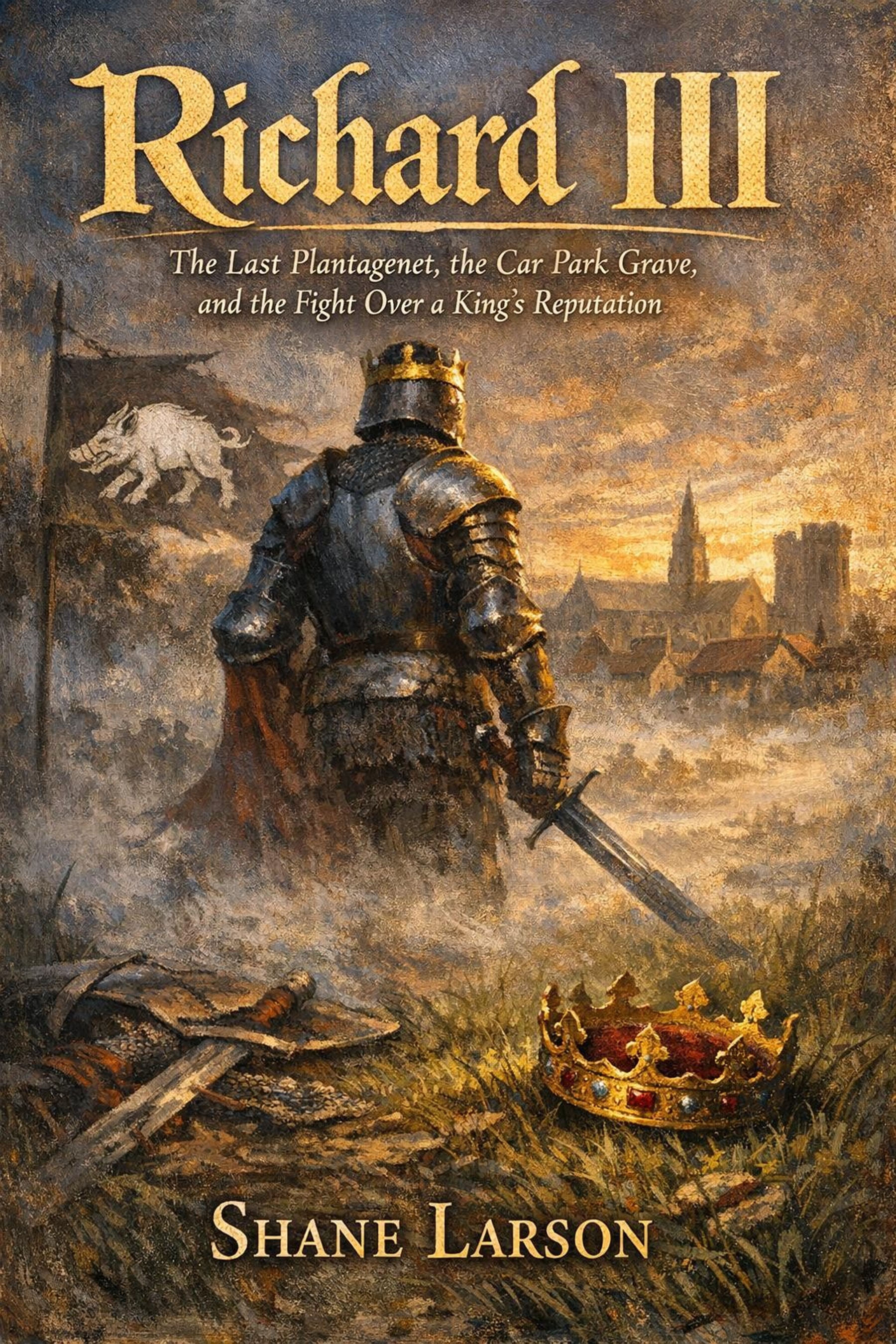
Richard III
The Last Plantagenet, the Car Park Grave, and the Fight Over a King's Reputation
By Shane Larson
About This Book
On the morning of 23 August 1485, the day after Bosworth, the clerk of the city of York opened the council's minute book and wrote down the news: King Richard, late mercifully reigning upon us, had been piteously slain and murdered, to the great heaviness of this city. There was no profit in it: the man who had killed him was already king, and no other town in England took the risk. York took it because for twelve years Richard had been its good lord.
Within a few years a chantry priest who had praised Richard in print while he lived rewrote him for the new regime, giving him a hump, teeth at birth and two years in his mother's womb. A generation later a lawyer who had been seven when Richard died added a withered arm. A century after that, a playwright gave him the best villain's part in the English language. None of those men had seen him, and nobody who had seen him described a deformity. In 2012, in a trench through a Leicester car park, the man himself turned up, with a spine that twisted hard to the right, both arms sound, and a skull struck nine times.
Two Richards, and the Man Underneath
Richard III: The Last Plantagenet, the Car Park Grave, and the Fight Over a King's Reputation is a biography in two halves. The first is the life, told from inside it: a boy of eight when his father and brother were killed at Wakefield, an exile twice before he was eighteen, a commander at Barnet in his first battle, and then the twelve years in the north that explain why anyone was loyal to him at the end. Then 1483 week by week, the reign treated as a government and not only as a usurpation, and Bosworth from his side of the field.
The second half is the afterlife, treated as history in its own right, with authors and dates. How a king who reigned for two years and two months became the arch-villain of English literature can be watched happening, from Rous around 1490 through Vergil and More to Shakespeare. How a defence was mounted against it, by an antiquary, a dilettante, a surgeon, a novelist and a society, is the same process running the other way. And how a search begun by members of the Richard III Society and carried out by University of Leicester archaeologists came to dig up a car park is a story about what evidence can do and what it cannot.
That distinction is the book's spine. The Greyfriars excavation settled where Richard was buried, what shape his back was, what he ate, how he died and who he was. Every one of those is a question about a body. The questions people actually fight over when they fight about Richard III, whether he murdered his nephews, whether his reign was tyranny or government, are questions about a man, and the scientists said at the time that the skeleton could not answer them. This book tests the Tudor case and the Ricardian case against the sources that were actually there at every contested point, and says plainly where the evidence runs out.
Why I Wrote This
The Wars of the Roses gave Richard two chapters and, deliberately, no verdict. I had not expected that to bother me afterwards, but it did. What pulled me in was a line in a council minute book. The city of York, the morning after Bosworth, called him murdered, in writing, when there was nothing to gain by it. Shakespeare's monster does not account for that, and neither does the wronged saint of the defence, who would not have needed to execute anyone without trial. Then there was the car park. I had followed the dig in 2012 like everyone else, and it took me years to notice that every question the bones answered was one nobody had been arguing about. That seemed to me the real story, and the only honest way to tell it was to keep the life and the legend in separate columns.
Frequently Asked Questions
Do I need to read The Wars of the Roses before this book?
No. This is a standalone biography, and the wider war appears only as Richard experienced it: Wakefield and Towton as news reaching a child, Barnet and Tewkesbury as battles an eighteen-year-old fought in. The political narrative of 1455 to 1471 belongs to The Wars of the Roses, the companion volume on this shelf.
Does this book decide whether Richard III murdered his nephews?
No. The two boys get one chapter, in which the case against their uncle and the case for him are set out as fairly as the sources allow and the other suspects are named. The book then stops, because the evidence does. If a verdict is what you came for, this is honestly not the book that gives one.
Did Richard III really have a hunchback?
He had scoliosis, a sideways curve of the spine, not the forward hunch the Tudor writers described. The Leicester skeleton shows a severe right-curving twist that began in adolescence, would have set his right shoulder higher than his left and cost him some inches of height, and could be hidden under good tailoring and fitted armour. Both arms were normal, and there was no evidence of a limp.
Is this a Ricardian book or an anti-Ricardian one?
Neither. The defence is right that the north was real, that contemporaries never described a deformity, and that no charge was made in England in his lifetime. The prosecution is right that he executed four men without trial in six weeks, declared his nephews bastards on a claim nobody could test, and never produced them. The book's position is that the hardest answer, capable and ruthless at once, is also the likeliest.
If You Liked This, You Might Like
- The Hundred Years' War — the French war whose last defeat sent the soldiers home to fight each other, and the England Richard's father marched on in the year he was born.
- Tutankhamun — the other king whose body told the modern world things his chroniclers never could, and whose discovery became an argument about who owned it.
- The Norman Conquest — the first English crown won in an afternoon's fighting and made legitimate afterwards; Bosworth, four centuries on, was the last.
- Catherine of Aragon — the Spanish princess married into the dynasty that needed Richard to have been a monster, and the next generation of the English shelf.
The bones settled where he lay, how he looked and how he died. Everything anyone had ever argued about, they left to the living.
A standalone biography on the English shelf, beside The Wars of the Roses.
What You'll Learn
- **The sources dated every time they are used**, so a reader always knows whether a detail comes from Mancini or Crowland in the 1480s or from Rous, Vergil and More writing for the man who killed its subject. Shakespeare appears as reception, never as evidence.
- **Middleham and the north given their full weight**: the arbitrations, the York civic records, the recovery of Berwick in 1482, and the reason a northern city called him murdered when the rest of England had gone quiet.
- **One chapter on the nephews and no verdict**: the case against Richard, the case for him, the other suspects named, and the point at which the evidence stops.
- **The 1484 Parliament as it actually legislated**, on forced loans, bail, juries and land, with the Council of the North and the College of Arms, and with the admirers' overclaims and the critics' silence both corrected.
- **The science explained from first principles**: why mitochondrial DNA runs only through daughters, how two independent female lines from Richard's sister Anne of York were traced and matched, why the first radiocarbon dates came back too early, and the break in the royal male line that the Y-chromosome revealed and nobody can locate.
- **The wounds and the spine**: the 2014 study that counted eleven injuries, nine to the skull, and a right-curving scoliosis with no hump, no withered arm and no limp, so the line between what his enemies saw and what they invented can be drawn exactly.
New Medieval History releases and free chapters — no spam, unsubscribe anytime.
More in This Genre
View all →