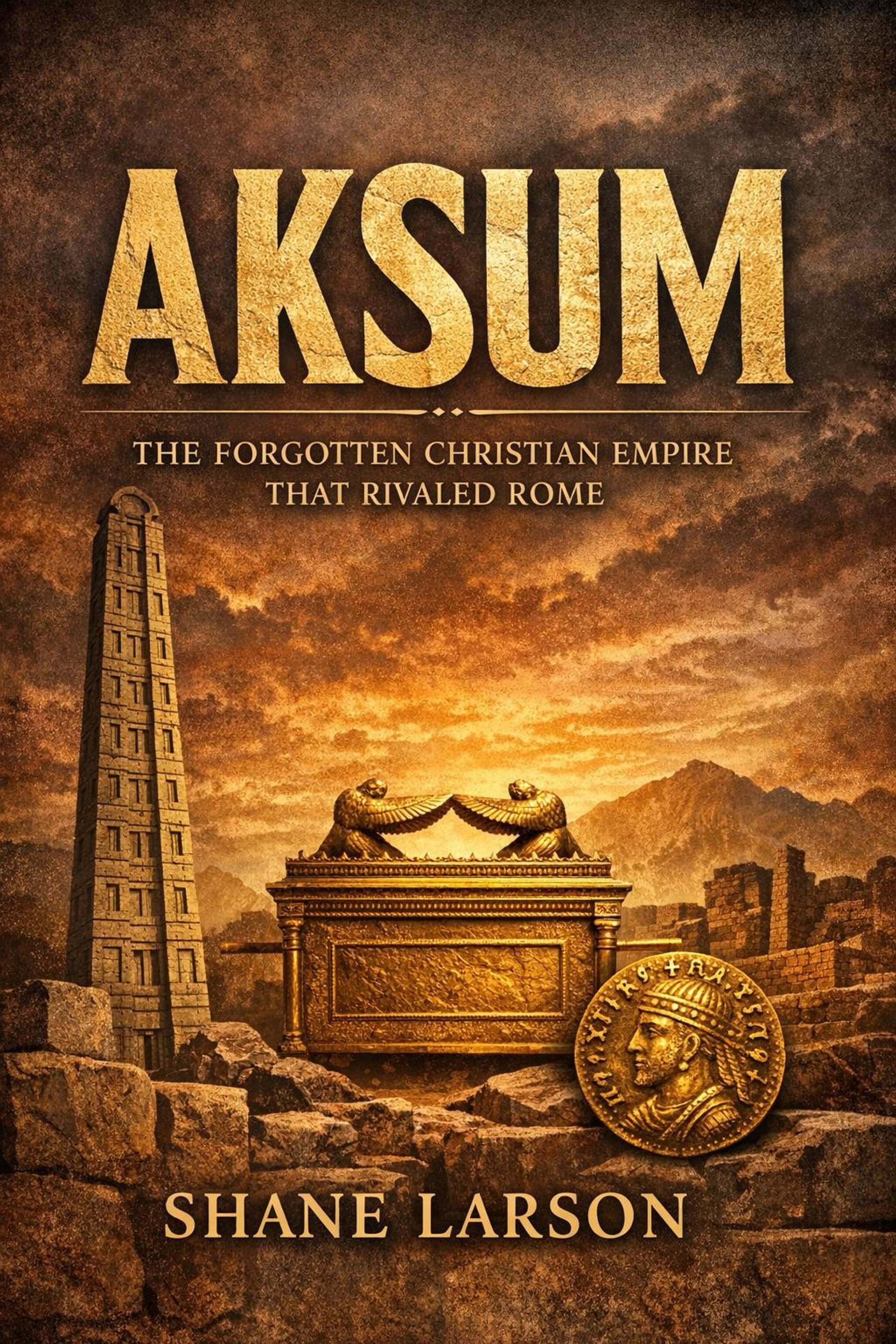
Aksum
The Forgotten Christian Empire That Rivaled Rome
By Shane Larson
About This Book
In the highlands of northern Ethiopia, a single block of granite stands more than 75 feet tall — carved on every face to look like a multi-story building, complete with false windows and a fake door at its base. It was quarried, dressed, hauled, and raised more than seventeen centuries ago by a kingdom most history books skip entirely. A second stela, larger still, lies shattered on the ground nearby. It snapped, archaeologists believe, the moment it was raised — the most ambitious single stone any ancient people ever attempted to stand upright, and it broke on the first try.
The kingdom that built it was Aksum. Around the year 240 CE, the prophet Mani named the four great powers of the world: Persia, Rome, China, and Aksum. The first three you know. The fourth controlled the Red Sea, minted its own gold, and adopted Christianity before the Roman Empire finished doing the same. Then it slipped out of the story the West tells about itself.
This is that story, restored to the map.
The Story
Aksum rose on the highland plateau of what is now Ethiopia and Eritrea, in a position that turned out to be one of the most valuable on earth: the hinge between the Mediterranean world and the Indian Ocean. Ships carrying African gold, ivory, and incense met traders bringing silk, spices, and silver through the Red Sea chokepoint, and Aksum sat astride the crossing. That trade made a landlocked-feeling highland kingdom into an international power — wealthy enough to strike gold coinage at a time when almost no state outside Rome and Persia could, and confident enough to deal with Constantinople as a peer.
The book follows the full arc. It opens with the rise of the Aksumite Empire and the engineering culture that produced the towering carved stelae. It moves through the early conversion: around 330 CE, King Ezana embraced Christianity and put the cross on his coins, planting a faith that Ethiopia has held without interruption ever since. It crosses the water with King Kaleb, whose sixth-century campaign into Yemen drew Aksum into the politics of Arabia and set the stage for the famous Year of the Elephant. And it traces the long decline as the rise of Islam reshaped the Red Sea, slowly severing Aksum from the trade routes that had fed it — followed by the kingdom's remarkable afterlife in the rock-hewn churches of Lalibela and the guarded chapel where, by a tradition almost two thousand years old, the Ark of the Covenant is said to rest to this day.
Written for the general reader, this is narrative history, not a textbook. No prior knowledge of Ethiopia, late antiquity, or the Indian Ocean world is assumed. If you can follow a story, you can follow Aksum.
What's Inside
- The contemporary source that ranked Aksum alongside Rome, Persia, and China — and why a single sentence from a third-century prophet still shapes how historians frame the kingdom.
- How control of the Red Sea crossing turned a highland plateau into a world power, linking African exports to the spice and silk routes of the Indian Ocean.
- The story of Aksumite gold coinage — a privilege of empire that almost no state on earth could claim — and what the coins reveal about the kingdom's reach and self-image.
- King Ezana's conversion around 330 CE, how Christianity took root before Rome had finished its own transformation, and why Ethiopian Christianity has endured unbroken since.
- The engineering of the great stelae: how the tallest stone monoliths ever raised were quarried and stood upright, and the catastrophic failure of the one that broke.
- King Kaleb's war across the Red Sea into Yemen, the events surrounding the Year of the Elephant, and Aksum's entanglement in the eve of Islam.
- The slow strangulation of a trade empire as new powers closed the sea, and how the kingdom's center of gravity shifted inland.
- The rock churches of Lalibela and the Ethiopian Ark of the Covenant tradition — the living legacy of a kingdom the wider world forgot.
Why I Wrote This
I kept running into Aksum sideways. A footnote in a book about Rome. A passing line in a history of early Christianity. A caption under a photo of an impossibly tall carved stone. Every time, the same shape: an empire that clearly mattered enormously to the people who lived near it, reduced to a margin note in someone else's narrative.
So I went looking for the book that told the whole story — rise, trade, conversion, stelae, the war in Arabia, the long fade, the churches at Lalibela — in one continuous arc for a general reader. I couldn't really find it. There were academic monographs, and there were tourist captions, and not much in between. This is the book I wanted to read: a single narrative that takes Aksum seriously as one of the great powers of its age, without assuming you arrived already knowing where Ethiopia is on a map of late antiquity. The fourth name on Mani's list deserves more than a footnote.
Frequently Asked Questions
Do I need to know anything about Ethiopia or ancient history first?
No. The book is written for the general reader and builds the context as it goes. If you've never encountered Aksum, late antiquity, or the geography of the Red Sea, you'll be fine — the narrative assumes curiosity, not background.
Is this a textbook or a narrative history?
It's narrative history. The aim is to tell Aksum's story with the pacing and clarity of a good account of Rome or Persia, not to drown the reader in citations. The scholarship is there underneath, but the experience on the page is a story with a beginning, middle, and end.
Does it actually cover the Ark of the Covenant tradition?
Yes. The book treats the Ethiopian Ark tradition as part of Aksum's long afterlife — what the tradition claims, where it sits in the religious life of the country, and how a kingdom from late antiquity became attached to one of the most famous relics in the world. It's presented as history and tradition, not as a treasure hunt.
How does this connect to early Christianity?
Closely. One of the book's central threads is that Aksum became a Christian state around 330 CE — early enough that the conversion predates the full Christianization of the Roman Empire. For readers interested in early Christianity outside the Western European frame, this is one of the most important and least-told stories there is.
Is the book available on Kindle Unlimited?
Yes. It's enrolled in Kindle Unlimited, so KU members can read it as part of their subscription.
If You Liked This, You Might Like
- Mansa Musa and the Mali Empire — another African power that dominated long-distance trade and gold, told in the same accessible narrative style.
- Great Zimbabwe — the stone city of southern Africa and the trade networks that built it, a natural companion for readers exploring Africa beyond Egypt.
- The Sea Peoples — for readers drawn to the way control of the sea makes and unmakes ancient powers, set in an earlier age of collapse and migration.
One of the four great powers of the ancient world has been hiding in plain sight for a very long time. This is the book that puts it back on the map — and tells the whole of its story, from the first gold coin to the last guarded chapel.
Included with Kindle Unlimited — read it free if you're a member.
New Ancient History releases and free chapters — no spam, unsubscribe anytime.