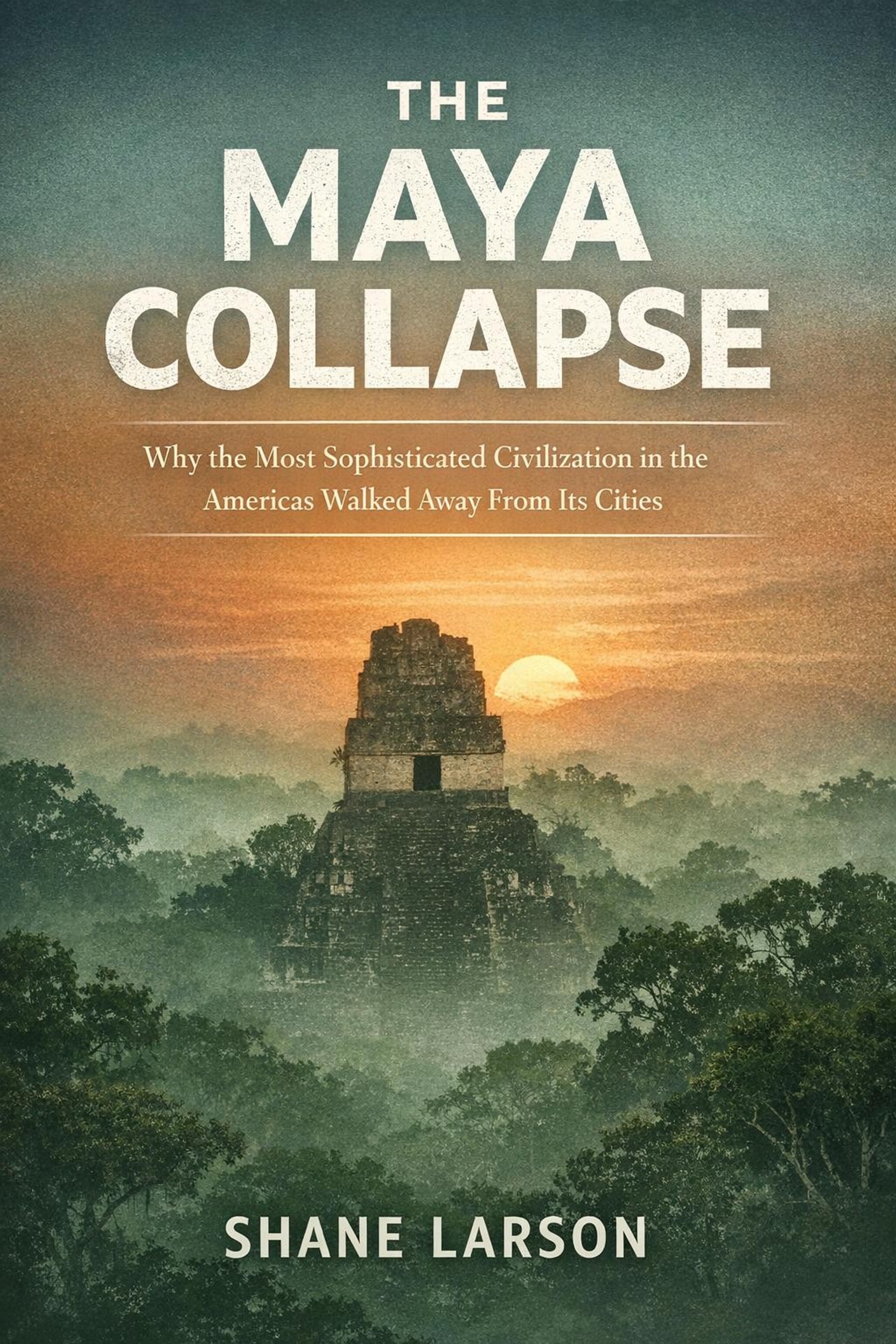
The Maya Collapse
Why the Most Sophisticated Civilization in the Americas Walked Away From Its Cities
By Shane Larson
About This Book
Stand in the Great Plaza at Tikal at sunrise. Temple I rises 154 feet above you. Across the plaza, Temple II faces it. Beneath your feet are paved walkways that once connected hundreds of thousands of people across a network of cities, causeways, and reservoirs stretching deep into the Petén jungle. The acoustics are so precise that a hand clap at the base of Temple I returns as a sound like the call of a quetzal — a bird the Maya considered sacred.
In the year 750 CE, this plaza was the political heart of one of the most sophisticated urban civilizations in the ancient world. By 900, it was empty. By 1000, the jungle had begun reclaiming the temples. The kings were gone. The astronomers were gone. The scribes who carved the hieroglyphs were gone. What happened?
The Classic Maya collapse is the most studied civilizational collapse in the Americas, and one of the most misunderstood. It was not a single event. It was not a mystery. And it was emphatically not the end of the Maya people, who number more than eight million today across Guatemala, Mexico, Belize, and Honduras. The Maya Collapse tells the story of what actually happened to the southern lowland cities between 750 and 900 CE — and why the simple answers you have probably heard are wrong.
The Argument
For most of the twentieth century, the Maya were a riddle. The hieroglyphs were undeciphered. The cities were assumed to be empty ceremonial centers visited only by priests. The collapse was attributed to peasant revolts, foreign invasion, or some vague environmental catastrophe — pick your decade, pick your theory.
The last fifty years have rewritten almost all of it. The glyphs are largely decoded. The cities turn out to have been densely populated. The 2018 LiDAR survey of the Maya Biosphere Reserve revealed more than 60,000 previously unknown structures hidden under the jungle canopy, forcing a complete revision of how many people actually lived in the Classic Maya world. Lake-sediment cores from across the Yucatán have given us a paleoclimate record precise enough to identify multiple severe droughts in the ninth century, including one of the worst dry periods in the region's last 2,000 years.
The collapse, it turns out, was not a single cause. It was a compound failure — drought that broke the agricultural base, war that drained elite legitimacy, soil exhaustion that compounded both, and a system of divine kingship that could not survive being unable to deliver rain. The southern lowland cities collapsed. The northern cities, with different water systems and different political structures, did not. The book walks through each strand of evidence, weighs what is settled, and is honest about what remains in dispute.
It also gives the survivors the place in the story they deserve. The people who walked away from Tikal and Calakmul did not disappear. They went north. They went into the highlands. They reorganized into smaller polities that the Spanish would still be fighting four centuries later. The collapse of the cities was real. The collapse of the civilization was not.
What's Inside
- The geography of collapse — why the southern lowlands failed and the northern lowlands flourished, and what the difference tells us about water, politics, and resilience
- The ninth-century megadrought — what lake-sediment cores from Lake Chichancanab and elsewhere reveal about the severity, timing, and geographic pattern of the drought
- Tikal versus Calakmul — the long dynastic war that shaped the southern lowlands and helped exhaust both superpowers before the climate turned
- The LiDAR revolution — how a single 2018 survey overturned a century of population estimates and what the new numbers mean for any theory of collapse
- The failure of divine kingship — why the political system itself was a structural vulnerability when the rains stopped, and how the inscriptions track its unraveling
- Soil, terraces, and limits — what the agricultural archaeology shows about how the Maya fed their cities and where the system broke
- The northern story — Chichén Itzá, Uxmal, and the Puuc cities that rose as the south fell
- The Postclassic and beyond — what happened to the people who walked away, and why "collapse" is the wrong word for what happened to the Maya as a culture
Why I Wrote This
I came to this book through frustration. Every popular account of the Maya I read either treated the collapse as a romantic mystery — vine-covered temples, vanished priests, unknowable jungle — or pinned it on a single cause that conveniently mapped to whatever the author wanted to argue about modern society. Neither is what the evidence actually says.
The Maya collapse is one of the most data-rich civilizational transitions we have. We have hieroglyphic inscriptions with precise dates. We have lake cores. We have skeletal remains. We have, now, LiDAR maps of entire city systems. We have the descendants. The honest version of this story is more interesting than the mystery version, and it doesn't require pretending the Maya were any less sophisticated than they were. They tracked Venus to within minutes per century. They built reservoirs that lasted a thousand years. They were not naive. They were caught by a combination of pressures that any complex society would struggle to survive — and most of the people lived through it.
This book is my attempt to tell that story the way the evidence tells it.
Frequently Asked Questions
Do I need to know anything about the Maya before reading this?
No. The book assumes no prior background. Key terms, dates, and figures are introduced as they come up, and the geography is mapped clearly. Readers who already know the basics will find the chapters on LiDAR, paleoclimate, and the Tikal–Calakmul rivalry have enough new material to be worth the time.
Is this an academic book or a narrative one?
Narrative, but built on academic sources. The prose is written for general readers — the kind of person who enjoyed 1491 or Collapse — but every major claim is grounded in the actual archaeology, epigraphy, and paleoclimate literature. No mystery-mongering, no pseudo-archaeology.
What does it say about Jared Diamond's account in Collapse?
Diamond's chapter on the Maya was influential and is still widely cited. The book engages with it directly. The short version: Diamond's environmental-overshoot framing got some things right and oversimplified others, and the evidence base has expanded substantially since Collapse was published in 2005. The book lays out where the current consensus differs.
Does it cover the Spanish conquest?
Only briefly, as the endpoint of the Postclassic period. The focus is the Terminal Classic collapse, roughly 750–900 CE. The conquest is its own story and would require its own book.
Is this part of a series?
It stands alone, but it sits naturally alongside the other Peak Grizzly books on civilizational collapse. Twilight of the Ziggurats, Ancient Apocalypse: The Fall of the Bronze Age, and The First Dark Age cover comparable transitions in the Old World. Readers interested in the pattern across regions and centuries will find the cross-references useful.
Is this book available on Kindle Unlimited?
Yes. The ebook is available through Kindle Unlimited as well as for direct purchase.
If You Liked This, You Might Like
- Ancient Apocalypse: The Fall of the Bronze Age — Another civilizational collapse caused by climate, war, and structural fragility — this time across the entire eastern Mediterranean around 1177 BCE.
- Twilight of the Ziggurats — How the Sumerian city-states collapsed under salinization, drought, and political exhaustion, with striking parallels to the Maya story.
- The Collapse Pattern — The synthesis volume that maps what the Maya, the Bronze Age Mediterranean, the late Roman west, and other failed systems have in common — and what they don't.
- The Sea Peoples — The mysterious raiders who helped bring down the Bronze Age world — a companion case study in compound civilizational failure.
Closing
The Classic Maya did not vanish into the jungle. Their political system failed, their cities emptied, and their descendants walked away to build something different. The Maya Collapse is the honest, evidence-grounded version of that story — drought, war, soil, legitimacy, and survival, told with the respect the Maya have always deserved.
Included with Kindle Unlimited — read it free if you're a member.
New Ancient History releases and free chapters — no spam, unsubscribe anytime.
More in This Genre
View all →