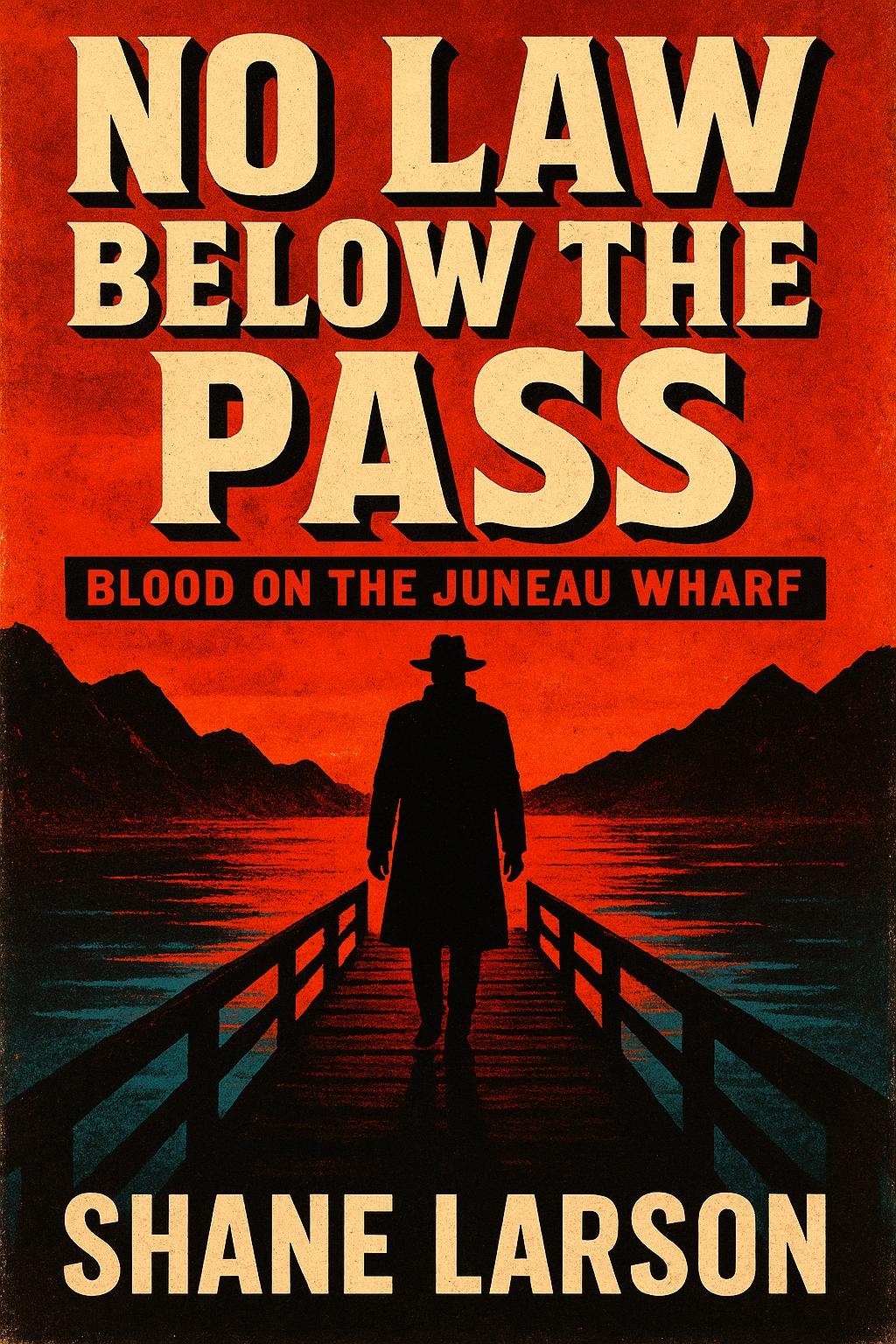
No Law Below the Pass
Blood on the Juneau Wharf
By Shane Larson · The Wild West Series (Book 21)
About This Book
The man who owned Skagway gave money to widows, paid for the church organ, and walked the boardwalk shaking hands like a candidate running for office. He also owned the saloon where your money disappeared, the telegraph office that charged you to wire family on a line that ran to nowhere, and the friendly clerk who happened to steer you toward the warmest faro table in town. By the spring of 1898, Jefferson Randolph "Soapy" Smith ran the gateway to the Klondike as one elegant machine built for a single purpose: taking everything a gold-rush stampeder carried, and leaving him grateful for the conversation.
Caleb Ross does not step off the steamer knowing any of this. He comes north from a Wisconsin farm with his life savings converted into an outfit bound for the goldfields — crates of gear, a year of provisions, and the kind of hope that rarely survives its first honest-looking swindle. He believes the hardest thing ahead of him is the climb over the pass. Within a single night, the hardest thing has already happened, and there is not a marshal in Alaska who will lift a finger to undo it.
What becomes of a man robbed of everything in a town where the thieves are the government? No Law Below the Pass follows Caleb from clean-handed victim to something harder to name, as the cheated and the furious band together into the Committee of 101 and decide that if Skagway refuses to keep the law, it will keep the rope instead.
The Story
This is a frontier thriller stretched tight across one of the strangest true episodes of the American West — a gold-rush boomtown that functioned, briefly, as a wholly owned subsidiary of a con artist. Skagway in 1898 was the funnel through which tens of thousands of stampeders poured on their way to the Klondike, and Soapy Smith had engineered the entire town to skim them on the way through. The novel takes that history at its word and drops a decent, ruined man into the gears of it.
Caleb's path runs straight into Frank Reid, the city surveyor whose name history would tie forever to Soapy's. Around them gathers the Committee of 101, a vigilante body that posts its warnings, draws its lines, and waits — until threats curdle into beatings, and beatings into something the men who started it can no longer control. The book's real engine isn't the question of whether Skagway will be cleaned up. It's what cleaning it up does to the people holding the brooms.
Caleb is pulled between a widow who has buried enough of the gold rush's victims to beg him to simply start over, and an enforcer who has learned exactly how good vengeance feels and wants Caleb to feel it too. Every road in the story bends toward one muddy stretch of planking on the Juneau Wharf, where two men are fated to meet and only the order of the gunfire is still in doubt. For readers who loved the wry menace of Patrick deWitt's The Sisters Brothers or the swept-up scope of Jess Walter's The Cold Millions, this is the same frontier seen from inside the swindle.
What's Inside
- A boomtown rendered as a single sophisticated trap — the fake telegraph office, the rigged games, the "information clerks" whose only job was steering marks toward the table that would clean them out.
- Soapy Smith as he actually operated: a man who funded charities and churches with one hand while running every grift in town with the other, beloved and feared in the same breath.
- The Committee of 101 from the inside, as ordinary merchants and busted stampeders talk themselves, meeting by meeting, into becoming the very lawlessness they swore to end.
- A protagonist whose arc is the book's hardest question — how a wronged man slides from seeking justice to enjoying it, and how quickly enjoyment becomes appetite.
- The Juneau Wharf confrontation that ended Soapy Smith's reign, reconstructed with the tension of a story that genuinely could have broken either way.
- A frontier morality without a comfortable side: the swindled and the swindlers, the vigilantes and the victims, all standing in the same mud by the end.
Why I Wrote This
I came to this story sideways, the way most people do — through the name "Soapy Smith" and the realization that the con man who ran Skagway wasn't a legend somebody made up. He was a real operator who turned an entire gold-rush town into a machine for fleecing strangers, and he was good enough at it that respectable people defended him.
What hooked me wasn't Soapy, though. It was the men who finally stood up to him. The Committee of 101 are usually written as the clean part of the story, the good townsfolk who restored order. But the closer I read, the less clean they looked. They threatened, they beat people, they decided who deserved what — and they did it without a court, a trial, or any law but their own certainty. I wanted to write about that exact discomfort: the moment a wronged man gets a gun in his hand and a target in front of him, and discovers that the line between justice and the mob was always thinner than he thought. Caleb is fictional. The trap he walks into, and the wharf he ends up on, are not.
Frequently Asked Questions
Is this based on a true story?
Yes. Soapy Smith's control of Skagway, the Committee of 101, Frank Reid, and the 1898 shootout on the Juneau Wharf are all real history. Caleb Ross and his personal story are invented, but he's dropped into events that happened largely as the novel describes them.
Do I need to know anything about the Klondike Gold Rush to follow it?
Not at all. The book sets up the stampede, the route over the pass, and how Skagway fit into all of it as the story goes. If you've never read a word about 1898, you'll have everything you need; if you already know the period, the real details will land harder.
Is this a Western or a thriller?
Both, leaning thriller. It has the frontier setting and the gunfight, but the pacing and the moral tension are built like a crime novel — the slow tightening of a trap, the corruption of a decent man, the dread of a confrontation everyone can see coming.
How violent is it?
There's real violence — beatings, threats, and the final shootout — and the book doesn't flinch from the ugliness of mob justice. It's not gratuitous, but it's grounded and at times grim. The brutality is the point, not the decoration.
How does it compare to The Sisters Brothers or The Cold Millions?
If you liked the morally gray frontier and dry tension of deWitt, or the historical sweep and underdog grit of Walter, this sits in the same neighborhood. It's a little leaner and more propulsive than either — closer to a thriller's clock — but it shares their interest in good people doing questionable things in a lawless place.
Is it available on Kindle Unlimited?
Yes. Like the rest of the Peak Grizzly catalog, it's enrolled in Kindle Unlimited, so KU members can read it at no extra cost.
If You Liked This, You Might Like
- The Queen's Physician — another piece of historical fiction built on real events and real menace, where loyalty and survival pull a decent person toward something darker.
- Conspiracy Below Zero — a modern Alaska thriller for readers who want the same frozen-edge-of-the-map tension in a contemporary setting.
- The Collapse Pattern — the nonfiction companion in spirit, on how systems and the people inside them talk themselves into becoming the thing they meant to stop.
Skagway's reckoning came down to one stretch of wet planking and a single choice. No Law Below the Pass is the story of the man standing in the crowd with a gun in his hand, deciding whether the justice he's owed is worth what it will cost him to take it.
Included with Kindle Unlimited — read it free if you're a member.
New Historical fiction / frontier thriller (Western) releases and free chapters — no spam, unsubscribe anytime.
More in The Wild West Series
View series →
More in This Genre
View all →