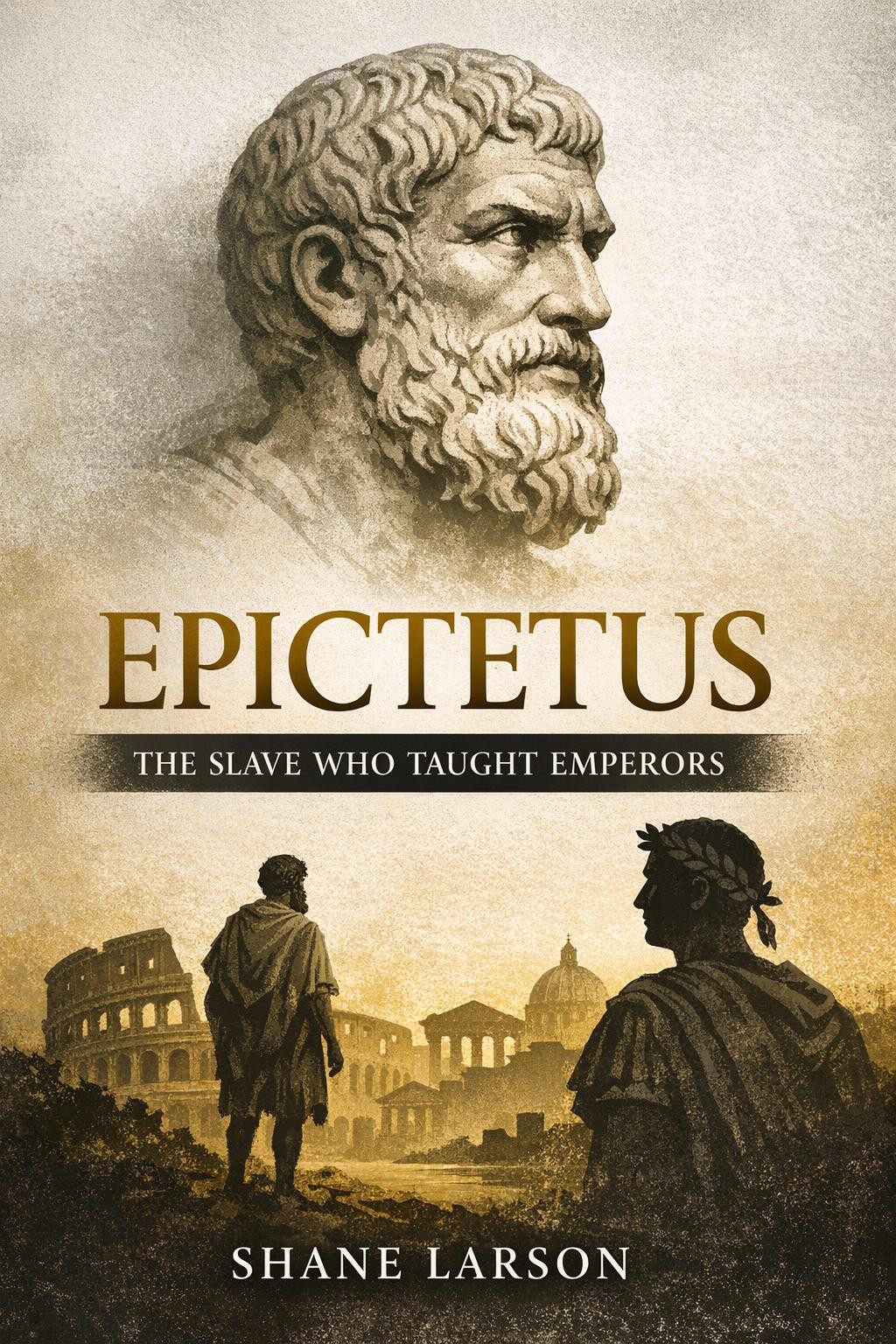
Epictetus
The Slave Who Taught Emperors
By Shane Larson
About This Book
The most quoted teacher in the Roman Empire was given a name that meant acquired. That is all "Epictetus" ever was — the label stamped on a boy who stood in an Asia Minor slave market sometime in the 60s CE, and the only one anyone bothered to give him. He was purchased by a freedman inside Nero's palace. A master broke his leg and left him lame for the rest of his life. By every calculation the Roman Empire understood, he should have disappeared into the machinery that ground through millions of people without noticing. Instead, he learned philosophy. By the time he died around 135 CE, an emperor was carrying his ideas into field tents on the Danube frontier, and a young Roman named Arrian had filled notebooks with every word he said. Readers have never stopped finding him. Epictetus: The Slave Who Taught Emperors is the complete story of the man, his world, his philosophy, and the nearly nineteen centuries of afterlife that followed. It is biography first and philosophy primer second — the ideas emerge from the life instead of floating above it. Readers meet Epictetus in the slave markets of Phrygia, in the corridors of Neronian Rome, through the philosophers' expulsion under Domitian, and finally in the provincial Greek town of Nicopolis, where Arrian sat and wrote down the lectures that became the Discourses. The book traces the dichotomy of control, prosoche (the discipline of attention), premeditatio malorum (the rehearsal of loss), and the other practices that made Stoicism a way of life rather than an argument. It does so without jargon, without self-help filler, and without the gloss that has turned modern Stoicism into a brand. Epictetus in his own words is harder, funnier, stranger, and more useful than the sanitized version. The final chapters follow the afterlife. Marcus Aurelius quoting Epictetus in the field tents of the Danube. Byzantine monks copying the Enchiridion by candlelight. Renaissance humanists rediscovering him in 1479. Frederick the Great carrying him on military campaign. Admiral James Stockdale reciting him alone in a North Vietnamese prison cell for seven and a half years. Aaron Beck and Albert Ellis crediting him as the founding father of cognitive behavioral therapy. The limping Greek slave is the reason your therapist asks whether a thought is within your control. What's inside:
The full biography, from the slave blocks of Phrygia to the imperial household of Nero, through the philosophers' expulsion under Domitian, to the school at Nicopolis that produced the Discourses Core Stoic philosophy explained through the life that produced it — dichotomy of control, prosoche, premeditatio malorum, cosmopolitanism, the proper use of impressions The nineteen-century afterlife — Marcus Aurelius on campaign, the Byzantine copyists, the Renaissance rediscovery of 1479, Frederick the Great, Admiral Stockdale at the Hanoi Hilton, and the psychiatrists who built modern therapy on his foundation A complete modern paraphrase of the Enchiridion, Arrian's handbook of essential teachings A practical Stoic toolkit of six exercises drawn directly from the Discourses, usable tonight An annotated further-reading guide for going deeper The direct, anti-jargon voice Shane Larson readers expect
For fans of Ryan Holiday, Massimo Pigliucci, Donald Robertson, Pierre Hadot, Mary Beard, and Tom Holland — and for anyone drawn to ancient history that actually changes how you live. Nearly nineteen centuries after a limping Greek slave finished teaching on a hillside in provincial Nicopolis, his philosophy still works. This is the book that shows you why.
Included with Kindle Unlimited — read it free if you're a member.
New Ancient History releases and free chapters — no spam, unsubscribe anytime.