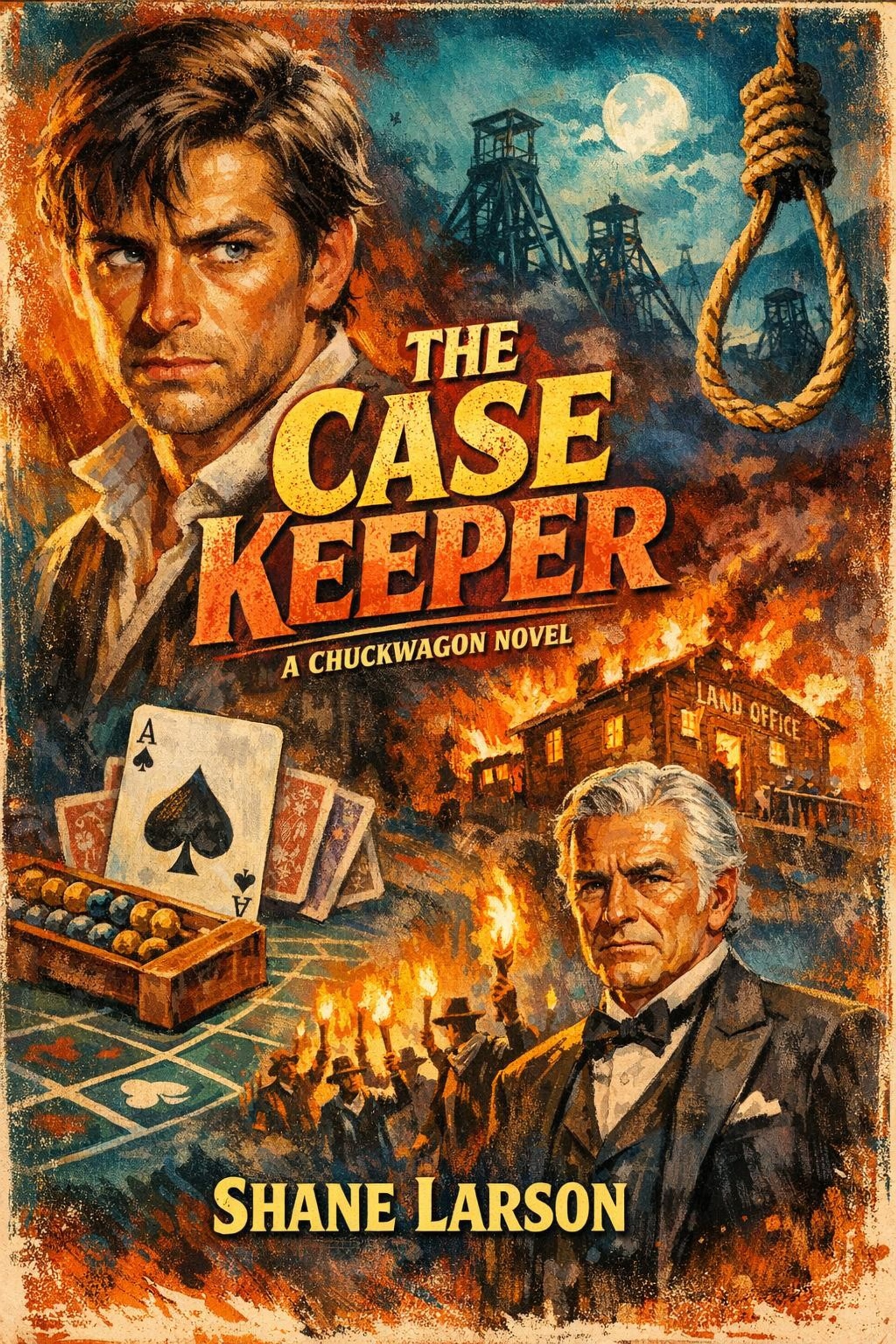
The Case Keeper
Every card is a witness.
By Shane Larson
About This Book
The deed is right.
The recorder checks the grantor, the chain, the margin, the witness, the seal. He has recorded nine thousand instruments in that district and he checks every one the same way, and this one is right.
The cards are wrong.
Ezra Tallow has kept case at the faro table in the Green Lumber Hall for eleven years. He holds the public memory of the deck — what fell, in what order, how many remain — and in eleven years nobody in that camp has caught him in an error. He carries no gun. He has spent a decade making certain that nobody looks at him twice, because a case keeper who gets noticed is a case keeper somebody suspects.
Then a clerk stands on a loading step in the middle of Argenta and reads a recorded deed aloud to a crowd that mostly cannot read, and Ezra stops walking in the middle of a sentence.
The deed says the ace of spades fell to the bank on the sixth turn. Twelve lines later it says the ace of spades was the last card in the box.
There is one ace of spades in a deck of cards.
A western where the weapon is a book, and it does not work
This is the part the book is actually about.
Ezra is right, and being right turns out to be worth nothing at all. A gambler's private notation is not an instrument of record — it is not weak evidence, it is not admissible-with-difficulty, it is not evidence. The recorder explains this kindly and he is correct. A lawyer explains that a false story in a deed does not void a good signature, and he is correct too. The sheriff explains that he has nine open files, two deputies and a coroner's finding of accidental death, and he is correct, and he hates it.
Every door in this book is locked by a man who is right.
So the proof sits in Ezra Tallow's hands, public and legible and completely inert, and the only thing it actually does is make him worth killing.
The antagonist who never raises his voice
Absalom Rook does not cheat when he can win, does not win when he can buy, and does not buy when he can wait. He has assembled eleven claims in three years, and he has never once put a hand on anybody.
He does not need to. He has a notary.
Amos Pryor holds a commission from the state of Colorado, and every single thing he does with that seal is lawful. He rides out to a sick man's cabin, he gets a mark on a paper, he witnesses it himself — that is the office, that is what a notary is for — and then the man does not recover. Four of the eleven men who signed were dead inside a month of signing. Rook is never shown planning any of it. His whole scheme is reconstructed, after the fact, out of paper and the arithmetic of dates.
What it costs
This is the hard end of the genre, and it should be said plainly: eight people die on the page.
A hoist man over forty dollars in the first two pages. A witness face down in eleven inches of creek water. A drifter who took sixteen minutes to die on a four-foot drop for a killing Ezra could prove he did not commit, in front of four hundred men who were sure. A miner's shift partner, at a dry sluice, two hours about it in the sun. The one honest functionary in the county, who ran back into a burning building for a filing cabinet.
And somewhere in the middle of it, Ezra Tallow works out that he could end the whole thing with eleven words. One line, added to a case book, in a hand nobody in Colorado has ever caught in an error. Everyone would believe him. He has never been wrong.
He writes it. He sits with it for an hour.
What he does next is the reason this book exists.
The ending is a card trick, and you can check it yourself
The counting proof is taught once, early, at the table, through action — not in a lecture, and never twice. You do not need to know anything about faro when you open the book and you will not need a diagram at the end of it. The whole thing rests on a fact you already know: there is one ace of spades in a deck.
What Ezra cannot do is take that to a judge. So he takes it to the only jurisdiction he can actually reach: one room, one sealed deck, and four hundred men who bet for a living and can count.
If You Liked This, You Might Like
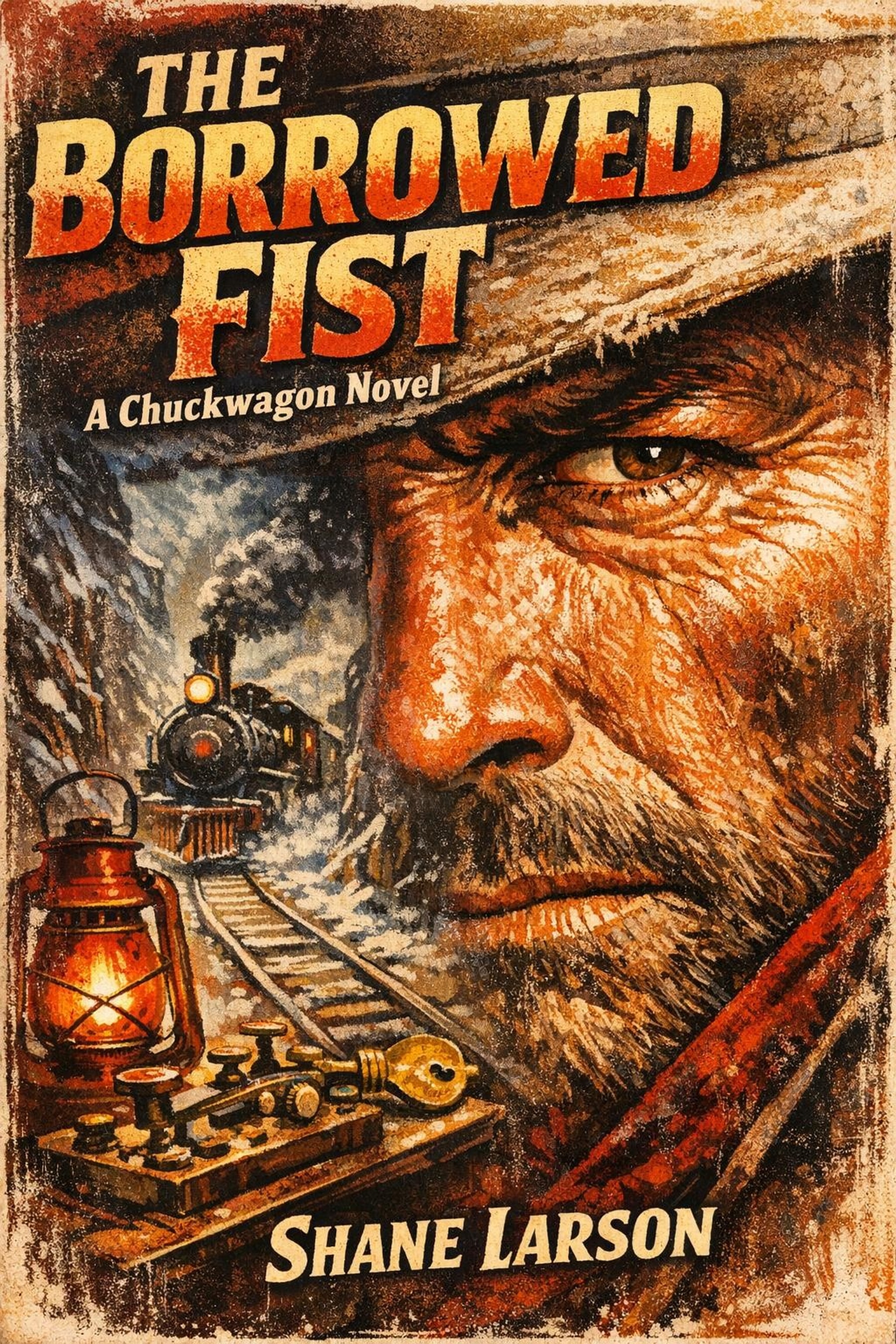
- The Borrowed Fist — the same idea run through a telegraph wire: a night operator hears a correct train order sent in the wrong hand, and knows it is murder.
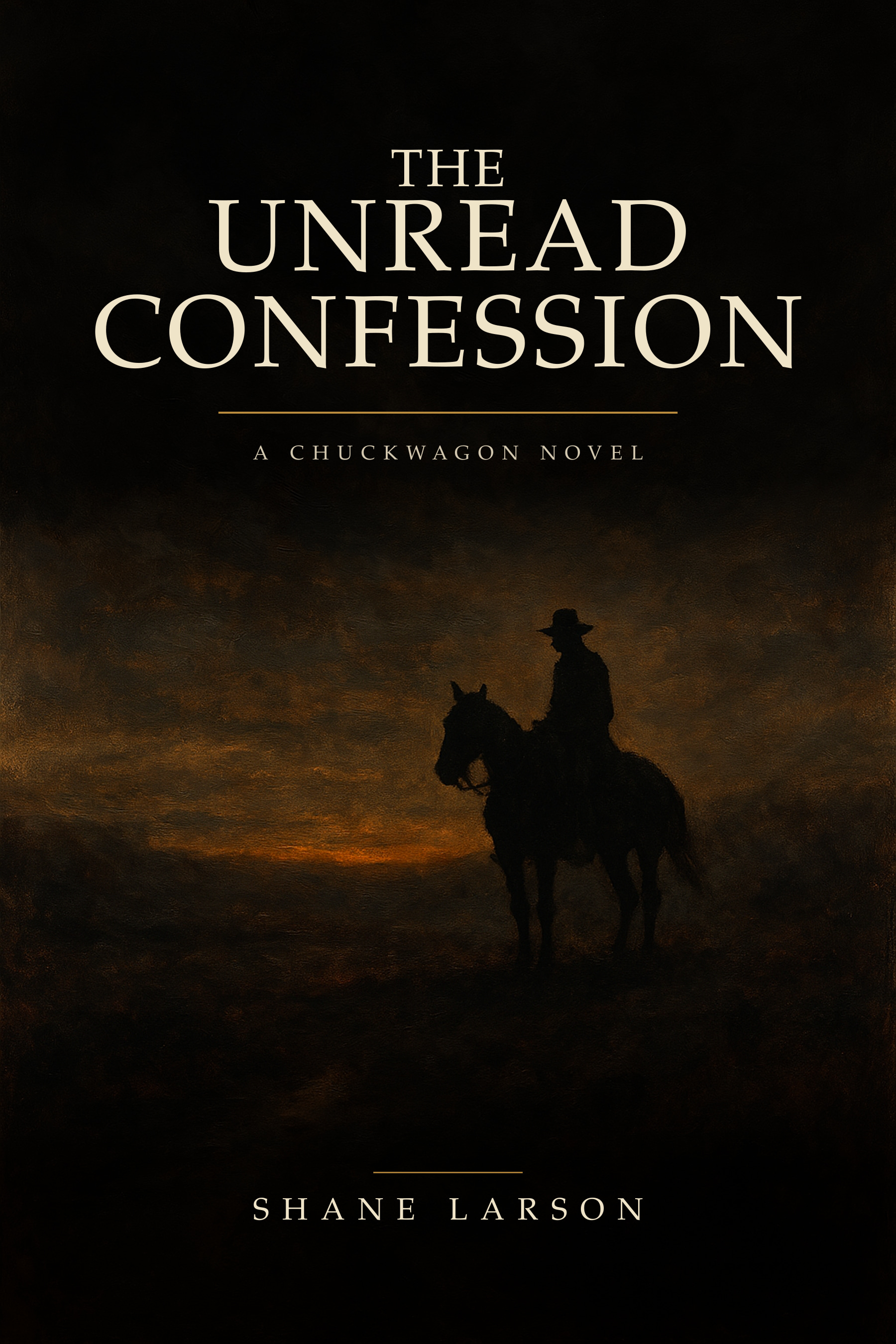
- The Unread Confession — a stagecoach guard who cannot read carries a signed confession across the range owned by the man it names; paper as the weapon again, from the other side.
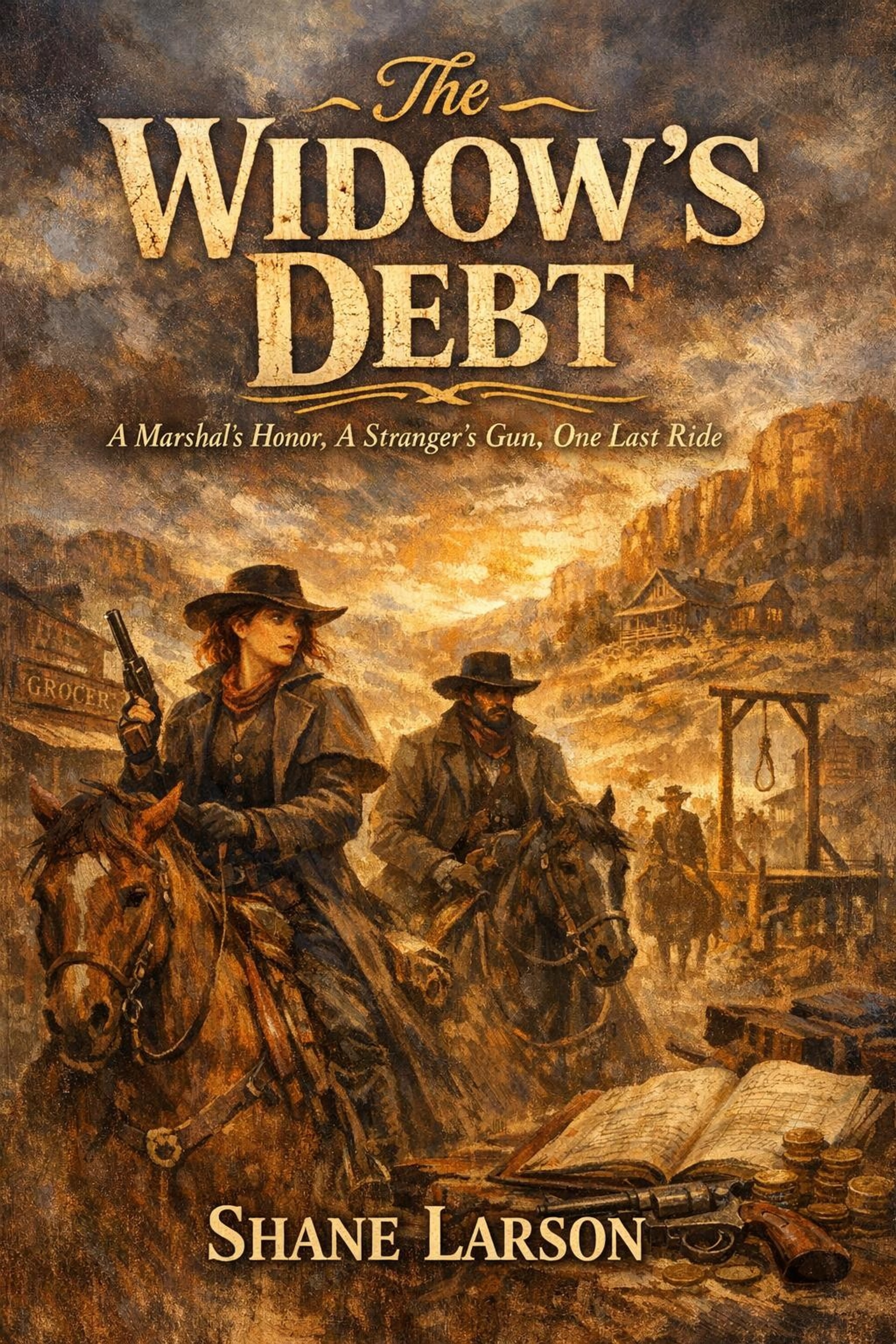
- The Widow's Debt — a disbarred marshal, a debt nobody owed, and a town that has already decided what happened.
The Chuckwagon series
Four books, each standalone, readable in any order.
- Book 1 — *The Unread Confession* — a stagecoach guard who cannot read carries a signed confession two hundred miles across range owned by the man it names.
- Book 2 — *The Widow's Debt* — a disbarred US Marshal escorts the outlaw the town believes she married, to collect a debt her dead husband never owed.
- Book 3 — *The Borrowed Fist* — a night telegraph operator hears a correct train order in the wrong fist. What this book does to a county index, that one does to a wire.
- Book 4 — The Case Keeper — this one.
Book 5 is on the trail.
Content note
Graphic violence, a lynching shown in full, torture, strong period language, eight on-page deaths. No sexual content and no romance subplot. No children are harmed. Every character, mine, company, camp and event in the book is invented.
New Historical fiction / frontier thriller (Western) releases and free chapters — no spam, unsubscribe anytime.