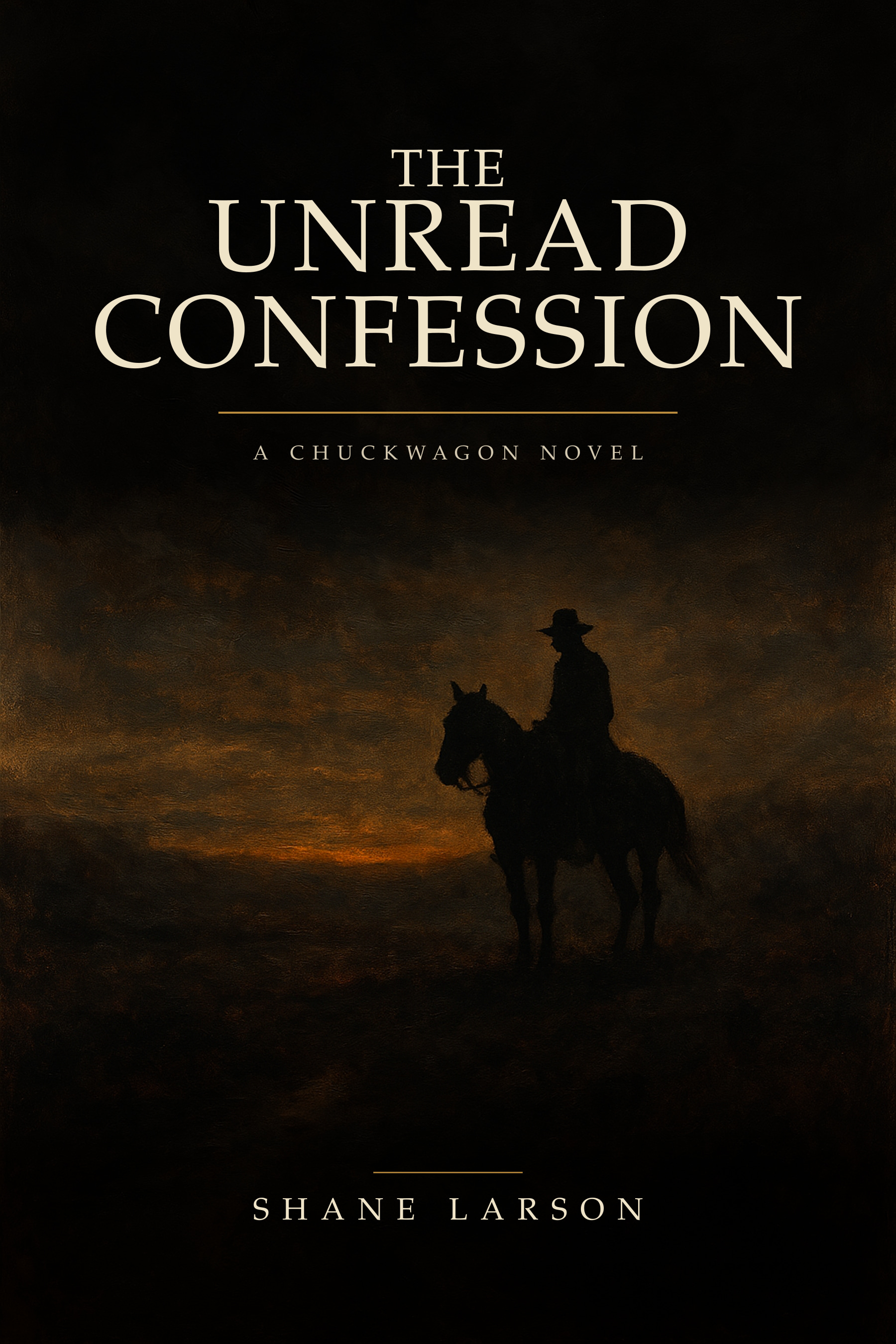
The Unread Confession
Silence speaks louder than ink.
By Shane Larson
About This Book
A man comes through the window of a moving stagecoach in the rain with a knife, and the guard breaks his wrist against the door frame, and by the time the coach stops the man is dead.
In his coat is an envelope. Heavy stock, folded once, sealed in wax the colour of dried blood.
The guard turns it over twice in the lamplight and hands it to the woman sitting across from him, because he has been looking at the front of it for a full minute and it is still only shapes.
A western where the weapon is a page
Barnaby Krell has ridden shotgun on the Oakhaven line for eleven years. He can read a wheel rut for weight and direction. He can tell you how long a track has been in wet mud by whether the ridge of it has gone grey along the top. He can read a man's hands across a card table and be right about it.
He cannot read a word of English, and he never has been able to, and in eleven years of guarding other men's freight nobody has ever once asked him to.
That was fine while the cargo was flour. The envelope he takes off a dead man on the pass is a confession, written out and signed by Corvus Vane — the rancher whose range runs unbroken from the Sangre de Cristo foothills to the outskirts of Denver, and whose money runs a good deal further than that. It sets out twenty years of it: the rustling rings, the men buried without markers, the marshals paid on a Friday.
Two hundred miles to a United States marshal. And the only person between here and Denver who can tell Krell what he is holding is a woman Corvus Vane tried to hire first.
The antagonist who never has to draw
Vane is not a gunman and has no intention of becoming one. He is a bookkeeper with a ranch attached.
His method is twenty years old and it has never failed: buy the silence of everyone who can read. Every judge in the state. Every marshal within a hundred miles. The lawyers, the clerks, the newspaper. He does not forge and he does not lie — a false figure in a column is how men get caught, and Corvus Vane has not been caught in his life.
What he has never had to deal with, and cannot price, is a man who is inert. There is nothing in Krell's head worth the money. No letter Vane can put in front of him will be believed, because it cannot be read. No document can be used to frighten him, because he has never been able to check one. And a man who cannot repeat what is written on a page cannot be beaten into repeating it.
Vane works this out somewhere around the middle of the book, and the pursuit changes shape when he does. He stops trying to buy the paper and starts trying to buy the people standing next to it.
What You'll Find Inside
- A limitation that is the plot, not a costume. Krell's illiteracy is never once cured, never once cheated, and never leaks: across the whole novel he does not read a single word. What he substitutes for it — ground, tracks, hands, tone — is all learnable, all concrete, and all shown working.
- A code that gets tested and holds. I do not kill men for their sins; I deliver them to justice, even if I must drag them there myself. At the midpoint he has a man dead to rights, alone, with a gun already in his hand and every reason. What he does instead is the hinge of the book.
- A supply ledger as the second weapon. The confession is one man's word about himself. What actually breaks Corvus Vane is a page in a camp requisition book that a clerk filled in for eleven dollars a month and never imagined anyone would ask to see.
- Country that behaves. Snow that survives on June slopes in the Sangre de Cristos because it is deep in the shaded cracks. A shelf road where the inside ruts will throw a wheel, so you drive the outside edge. A freight skiff hauled upstream on a bow line, because nothing steams up a snow-fed creek.
- Dialogue-forward pulp. People talk, and the talking is where the plot happens. Deals, betrayals, and the entire mechanism of the confession are transacted in conversation, not explained afterwards by the narration.
- A body count that costs something. Nine men are promised and the promise is kept. Two of the deaths matter for the rest of the book, and one of them is a young man who dies reading a page out loud to somebody who cannot check him.
- An ending that turns on the premise. The last move Krell makes at the river only works because he is the one man in Colorado who could not possibly have altered what he was carrying.
Why I Wrote This
Somewhere between a fifth and a quarter of adults in the United States could not read in the years this book is set in. In the mining and cattle West the share was higher, and it was higher again among the people doing the work the West is famous for.
They did not stop signing things. They signed with a mark — an X, a cross, a shape — and somebody else wrote his mark beside it, and somebody else read the document aloud, and everyone involved agreed to proceed on the strength of that reading.
Which means that in an enormous number of the transactions that built the American West, the most powerful person in the room was whoever was doing the reading. Not the man with the money and not the man with the gun. The clerk.
Every western I grew up with put the power in a fast draw. I wanted one where it sits where it actually sat: in the hands of the people who could read the paper to the people who could not, and in the astonishing amount of trust that arrangement required from everybody on the wrong side of it.
Then I wanted a hero on the wrong side of it who wins anyway — not by learning to read in the third act, which would be a cheat and a lie about how any of this works, but because the one thing money cannot do to a man is buy a page he was never able to open.
Frequently Asked Questions
Is this a traditional western or a literary one?
Traditional, and unapologetically. There are nine dead, a running fight down a mountain road, a cave siege, a river, and a hard ending. The chapters are short, the dialogue carries the weight, and nobody gets a paragraph of interior weather. If you want the pulp done properly, this is aimed squarely at you.
Does he learn to read?
No. Not in the last chapter, not in an epilogue, not off-screen. That was the one rule I set before I started.
How long is it, and is it a series?
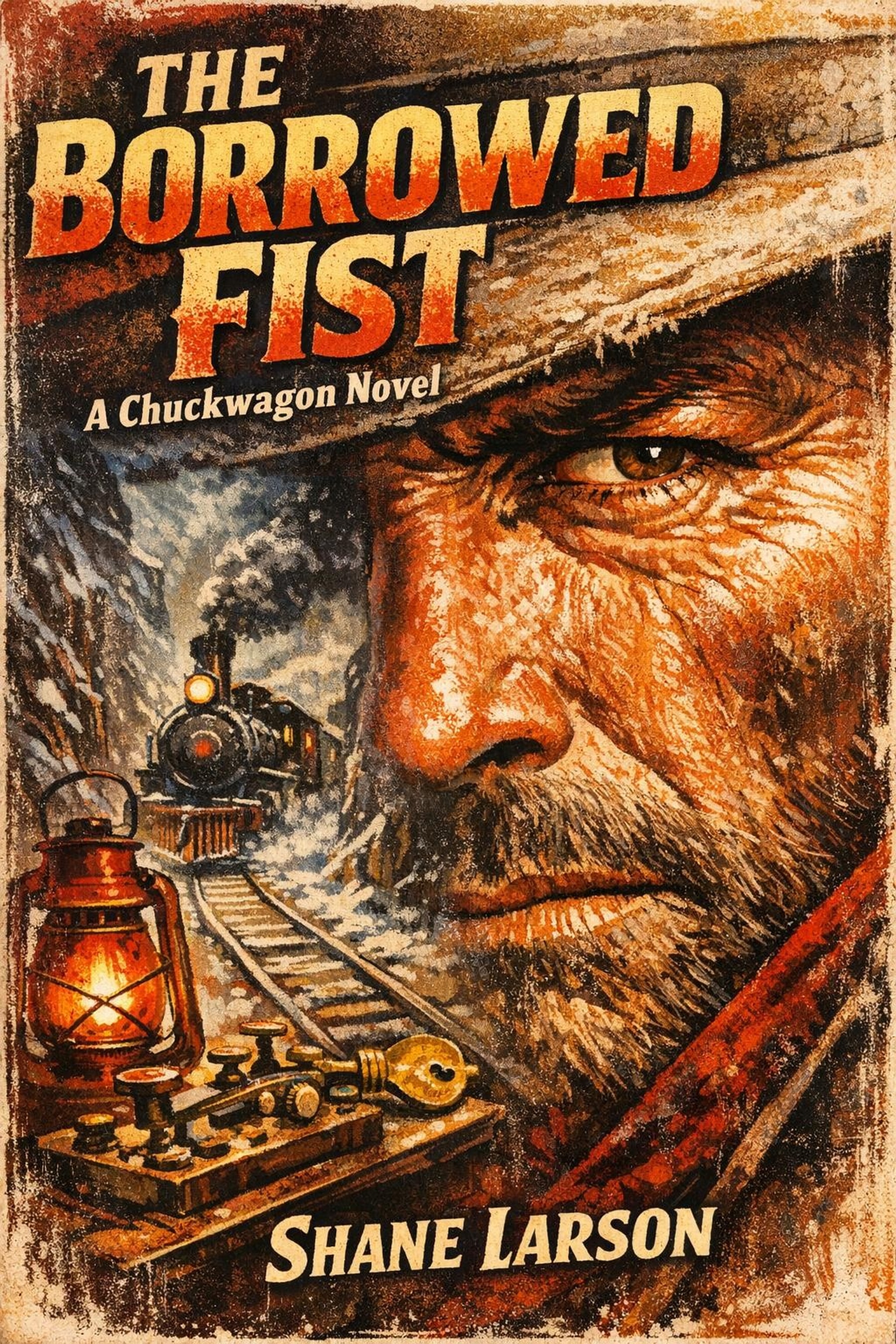
Twenty chapters, about 49,000 words — a single evening or two commutes. It is Book One of Chuckwagon, a series of standalone frontier novels. This one resolves completely; nothing is held back for a sequel.
Is any of it real?
The setting is: Colorado in 1882 (a state since 1876, not a territory — a distinction the book is careful about), the Sangre de Cristo range, the snow that lasts into June, and the way a supply ledger and a priority of signature actually worked. The people, the ranch and the events are invented, and Corvus Vane is not modelled on anyone.
Anything I should know about the content going in?
Nine deaths on the page, including one that is meant to hurt. No sexual content, no romance subplot, no children in peril, and no dialect spelling.
If You Liked This, You Might Like
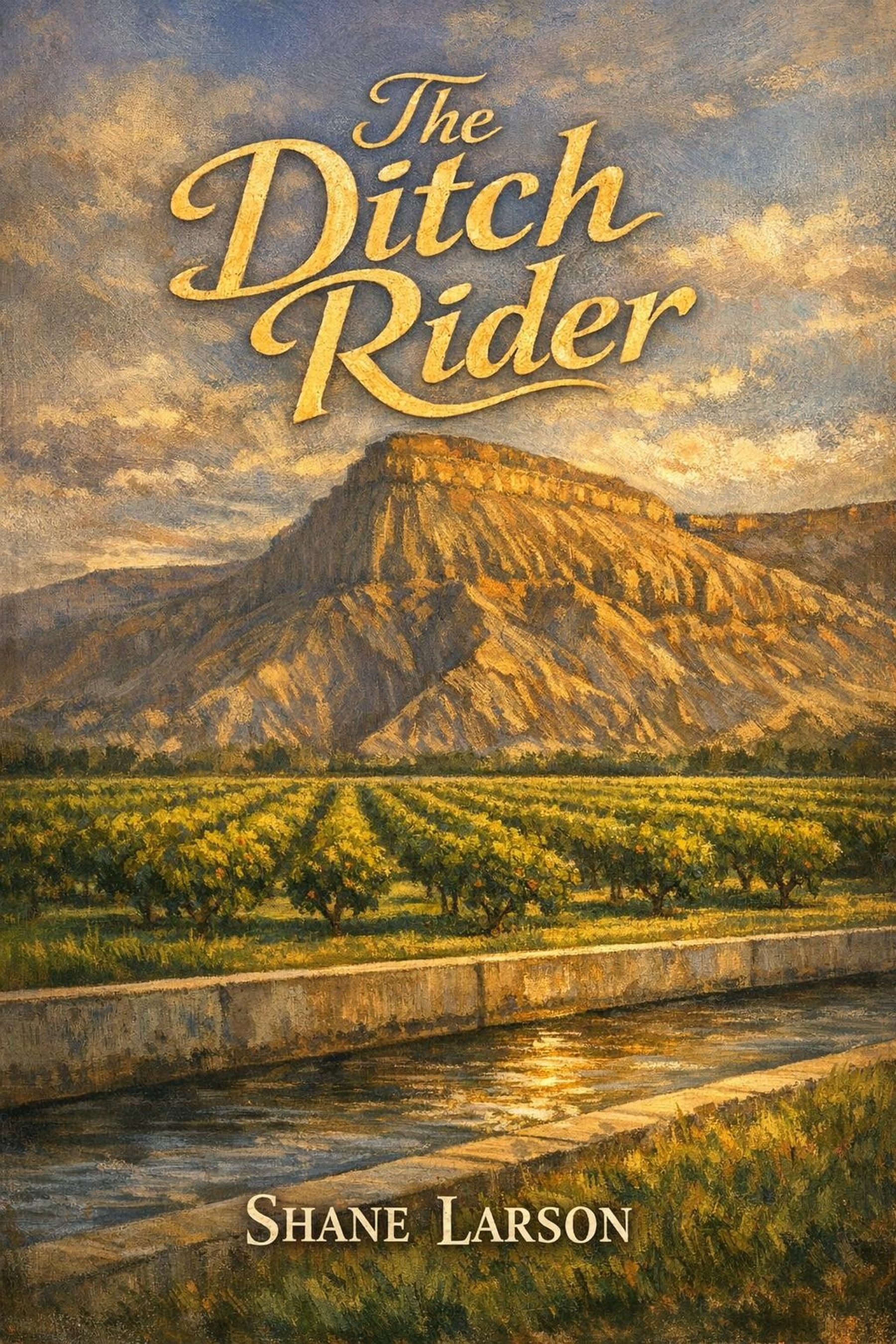
- The Ditch Rider — a western where the antagonist keeps honest books and wins with them, and the fight is over water instead of paper.
- The Johnson County War — the documented version of the argument: cattle money hiring an army against homesteaders, with the law on the wealthy side throughout.
- The Dime Novel West — how the myth of the fast draw was manufactured while the real West was being settled at the county recorder's office.
Every western is about the thing men will kill for. In this one it is a single sheet of paper, and the man carrying it across two hundred miles of the killer's own range has no idea what it says.
The Unread Confession — Chuckwagon, Book One.
What You'll Learn
- A limitation that is the plot, not a costume. Krell's illiteracy is never cured, never cheated, and never leaks: across the whole novel he does not read a single word.
- A code that gets tested and holds. At the midpoint he has a man dead to rights, alone, with a gun already in his hand and every reason. What he does instead is the hinge of the book.
- A supply ledger as the second weapon. What actually breaks Corvus Vane is a page in a camp requisition book that a clerk filled in for eleven dollars a month.
- Country that behaves. Snow that survives on June slopes because it is deep in the shaded cracks. A shelf road where the inside ruts will throw a wheel.
- Dialogue-forward pulp. People talk, and the talking is where the plot happens.
- A body count that costs something. Nine men are promised and the promise is kept.
- An ending that turns on the premise. Krell's last move only works because he is the one man in Colorado who could not possibly have altered what he was carrying.
New Historical fiction / frontier thriller (Western) releases and free chapters — no spam, unsubscribe anytime.