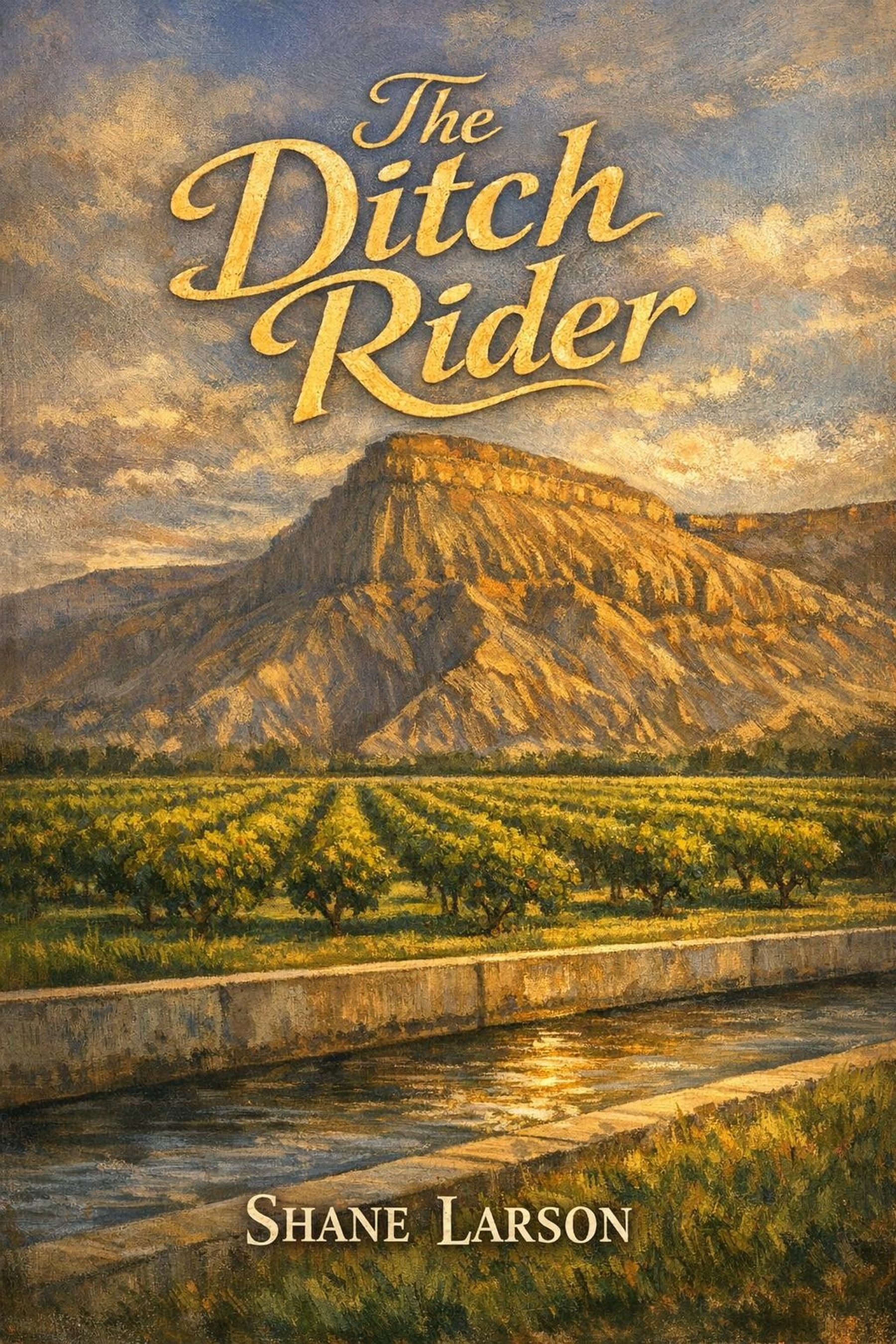
The Ditch Rider
A Novel of the Grand Valley
By Shane Larson
About This Book
Three men stand in the bottom of a dry irrigation canal on an April morning in 1918, unbolting a gate frame off a concrete headwall. The gate belongs to a widow whose water has not run in two years. They have a paper that says the right has been abandoned through non-use, and they are most of a day's work from finishing.
Four hundred yards upstream, a man they cannot see opens a check gate that was scheduled to be opened at noon anyway, and shuts a waste gate that had no business being shut, and then sits down on the wall to wait.
The water takes about four minutes to arrive.
A western where the weapon is a maintenance schedule
Amos Teague spent eight years riding ditch on the Government Highline Canal — fifty-five miles of federal concrete running west along the foot of the Book Cliffs, watering the richest peach country in the American West. He knows every check, every turnout, every measuring weir, and exactly how long a surge takes to travel a mile.
He also knows what the job actually is. Water in Colorado runs on prior appropriation: first in time, first in right. Every ditch carries a priority date, and when the river falls short the oldest dates take everything they are owed before the next one gets a drop. No sharing of shortage, no hardship provision. In a dry year a state officer rides out with a chain and shuts off farms in the order a book tells him to, and the book is correct.
In August of 1916, Teague was the man carrying that list. He chained the Sheehan headgate because the name was on the paper and the paper was right. The orchard died that fall. Their eleven-year-old son went up the canal bank in the dark with a crowbar to steal the water back, and Teague pulled him out of the trash rack at the Twelve Mile wasteway.
Now he has come back, because the snow never fell, because the call will come on the river by July — and because the man who gave that order has been appointed Water Commissioner for the district.
The antagonist who is never once wrong
Teague expects to find a forged ledger. It is the thing he has built two years and four hundred miles on top of: a false line in a book, the kind of thing a man can carry into a courtroom.
What he finds is Owen Halloran — fifty-two, sweating through clean linen by ten in the morning, carrying a rolled canal tracing instead of a gun. He never lies and never raises his voice. He keeps the most meticulous books in Colorado, and when Teague finally reads the original court decrees against them, every figure agrees to the second-foot and to the day.
And in the twenty-two months before the story opens, a corporation registered to Halloran's brother-in-law has bought four hundred and nineteen acres of ruined orchard for an average of thirty-one dollars an acre — every parcel of it sold within ninety days of the day its gate went shut. All of it recorded. All of it public. Every deed available to any person in Mesa County for fifteen cents a page.
Nobody had ever looked.
The novel is about what a man does when he goes looking for a criminal and finds a system instead — and discovers, layer by layer, that the decrees are honest, the commissioner is honest, the judge who wrote the priorities is honest, the sheriff is honest, and eleven families are still finished.
What You'll Find Inside
- A setting the western has never worked. Irrigation-era Colorado, 1918: emerald orchard rows against the ochre wall of Mount Garfield, a fifty-five-mile canal above all of it, and the Grand River — not renamed the Colorado until 1921 — running low in a drought year.
- Machinery that actually functions. Head, flow, gate mechanics, the lag between opening a check and the surge arriving. Every act of sabotage in this book would work, and all of it is done with tools hanging in a ditch company toolshed.
- A slow, non-graphic act of violence that will stay with you longer than any gunfight. A man goes into a lined section of canal with side slopes he helped approve and a rounded lip cast in place, and another man walks the bank beside him for a quarter of a mile, matching his pace. There is no dialogue in the chapter at all.
- An orchard gunfight filmed at eye level. Sight lines of six feet between the rows, half the shots going into the trees, and an orchardist screaming at armed men to stop while people are dying, because those trees are the whole of his savings.
- Real history doing the work. The roller dam at Cameo and its six steel gates, the first of their kind in the country. The Elberta harvest, three weeks in August, iced railcars pre-cooled at Grand Junction. The 1918 drought, which shows up in tree-ring reconstructions of Colorado River flow. The Cameo call, still placed most summers.
- A mirror instead of a sidekick. Dell Croy is twenty-seven, rides an Indian motorcycle along the canal bank, does Teague's old job better than Teague ever did, sleeps every night, and can explain exactly why in terms nobody here can answer.
- An ending that does not let anybody off. Including the reader, and including the man you have been following for three hundred pages.
Why I Wrote This
I got interested in Colorado water law the way most people do, which is by accident, and then could not put it down.
What got me was the flatness of it. Prior appropriation is not a corrupt doctrine. It is not a loophole somebody exploited. It is an honest, transparent, publicly recorded rule that a state adopted in its constitution in 1876 and has kept ever since, and it decides who eats in a dry year on the basis of a date. Not need. Not acreage. Not children. A date.
Every western I grew up with put the evil in a man — the cattle baron, the crooked marshal, the hired gun — and let you believe shooting him would fix it. I wanted one where the machinery is out in the open, where everyone operating it is doing the job correctly, where the paperwork survives inspection, and where the protagonist has to work all the way to the bottom before he understands there is nobody down there.
Then I wanted to see what he does about that. I did not enjoy the answer.
Frequently Asked Questions
Is this a traditional western or a literary one?
Both, and the balance matters. There is a body count of twenty, a gunfight in an orchard, a beating on a headgate wheel, and a flood. The pacing is hard and the chapters are short. But the antagonist never draws a weapon, the climax is not a duel, and the ending withholds the resolution a traditional western promises. If you want the fast draw, this is not it.
Do I need to know anything about water rights to follow it?
No. Everything you need is taught inside the story, by characters learning it themselves — an immigrant orchardist who bought forty acres off a government circular and does not know what a priority date is, and a widow who does.
How much of this actually happened?
The infrastructure and the law are real: the Grand Valley Project, the canal, the roller dam, the priority dates, the office of water commissioner, the 1918 drought, the peach industry, the Cameo coal camps, and Colorado's statewide prohibition from 1916. The people and the events are invented, and Owen Halloran is not modelled on anyone who held the post.
How long is it, and is it a series?
Thirty-four chapters in four parts plus an epilogue, roughly 88,000 words. It is Book One of Priority — one book per water fight, per valley, across the West. It resolves as a complete novel; the epilogue opens the door to the next one without leaving this one unfinished.
Is there anything I should know about the content going in?
Sustained violence, a drowning, and a mass-casualty event with named dead including a child. Another child dies in the backstory, off the page, in a single sentence. None of it is gratuitous, but the book is unsentimental about consequence and does not spare anyone the arithmetic.
If You Liked This, You Might Like
- The Johnson County War — the documented version of this novel's argument: Wyoming's cattle barons hiring an army against homesteaders, with the law and the paperwork on the wealthy side the entire time.
- The Lincoln County War — another frontier fight that looked like a gunfight and was actually a fight over who controlled a monopoly, a courthouse, and a set of accounts.
- The Dime Novel West — how the myth of the fast draw was manufactured while the real West was being decided at the county recorder's office. Read it against this novel, which refuses the myth on purpose.
Every western is about the thing men will kill for. In the Grand Valley it is water, and the man who controls it does it with a wrench and a ledger.
The Ditch Rider — Priority, Book One.
What You'll Learn
- A hard, unsentimental western in a setting the genre has never worked — irrigation-era Colorado, 1918
- An antagonist who never draws, never explains himself, and is never once wrong
- Violence that costs a livelihood every time: in an orchard valley, a life and a season are one bad night apart
- Water that behaves correctly — head, flow, gate mechanics, and the timing of a surge
- Real history doing the work: the Government Highline Canal, the roller dam at Cameo, the Palisade peach harvest, and the drought of 1918
- 34 chapters, ~88,000 words, and an ending that does not let anybody off
Included with Kindle Unlimited — read it free if you're a member.
New Historical fiction / frontier thriller (Western) releases and free chapters — no spam, unsubscribe anytime.