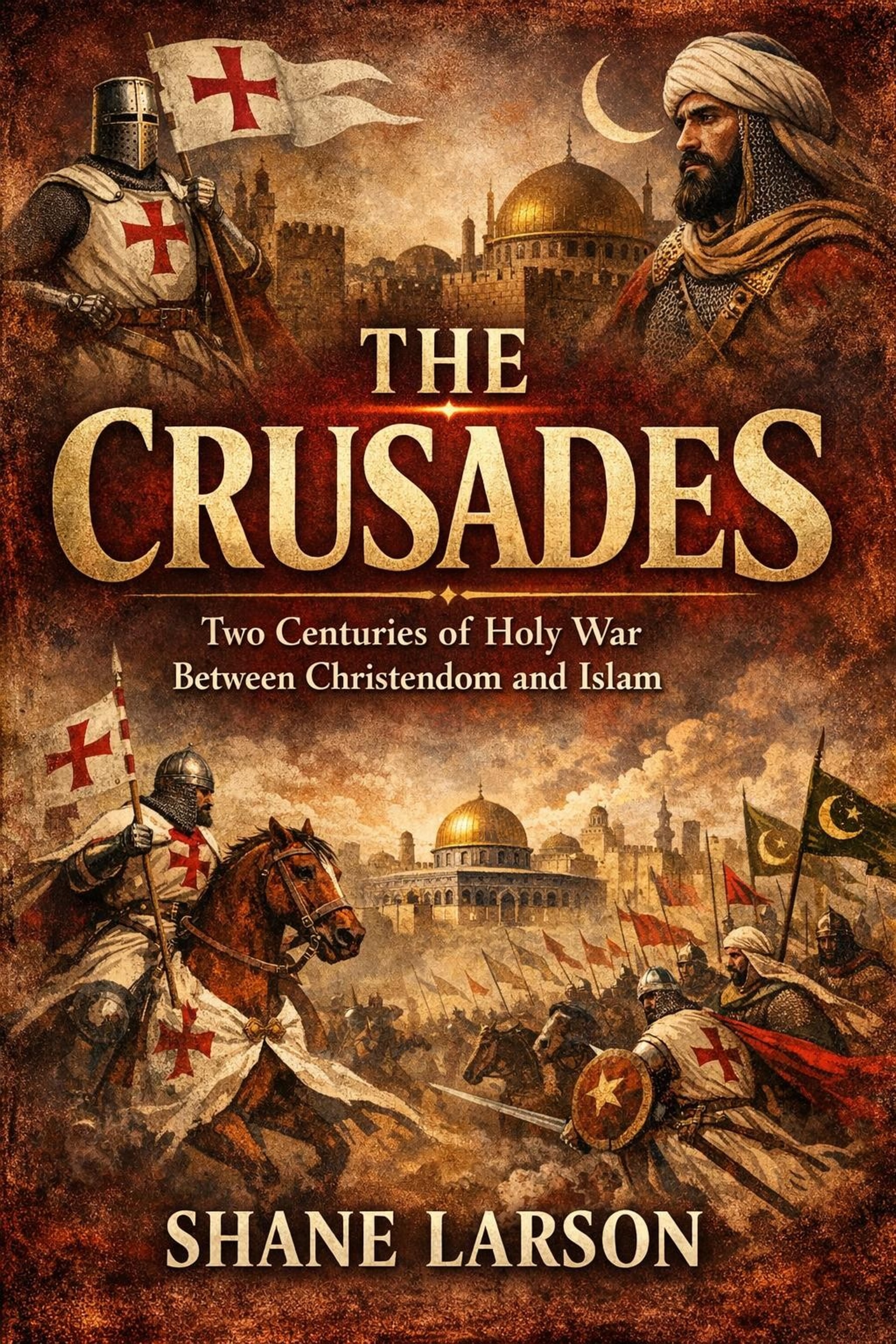
The Crusades
Two Centuries of Holy War Between Christendom and Islam
By Shane Larson
About This Book
On the morning of May 18, 1291, the Mamluk army broke through the walls of Acre. The city had been the last real foothold of the Crusader states for a century — the port where pilgrims landed, where the military orders kept their treasuries, where the whole enterprise of Latin Christendom in the East made its final stand. By nightfall it was burning. Within weeks, every remaining crusader outpost on the mainland surrendered without a fight.
Nearly two hundred years earlier, a pope had stood in a field in France and promised that God willed the liberation of Jerusalem. Tens of thousands believed him. What happened between that promise and the fall of Acre is one of the most argued-over stories in all of history — and one of the most misunderstood.
This book tells that story whole, from the first call to the final collapse.
The Story
The Crusades didn't begin as a clash of civilizations. They began as an opportunistic strike into a fractured Islamic world — Seljuk emirs feuding with each other, the Fatimid caliphate in Cairo at odds with Sunni Baghdad, no one in the Levant capable of mounting a unified defense. That fragmentation, more than any miracle, explains why the First Crusade succeeded where every later expedition failed. The crusaders took Jerusalem in 1099 not because they were unstoppable, but because nobody coordinated to stop them.
What follows is the long, remarkable history of the states they built: Jerusalem, Antioch, Tripoli, Edessa — Latin kingdoms grafted onto the Levantine coast, perpetually short of manpower, sustained by pilgrim traffic, Italian shipping, and the new military orders of the Templars and Hospitallers. And on the other side, the slow work of Muslim reunification: Zengi taking Edessa, Nur al-Din binding Syria together, and finally Saladin — the Kurdish officer who absorbed Egypt, unified the region, and destroyed the crusader field army at Hattin in 1187 before taking Jerusalem back almost bloodlessly.
The Third Crusade brought Richard the Lionheart east for the most famous confrontation of the entire era — a campaign of brilliant battlefield victories that never quite reached its objective, settled in the end by negotiation between two commanders who never met. Then came the turn no one saw coming: the Fourth Crusade, launched to strike Egypt, diverted by debt and Venetian politics until it sacked Constantinople itself in 1204 — crusaders destroying the greatest Christian city in the world.
The final century is a story of erosion. Frederick II regained Jerusalem with a treaty and lost it again. Louis IX's crusades ended in captivity and death. The Mongols arrived, the Mamluks rose to stop them, and Baibars and his successors methodically dismantled what remained of the crusader coast — until Acre, and the end.
Throughout, the Islamic powers appear here as they actually were: the Fatimids, Seljuks, Zengids, Ayyubids, and Mamluks as full historical actors with their own politics, rivalries, and reasons — not scenery for a European drama.
What You'll Discover
- The world of 1095 on both sides of the Mediterranean — why Urban II made his call at Clermont, and why a fragmented Islamic Levant couldn't answer it
- How four Latin states survived for generations on a hostile coast, and the structural weaknesses that meant their time was always borrowed
- The three-generation project of Muslim reunification, from Zengi's capture of Edessa through Nur al-Din to Saladin's empire
- Hattin, 1187 — the single afternoon that undid ninety years of crusader statehood
- Richard and Saladin's campaign along the coast, and why the Third Crusade's greatest general never took the city he came for
- The Fourth Crusade's descent from holy war to hostile takeover, and what the sack of Constantinople cost both Christendoms
- The Templars and Hospitallers as the era's first standing professional armies — and its first multinational financial institutions
- The Mamluk endgame: Baibars, Qalawun, and the systematic reduction of the crusader coast that ended at Acre in 1291
Why I Wrote This
Most Crusades books I've read pick a side, sometimes without meaning to. The older tradition treats the crusaders as protagonists and everyone else as backdrop; the modern corrective sometimes just inverts the casting. Both approaches flatten what is genuinely one of the strangest stories in medieval history — a two-century enterprise in which nearly everyone involved believed they were doing something righteous, and nearly everything went sideways anyway. I wanted a single volume that follows the entire arc, gives the Islamic dynasties the same depth of treatment as the Latin kingdoms, and trusts the reader to sit with the moral complexity instead of resolving it for them. The sources are rich on both sides — Ibn al-Athir is as vivid as any Latin chronicler — and the story is better when you can hear all of them.
Frequently Asked Questions
Is this a narrative history or an academic study?
Narrative history. The book moves chronologically from Clermont in 1095 to the fall of Acre in 1291, telling the story through campaigns, sieges, and the people who drove them. It's grounded in the scholarship but written to be read, not consulted.
Does it cover all the Crusades or just the famous ones?
The full sequence in the Holy Land — from the First Crusade through the Third, the diversion of the Fourth to Constantinople, Frederick II's negotiated crusade, Louis IX's expeditions to Egypt and Tunis, and the Mamluk conquests that ended the crusader states. The focus stays on the eastern Mediterranean rather than the Baltic or Iberian theaters.
How does the book handle the Muslim side of the war?
As half the story, not background. The Fatimids, Seljuks, Zengids, Ayyubids, and Mamluks each get real treatment — their internal politics, their rivalries with each other, and the long project of reunification that culminated in Saladin and, later, the Mamluk victories that ended the crusader presence for good.
Do I need any background in medieval history to follow it?
No. The opening chapters establish the world of the late eleventh century on both sides of the Mediterranean before the First Crusade launches. Names, dynasties, and geography are introduced as the story needs them.
What makes this different from Runciman or Asbridge?
Runciman's classic trilogy is beautiful but seventy years old and openly partisan toward Byzantium; Asbridge's single volume is excellent on the period through 1291 with a strong crusader-side focus. This book aims for a single fast-moving volume with genuinely balanced weight — the Islamic powers as fully realized actors — written for readers who want the whole arc without three volumes of commitment.
Where is the book available?
In ebook across major retailers, including Amazon, Apple Books, Barnes & Noble, and Kobo, with additional formats to follow.
If You Liked This, You Might Like
- The Mongol Storm — The other great thirteenth-century collision with the Islamic world, and the force that forged the Mamluks who ended the Crusades.
- Suleiman the Magnificent — Where the long contest between Christendom and the Islamic world went next: the Ottoman golden age.
- Charlemagne — The making of the medieval Christendom that would one day march east, three centuries before Clermont.
- The Viking Expansion — Another two-century story of armies, faith, and ambition reshaping the medieval world — including the Norse who reached Constantinople.
Two hundred years, five dynasties, four kingdoms in the sand, and one idea that outlived its own failure. This is the Crusades from beginning to end — every side fully human.
New Medieval History releases and free chapters — no spam, unsubscribe anytime.
More in This Genre
View all →