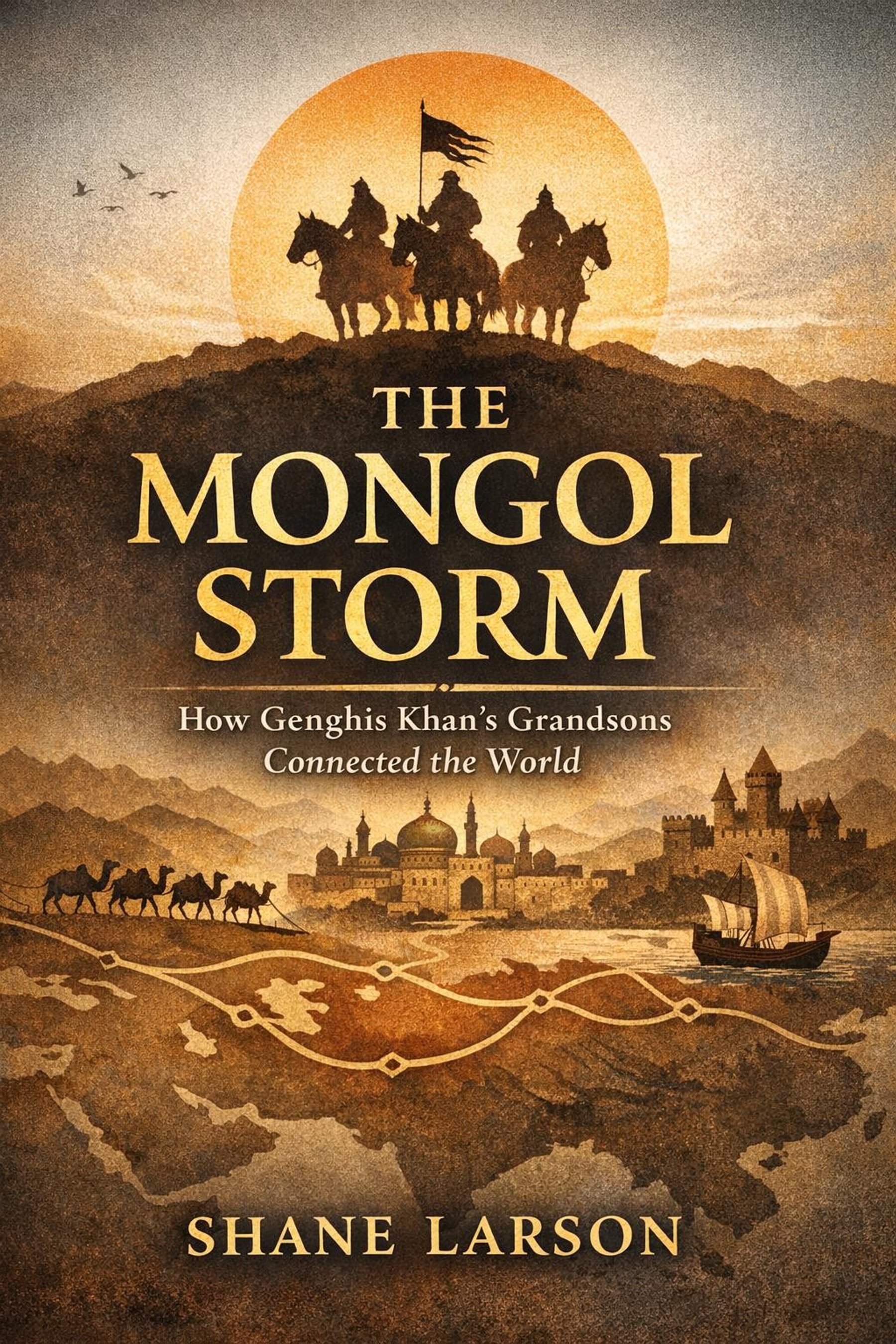
The Mongol Storm
How Genghis Khan's Grandsons Connected the World
By Shane Larson
About This Book
A merchant leaves the Yellow Sea with a cart of silk and a head full of prayers. He crosses deserts, mountains, and the territory of a dozen peoples who, a generation earlier, would have killed him for his boots. He arrives at the edge of Europe alive, paid, and unrobbed. One law protected him the whole way. One empire built the road.
That road was the Mongol Empire, and the century it held open is the closest the medieval world ever came to globalization. Historians call it the Pax Mongolica — the Mongol Peace — and it moved goods, gunpowder, paper money, printing, and ideas across Eurasia faster and farther than anything before it. It also moved the Black Death. The first true world-system was not drawn up in a European court. It was assembled by nomads on horseback, and the same network that carried prosperity carried plague along every mile of it.
This is the story of the people who stitched that world together, and of the price the world paid for being connected.
The Story
The Mongol Storm follows the empire from a single improbable life to a civilization-spanning machine. It opens with Temüjin — a boy abandoned to starve on the Mongolian steppe, captured, enslaved, and somehow still alive — and traces how he welded scattered, feuding tribes into one nation and emerged as Genghis Khan. From there the conquest widens: northern China, the Khwarazmian realm of Persia, the principalities of the Rus, and finally Baghdad, where in 1258 the fall of the city ended the Abbasid Caliphate and closed the Islamic Golden Age.
But conquest is only half the book. The other half is administration — the unglamorous, world-changing work of running the largest contiguous land empire in history. Genghis was a lawgiver as much as a warlord. Möngke counted and governed. Kublai sat on the throne of China. The empire's relay stations, its tolerance of trade and faith, its protection of merchants and envoys, turned the Silk Roads from a chain of risky regional routes into one continuous highway. Europe met Asia in earnest for the first time, and neither was the same afterward.
The book is honest about both faces of that achievement. The Mongol conquests were staggeringly violent; the cities they broke stayed broken for centuries. The connectivity they created was real, and so was the catastrophe that rode it westward. The Mongol Storm holds both truths at once — clear about the accomplishment, clear about the cost, and free of both the romance and the cartoon savagery that usually crowd out the actual history.
What You'll Discover
- How a child left to die on the steppe forged a unified nation out of tribes that had spent generations killing each other
- Why Mongol cavalry consistently outmaneuvered and outlasted every settled power it faced, from Chinese dynasties to European knights
- What actually happened at Baghdad in 1258 — and why the end of the Caliphate marked a turning point the Islamic world still reckons with
- How the empire's relay and protection systems turned the Silk Roads into a single working trade network spanning a continent
- The careers of the men who ran it: Subutai the undefeated strategist, Batu who shattered Europe's armies, Hülegü who took Persia, Möngke the administrator, Kublai the emperor
- The grim symmetry of the Black Death — how the plague used the empire's own roads, relay stations, and trade caravans to reach Europe
- Why so much of the connected, fragile, global world we now take for granted was first sketched out under Mongol rule
Why I Wrote This
I kept running into the Mongols as a footnote — the barbarians who showed up, burned everything, and left. The more I read, the more that version fell apart. These were the people who made it possible for a Venetian to reach China and come home with a book about it. They standardized weights, protected caravans, ran a continental postal relay, and were strikingly indifferent to which god you prayed to as long as you paid your taxes.
What hooked me was the contradiction. The same empire that piled skulls outside conquered cities also created the safest long-distance trade conditions the medieval world ever saw. I didn't want to write a redemption story or a horror story. I wanted to write the actual one — where the road that carried silk and printing and paper money also carried the plague, because they were the same road. That tension is the whole point, and most popular accounts flatten it in one direction or the other.
Frequently Asked Questions
Do I need to know anything about Mongol or medieval history first?
No. The book assumes no background. It starts with Temüjin's childhood and builds the world from the ground up, explaining the steppe, the tribes, and the surrounding empires as it goes. If you've never read a page about Genghis Khan, you'll be fine.
Is this a dense academic history or a narrative one?
Narrative. It's written to read like a story — chronological, character-driven, propulsive — while staying faithful to the historical record. There's no jargon and no thicket of footnotes in the text. It respects your intelligence without demanding a graduate seminar.
How is this different from Jack Weatherford's Genghis Khan and the Making of the Modern World?
Weatherford's book is excellent and centers tightly on Genghis and his legacy. The Mongol Storm covers the full arc through the successor khans — Batu, Möngke, Hülegü, Kublai — and gives equal weight to the dark side of the connectivity, especially the way the plague traveled the empire's own infrastructure. If you loved Weatherford, this is a natural next read rather than a repeat.
Does it actually cover the Black Death and the Silk Roads, or just the conquests?
Both, substantially. The trade network and the pandemic are central to the book's argument, not afterthoughts. The whole thesis is that the prosperity and the plague used the same roads.
Is it available on Kindle Unlimited?
Yes. It's enrolled in Kindle Unlimited, so KU subscribers can read it at no additional cost.
If You Liked This, You Might Like
- Attila — Another steppe horseman whose mounted armies broke settled empires and terrified a continent; the closest historical rhyme to the Mongol storm a thousand years earlier.
- The Persian Empire — The world Hülegü conquered had a deep imperial past of its own; read the empire the Mongols inherited and dismantled.
- The Empire Collapse Pattern — A cross-genre companion on why the mightiest powers fall, with the Mongol rise and fragmentation as one case among many.
- The Black Death — The pandemic that rode the empire's roads into Europe, told from the other end of the same story.
- The Silk Road — The corridor the khans finally unified, told across its full two thousand years: what the post stations and passports actually carried, and how the same roads delivered the plague.
The connected, global, fragile world we live in didn't begin in a European harbor or a modern boardroom. It was first traced across a continent by riders on the open steppe, eight hundred years ago. The Mongol Storm is the story of how that happened — and what it cost.
Included with Kindle Unlimited — read it free if you're a member.
New Medieval History releases and free chapters — no spam, unsubscribe anytime.