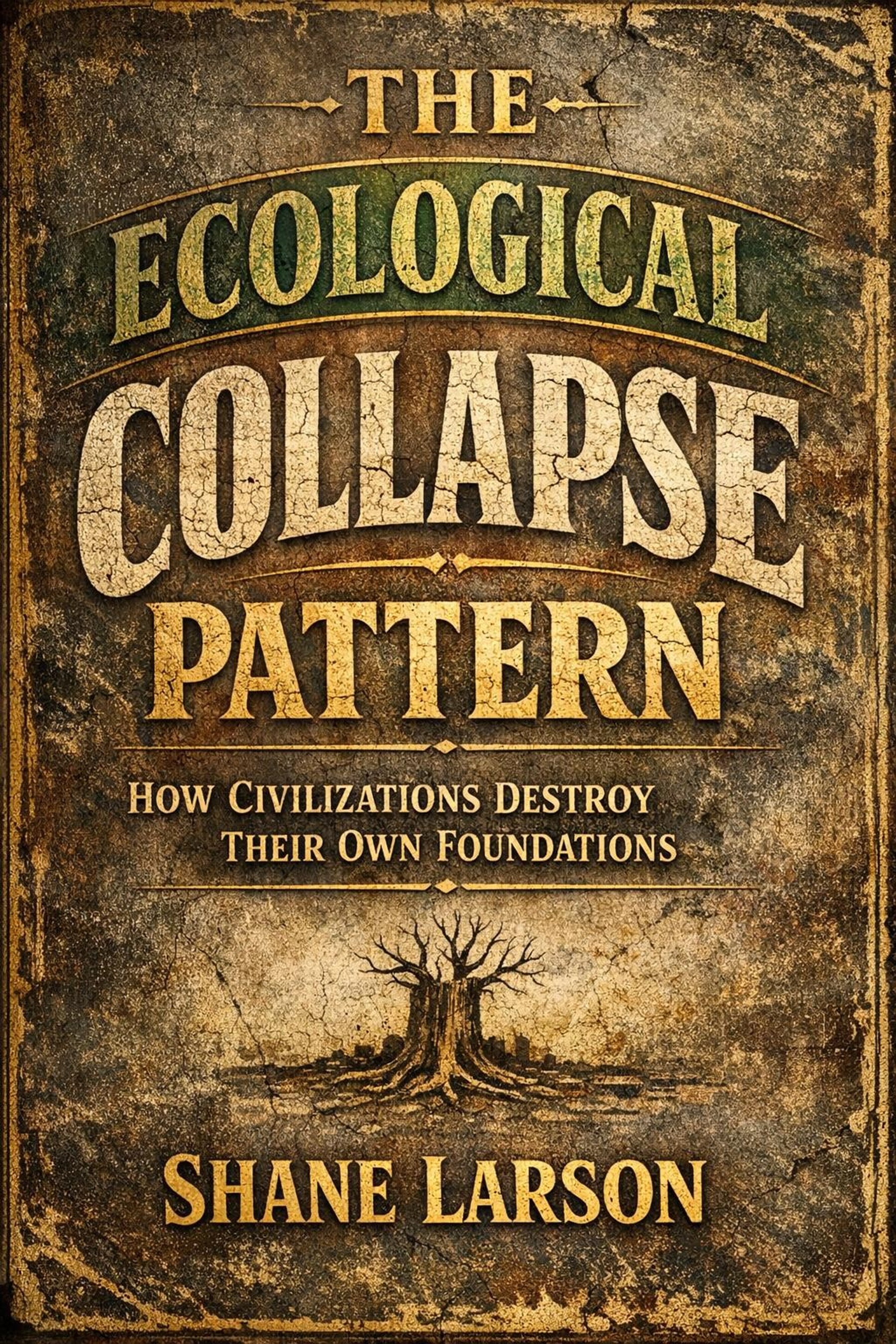
The Ecological Collapse Pattern
How Civilizations Destroy Their Own Foundations
By Shane Larson · The Collapse Pattern (Book 10)
About This Book
In the 1930s, a wind picked up topsoil from the American plains and carried it east in clouds dense enough to darken the sky over Washington, D.C. Senators debating a soil-conservation bill could look out the window and watch Oklahoma drift past the Capitol. The Dust Bowl was, by every measure, an ecological collapse in progress: land drawn down past the point of return, farms failing, families loading trucks and heading west.
And then it stopped. Not by luck, and not because the rain simply came back. People changed how they farmed, replanted what they had stripped, and pulled the land back from the edge. Within a generation the plains were producing again. The collapse was real. So was the recovery.
That second half of the story almost never gets told, and its absence is the reason we misunderstand this kind of collapse so badly. We treat ecological ruin as fate — a slow-motion tragedy we can only narrate on the way down. But of all the ways a civilization can come apart, this is the one it can see coming from farthest off, and the one it has most often managed to stop.
The Argument
Every society runs on an ecological account it did not open: soil, freshwater, forests, fisheries, a climate stable enough to plan around. Nobody deposited that capital, and no society can easily rebuild it once it's gone. Spend it slower than it renews and you can run indefinitely. Spend it faster, and you set in motion a collapse that follows a startlingly consistent arc — the same shape whether it's a Sumerian city watching salt whiten its irrigated fields three thousand years ago or a Great Plains county watching its dirt blow toward the Atlantic.
This is Book 10 of the Collapse Pattern series, and it turns the framework on the domain most people already picture when they hear the word — the environmental one. The five-stage pattern the series traces across empires, economies, corporations, and institutions applies here too: overextension, brittleness, a trigger, a cascade, an aftermath. A society draws its ecological buffers thin during good years, loses the slack that would let it absorb a shock, and then a drought or a blight or a market swing arrives and finishes what the overextension began. The trigger gets the blame in the history books. The overextension did the real work.
But the environmental version of the pattern carries a twist the others don't, and it's the reason this book exists. Ecological systems warn you. They fail slowly, with decades of visible signals — falling water tables, thinning soil, shrinking catches — before the cascade arrives. That long fuse makes this the most interruptible collapse of them all. The Dust Bowl was reversed. London legislated away the coal smog that killed thousands in a single week. The ozone layer, punctured and then protected, is measurably healing. This book gives those recoveries the same weight as the ruins, because the difference between a Sumer and a saved system is the single most useful thing the pattern has to teach.
It is also honest about how we get these stories wrong. The famous morality tale of Easter Island — a people who chopped down their last tree and doomed themselves — turns out to be contested, maybe wrong. How a collapse story gets simplified into a parable is itself part of understanding collapse, and the book treats that as evidence rather than embarrassment.
What You'll Discover
- The five-stage arc — overextension, brittleness, trigger, cascade, aftermath — laid out as a working framework you can carry from one case to the next rather than a list of unrelated disasters.
- Why the trigger is never the cause — droughts strike resilient societies and healthy ones survive them; what determines the outcome is how much buffer got spent in the good years beforehand.
- What really happened on Easter Island — the contested archaeology behind the ecocide parable, and why the version everyone learned in school may have the story backwards.
- How three civilizations spent their buffers — the Maya, Mesopotamia, and the Ancestral Puebloans, each drawing down its ecological reserves until an ordinary drought became an extinction event.
- What the recoveries share — the Dust Bowl, the Montreal Protocol, and the partial rescue of the Aral Sea, read side by side for the common ingredients of a reversal.
- A field checklist — a plain, non-prophetic way to read overshoot in soil, water, and fisheries today, without sliding into either denial or doom.
- Why this collapse is the hopeful one — the long warning period that makes ecological failure, alone among the patterns, something a society can routinely see and stop.
Why I Wrote This
I've spent this whole series chasing one question: why do systems that look permanent come apart, and why do they so often do it the same way? Empires, banks, corporations, institutions — the arc keeps rhyming. When I got to the ecological version, I expected it to be the bleakest entry. It's the one the culture treats as hopeless, the domain of the doom shelf.
It turned out to be the opposite. Once I lined up the cases, the environmental pattern was the one civilizations have most often managed to interrupt — not because the threat is smaller, but because the warning is longer. That reframing felt worth a book. I'm not interested in prophecy, and I've got no patience for either the people who insist nothing is wrong or the ones who insist everything is already lost. Both are refusing to read the ledger. I wanted to write the version that takes the drawdown seriously and takes the recoveries just as seriously, because that gap is where all the useful knowledge lives.
Frequently Asked Questions
Do I need to have read the other Collapse Pattern books first?
No. Each book in the series is self-contained and re-establishes the five-stage framework from scratch. If you start here, you'll have everything you need. If you've read the earlier ones, you'll recognize the arc immediately and see how the environmental case both fits it and bends it.
Is this a doom-and-gloom climate book?
Deliberately not. It spends as much time on the Dust Bowl's reversal and the ozone layer's healing as on the collapses, and it argues that this pattern is the most interruptible of all of them. It takes the risks seriously without treating the ending as written.
How much is ancient history versus the present day?
Both, on purpose. The deep cases — Sumer, the Maya, the Puebloans — establish the pattern; the modern cases — the Dust Bowl, the Aral Sea, London's smog, the ozone hole — show it running fast enough to watch and, sometimes, to stop. The final chapters hand you a way to read the present without pretending to predict it.
Does it take a political side?
No. The framework is about overshoot and feedback, not policy factions. The recoveries it studies came from very different quarters, and the checklist at the end is built to be usable regardless of where you sit.
Where does it fall in the series?
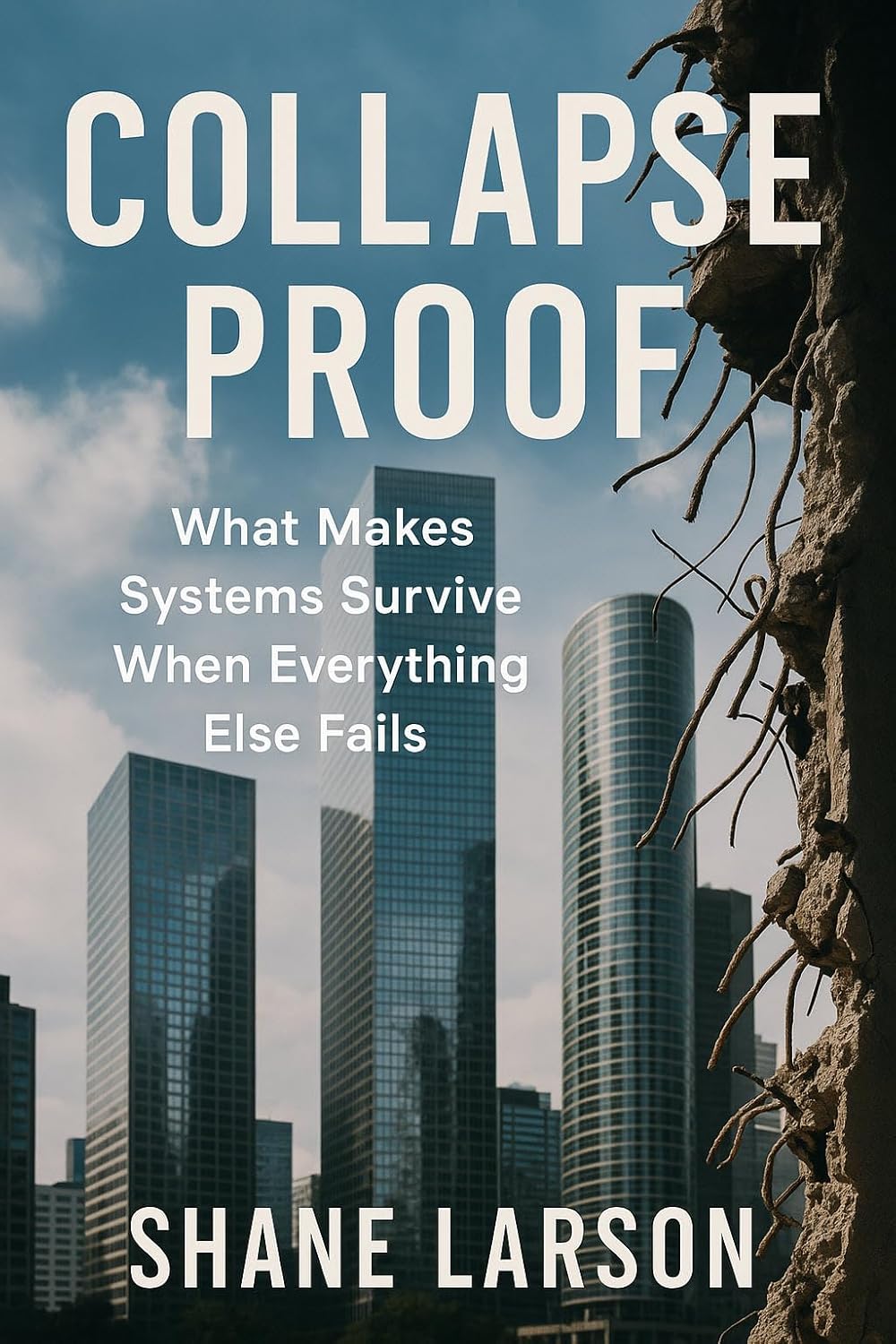
It's Book 10. Collapse Proof (Book 7) is the synthesis volume on what makes systems survive; this one is the environmental case study that feeds into that larger argument.
If You Liked This, You Might Like
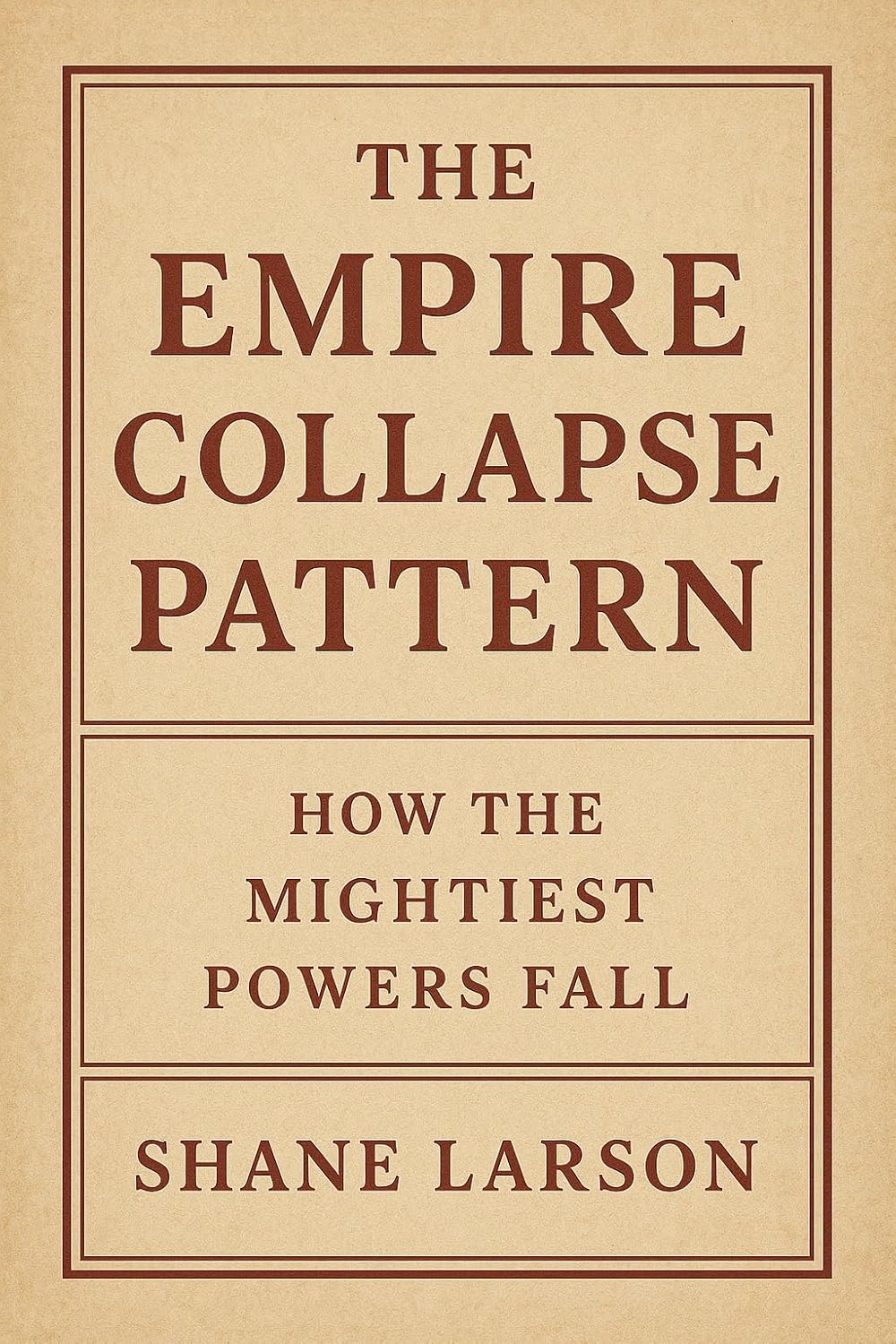
- The Collapse Pattern — the foundational volume that lays out the five-stage arc this book applies to soil, water, and forests.
- Collapse Proof — the flip side of the question: what the survivors did differently, which is exactly what the ecological recoveries here illustrate.
- The Maya Collapse — a full-length look at one of the central cases in this book, where drought met a civilization that had already spent its ecological margin.
- Ancient Apocalypse — a whole interconnected world unraveling under compounding stress, the pattern operating at the scale of an entire age.
Collapse of this kind is not destiny. It's compound interest on feedback nobody wanted to read, and the ledger stays open right up until the trigger arrives. The point of the pattern is to read it while there's still time to change the balance.
The Ecological Collapse Pattern is Book 10 of the Collapse Pattern series.
What You'll Learn
- **The five-stage arc** — overextension, brittleness, trigger, cascade, aftermath — laid out as a working framework you can carry from one case to the next rather than a list of unrelated disasters.
- **Why the trigger is never the cause** — droughts strike resilient societies and healthy ones survive them; what determines the outcome is how much buffer got spent in the good years beforehand.
- **What really happened on Easter Island** — the contested archaeology behind the ecocide parable, and why the version everyone learned in school may have the story backwards.
- **How three civilizations spent their buffers** — the Maya, Mesopotamia, and the Ancestral Puebloans, each drawing down its ecological reserves until an ordinary drought became an extinction event.
- **What the recoveries share** — the Dust Bowl, the Montreal Protocol, and the partial rescue of the Aral Sea, read side by side for the common ingredients of a reversal.
- **A field checklist** — a plain, non-prophetic way to read overshoot in soil, water, and fisheries today, without sliding into either denial or doom.
- **Why this collapse is the hopeful one** — the long warning period that makes ecological failure, alone among the patterns, something a society can routinely see and stop.
Included with Kindle Unlimited — read it free if you're a member.
New The Collapse Pattern Series releases and free chapters — no spam, unsubscribe anytime.
More in The Collapse Pattern
View series →
More in This Genre
View all →