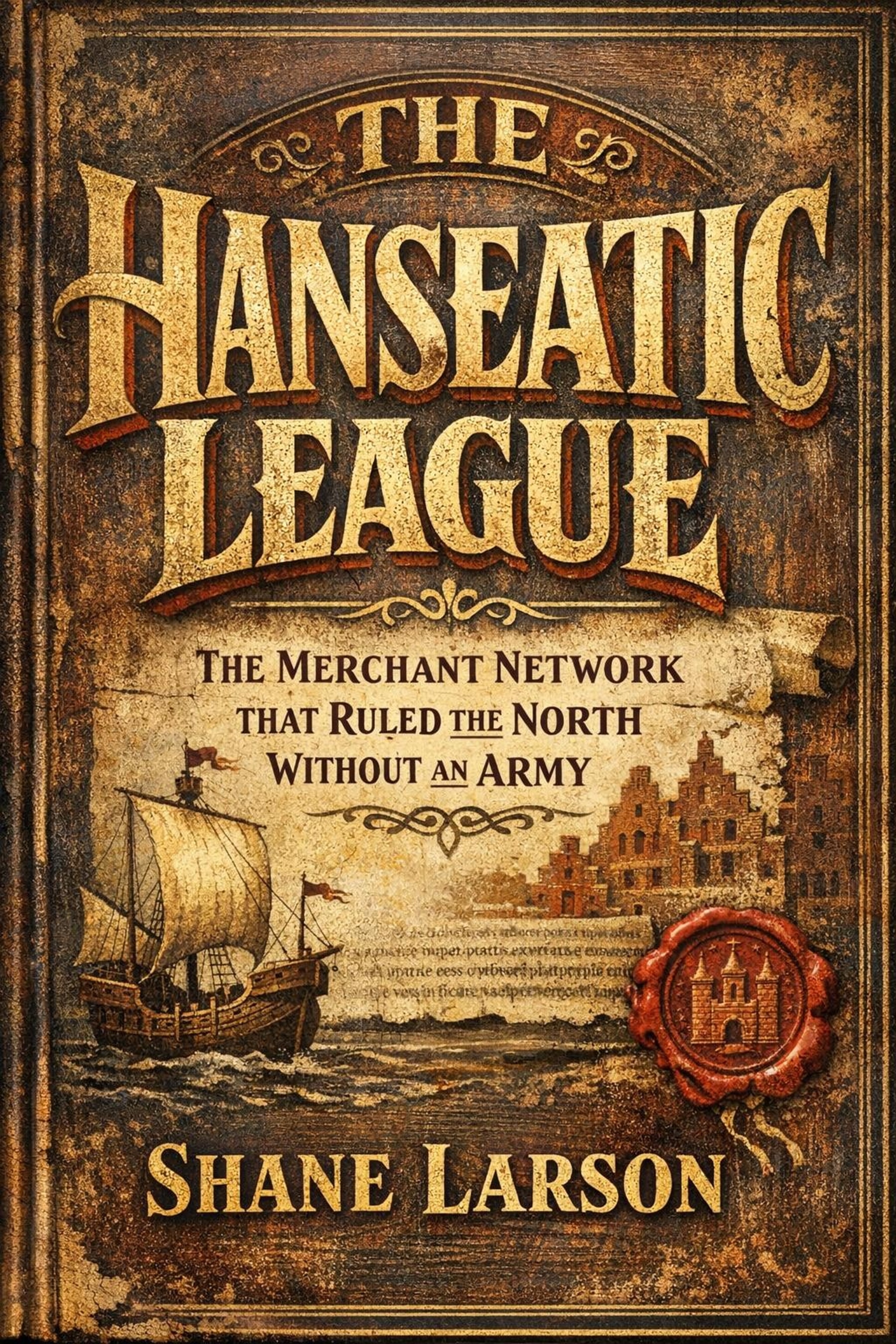
The Hanseatic League
The Merchant Network That Ruled the North Without an Army
By Shane Larson
About This Book
Every autumn for three hundred years, on a stretch of open beach in southern Sweden, a temporary city assembled itself out of nothing. The herring arrived in the Sound in numbers that medieval writers could only gesture at, and behind them came the men: gutting crews, salters, coopers hammering barrels together on the sand, clerks with tally sticks, and merchants from towns a thousand miles apart, each renting a marked-out patch of beach that operated under his own home town's law. For a few weeks the sand was the busiest commercial ground in northern Europe. Then the fish moved on, the booths came down, and the beach was a beach again.
Nobody governed that. No king organized it, no charter created it, and no official was responsible for making it happen. It assembled because salt from one set of brine springs in Lower Saxony met fish from one run in the Sound, and because a hundred and fifty fast days a year in the church calendar meant that Latin Christendom had to eat salted fish whether it wanted to or not.
The organization that ran that trade, and most of the other trade in the northern seas, spent four centuries as the dominant commercial power in Europe north of the Alps. It never had a capital. It never had an army it did not hire for the season. It never wrote a constitution, never elected a head, never kept a treasury, and never — in four hundred years — drew up a list of its own members. When its enemies demanded to know who exactly they were negotiating with, the towns did not refuse out of cunning. They could not answer.
An Organization That Was Barely an Organization
This is a book about how that worked, and then about why it stopped working.
The Hanse held one instrument of power. It could stop doing business with you. There were no fines it could collect, no court that could compel you, no soldiers it could send. A town that broke the network's rules was cut out of the network — Verhansung, the towns called it — and the loss of access to salt, to grain, to the Skåne beach, and to every counterparty from Novgorod to Bruges was ruinous enough that towns which had been excluded came back on their knees. Brunswick, expelled after its craft guilds overthrew the merchant council, was readmitted only after a public unwinding of the revolution: restitution paid, masses endowed for the dead, the responsible men sent on pilgrimage. Cologne, the largest city in Germany, held out for five years against an assembly of Baltic herring towns and then submitted.
That sanction beat a kingdom. In 1370, after a naval war fought by hired fleets and paid for by a levy the towns collected separately in their own harbors, Denmark ceded the four castles commanding the Sound, a share of the customs revenue collected beneath them, and a formal voice in who would next wear the Danish crown.
And that same sanction is why the Hanse eventually lost everything. Exclusion works on people who want in. It has no content whatever against a Dutch skipper who never held Hanseatic privileges and could carry Baltic rye to Flanders more cheaply without them. Nothing to withdraw from an English clothier sailing his own cargo to Danzig to sell it himself. Nothing to withdraw from a Grand Prince of Moscow who had decided that the trade of Novgorod would run on his terms. The instrument that made the network unkillable for four hundred years is the same instrument that left it helpless against organized power — and both facts were visible in the room at Stralsund in 1370, if anyone had thought to look.
What's Inside
- The two commodities that built the first fortune. Brine springs at Lüneburg concentrated enough to be worth boiling in a climate with no sun for evaporation, an autumn herring run in the Sound, and the fuel problem that ate a forest. Salt and fish are treated as the strategic materials they were.
- How a religious calendar functioned as a demand curve. Lent, Fridays, Advent, and the ember days added up to roughly a hundred and fifty days a year on which a third of a continent could not eat meat. That was not a preference. It was a structural requirement, and someone had to supply it.
- The cog, and the paperwork that made the cog worth building. A flat-bottomed hull that could sit upright on a tidal flat and be unloaded where there was no quay, plus the commission arrangements, reciprocal agencies, and letter-books that let a merchant trust an agent he would not see for a year.
- Four fortified trading posts, four completely different bargains. German merchants living under their own law inside someone else's realm: the locked compound at Novgorod, the celibate winter residents of Bergen, London's Steelyard with its customs rates better than the English paid, and Bruges — where there was no compound at all, and the Hanse had to invent a different weapon.
- A war fought by towns. How a confederation with no army raised a fleet by assessment and hired crews, took a kingdom's fortresses, and won a veto over a royal succession — and the honest accounting of what it actually did with that veto, which was less than the clause suggests.
- The pirates the towns had to become state-like to destroy. Privateers hired for a Scandinavian dynastic quarrel who kept sailing after it ended, and what convoy duty and patrol fleets cost an organization that hated paying for anything permanent.
- Plague along the network's own sea lanes, and the long aftermath in the eastern grain lands that would supply Hanseatic rye for two more centuries.
- The decline, told as one story rather than two. Cheaper Dutch hulls, English clothiers going direct, a herring shoal that left the Baltic for the North Sea, and all around the rim the consolidation of states with treasuries and navies — ending at an assembly in 1669 attended by nine towns, which closed without dissolving anything because there was nothing to dissolve.
Why I Wrote This
I got stuck on one sentence in a reference book: that the Hanseatic League never compiled a membership list. Not that the list was lost — that it was never made, in four hundred years, by an organization that was simultaneously running the trade of half a continent and dictating terms to kings.
I kept expecting to find the missing piece. Some quiet permanent secretariat, some archive, some mechanism I had not read about yet. There isn't one. The assembly met when someone with standing insisted. Its decisions bound only the towns that had bothered to send a representative and then chose to be bound. The whole apparatus cost, at the center, approximately nothing.
Most history about power is about how power gets concentrated. This is the opposite case, and it is the better puzzle: an enterprise that worked for four centuries with no center at all, and then met something it could not refuse to trade with. I wanted to write the book that took the salt and the herring and the barrel gauges as seriously as the treaty, because the cargo is where the answer turned out to be.
Frequently Asked Questions
Do I need to know anything about medieval Europe to read this?
No. The book assumes you know roughly where the Baltic is and nothing else. Every institution, term, and unit of measure is explained where it first appears, and there is an appendix on the commodities and another on the towns for anyone who wants to go back and check something.
Is this a business book about networks, or a history book?
A history book, without apology. The structural argument about networks and states is made about the Hanse and left in the past — there are no modern comparisons, no contemporary parallels, and no chapter of lessons for today. If the argument travels, it will travel on its own without help. Readers who come to it for the institutional puzzle will find it fully worked; they will just find it worked in the fourteenth century.
How much of this is about ships and battles?
Less than you might expect, and that is deliberate. There is one naval war and one campaign against pirates, both covered properly. But the Hanse's real story happens at the weighing beam, in the account book, and inside four walled compounds in foreign cities. The book follows the cargo.
Why haven't I read about this before?
Because there is almost nothing to read in English. The standard scholarly account is more than sixty years old and translated from French, and most of the serious modern work is in German and untranslated. The subject is enormous, the sources are extensive, and the accessible shelf is nearly bare.
What's the source policy on quotations?
The Hanse's own records — the assembly recesses, the trading-post statutes, the town chronicles, the surviving merchant letters — are almost entirely untranslated, and the modern English renderings that do exist are under copyright. Everything is therefore paraphrased in the author's own voice rather than quoted, and where a famous story rests on legend rather than record, the text says so on the spot.
How long is it?
Around 82,000 words: an introduction, fourteen chapters in four parts, a conclusion, and three appendices. The paperback runs 271 pages.
If You Liked This, You Might Like
- The Purple Merchants — The same book in a warmer sea two thousand years earlier: a trading network that accumulated extraordinary wealth and converted almost none of it into lasting power. Read together, the two make one argument twice.
- The Viking Expansion — Covers the Baltic and Novgorod routes three centuries before the German towns arrived to organize them. It is the world Chapter 1 of this book opens in.
- The Black Death — The plague reached the north along the sea lanes described here. This book gives you one chapter on that; the other gives you the whole catastrophe.
- The Institutional Collapse Pattern — The structural companion. The Hanse is an unusually clean case of an institution that kept its rules long after it had lost any way to enforce them.
Four hundred years of dominance, built on refusing to trade with people. It was enough to humble a kingdom, and it was no defense at all against the first organization that could simply take what it wanted.
What You'll Learn
- How salt from Lüneburg's brine springs and herring from the Sound built the first Hanseatic fortune — and why the fuel to boil that brine ate a forest
- Why a religious calendar of roughly 150 fast days a year functioned as a demand curve a third of a continent could not opt out of
- How the cog, the commission agency, and the merchant letter-book made it possible to trust a partner you would not see for a year
- Four fortified trading posts and four completely different bargains: the locked compound at Novgorod, celibate winter residents at Bergen, London's Steelyard, and Bruges — where there was no compound at all
- How a confederation with no army raised a fleet by assessment, took a kingdom's fortresses, and won a veto over the Danish succession in 1370
- What Verhansung — exclusion from the network — could actually compel, and why Cologne held out five years before submitting
- Why the same sanction that made the Hanse unkillable left it helpless against Dutch skippers, English clothiers, and the Grand Prince of Moscow
- How the decline runs as one story: cheaper hulls, direct traders, a herring shoal that moved, and states with treasuries and navies closing in around the rim
Included with Kindle Unlimited — read it free if you're a member.
New Medieval History releases and free chapters — no spam, unsubscribe anytime.