A Single Chip Is Now Worth More Than a Barrel of Oil
June 26, 2026 · 5 min read
A single advanced chip is now more strategically valuable than a barrel of oil—and almost no one following the AI boom understands why that changes everything.
That sounds like an exaggeration. It isn't. Oil is one of the most strategically important commodities in history, and it is still produced in dozens of countries, refined in hundreds of facilities, and traded on deep, liquid markets. If one supplier falters, others step in. The most advanced semiconductors—the ones that train large AI models and run the data centers behind them—are nothing like that. They are designed by a small number of companies, manufactured by an even smaller number, on machines that essentially one company in the world knows how to build, using ultrapure materials sourced from a short list of suppliers.
Concentration like that doesn't just create business risk. It creates leverage. And leverage, in the hands of governments, becomes policy.
This is the quiet shift I wrote a book about. We have spent the last few years reading two stories as if they were unrelated. One is the breathtaking rise of artificial intelligence. The other is the slow fragmenting of the global economy into rival technology blocs—export controls, investment screening, "friend-shoring," data-localization laws, fights over technical standards. Most coverage treats these as separate beats. They are not. They are the same story, and once you see the connection, the headlines stop looking random.
Why the AI boom and the trade wars are one story
Start with the obvious. AI runs on compute, and compute runs on chips. The leap from a clever research demo to a system millions of people use is, in large part, a story about access to enormous quantities of advanced semiconductors. Whoever controls the chips controls the pace of the AI frontier.
Now follow the chain backward. Those chips are manufactured using extraordinarily complex tools. Those tools depend on components and materials from a global web of specialized suppliers. And that entire web sits inside a geography that no single country fully controls. The result is a supply chain with a handful of irreplaceable chokepoints—and chokepoints are exactly what policymakers reach for when they want to shape another country's trajectory without firing a shot.
That is how technology policy started to read like trade policy. Export controls, once a niche legal specialty, became a front-page instrument of statecraft. Decisions about which chips can be sold, to whom, and under what conditions are now made with the same seriousness once reserved for energy or weapons. The tools are economic and technical. The stakes are strategic.
It doesn't stop at chips
If the story ended with semiconductors, it would already be consequential. It doesn't. The same logic shows up across the technology stack.
Talent. Frontier AI is built by a small, mobile population of researchers and engineers. The competition to attract, retain, and sometimes restrict the movement of that talent is as real as the competition for chips—and far less discussed.
Data. AI systems are trained on data, and a growing number of countries now treat data the way they once treated natural resources: something to be kept within national borders, governed by local rules, and not handed freely to foreign firms. Data sovereignty sounds like a legal abstraction until it reshapes where you're allowed to build and serve.
Standards. Whoever sets the technical standards—the invisible rules that decide how systems connect and interoperate—gains durable, compounding advantage. Standards fights are slow, unglamorous, and enormously important.
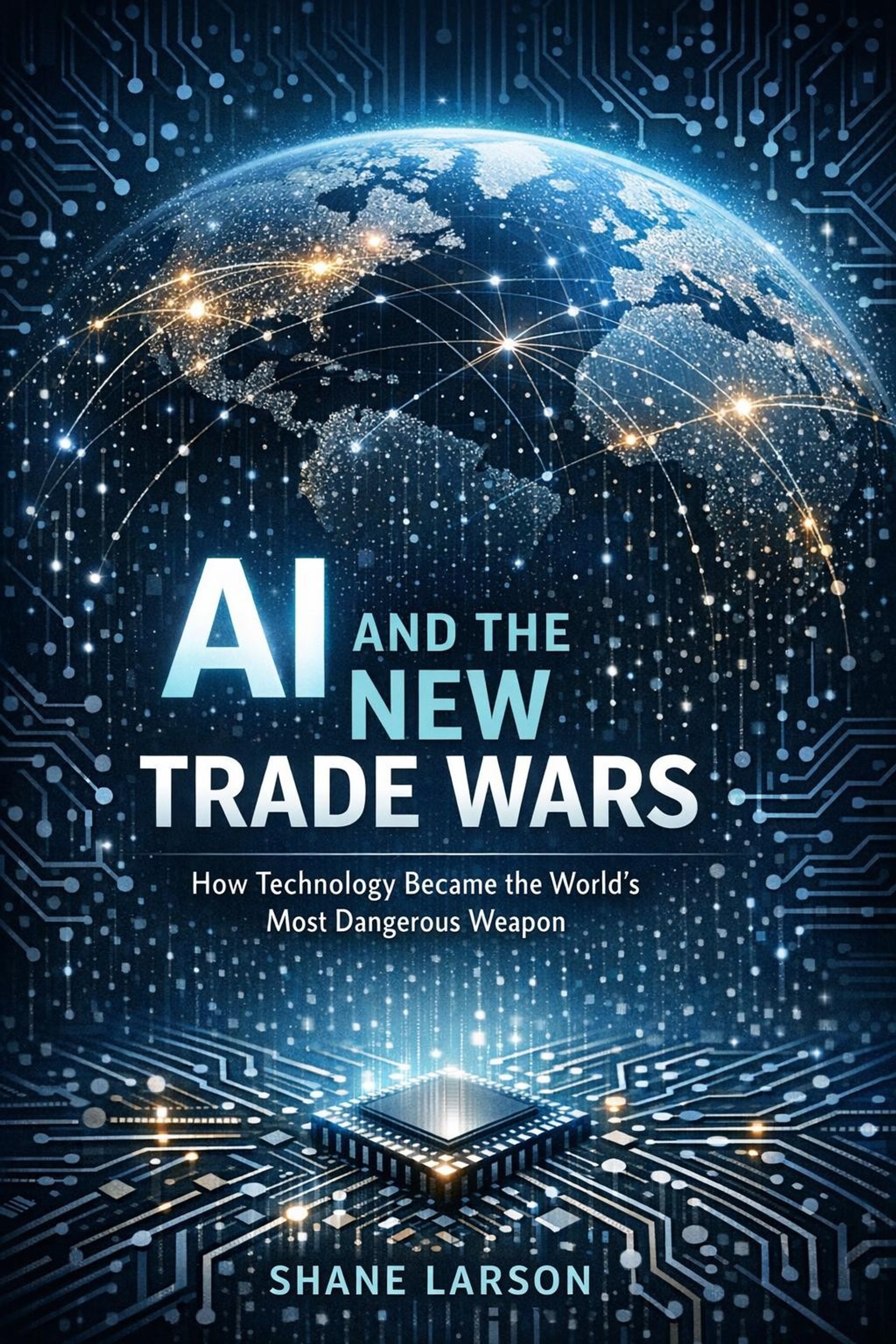
AI and the New Trade Wars
Materials. Underneath all of it sits a physical bottleneck: rare-earth elements and other critical minerals, concentrated in a few places, with refining capacity concentrated in even fewer. Most companies that depend on these inputs have never mapped where they actually come from. That is a planning failure waiting to surface.
Layer these together—chips, talent, data, standards, materials—and a pattern emerges. Each is a place where a small number of actors hold outsized influence, and each has therefore become a lever in a larger contest. The book walks through all of them, plus the regulatory strategies of the major players, the rise of parallel technology ecosystems, and where the rest of the world fits in a contest it didn't choose.
A deliberately non-partisan lens
Here's what I want to be clear about, because the subject invites it: this is not a book that picks a side, predicts collapse, or assigns villains. The "weapon" in the subtitle refers to leverage, not literal warfare, and the analysis stays even-handed by design. Different countries are pursuing rational strategies given their positions. Understanding those strategies—rather than cheering or condemning them—is what lets you plan.
That matters because the audience I wrote for is practical. If you lead strategy, operations, supply chains, or product at almost any company touched by technology (which is now almost any company), the fragmentation of the technology world is not a geopolitical curiosity. It's a planning input. Where you manufacture, where you store data, which standards you bet on, which suppliers you depend on, and which markets you can realistically serve are all now shaped by forces that used to sit safely in the "someone else's problem" column.
What to actually do about it
Analysis without application is just anxiety. So the back half of the book turns toward frameworks: how to map your own exposure to these chokepoints, how to build optionality into supply chains and data architecture without bankrupting yourself on redundancy, and how to read policy signals early enough to act rather than react.
It closes with three scenarios for the next decade—not predictions, but distinct futures worth preparing for. One where fragmentation deepens into two largely separate technology worlds. One where pragmatic interdependence reasserts itself. And one messy middle path that looks a lot like where we are now, extended and intensified. Each scenario implies different bets. The goal isn't to guess which arrives, but to build a strategy that survives more than one of them.
Where this fits
If you've read Chip War and wanted the connection to the broader AI story, or AI Superpowers and wanted the trade-and-supply-chain dimension drawn out, or The World Is Flat and wanted the sequel about a world that is decidedly un-flattening—this book sits in that conversation. It's also a natural companion to my earlier book on long-range forecasting, *The Next Ten Years*, for readers thinking seriously about the decade ahead.
The through-line of everything I write is the same: clear, plain-language analysis with no hype and no agenda. You can read more about my work and the rest of the catalog at shanelarson.com.
The AI revolution and the new trade wars are the same story. Once you see it that way, you can finally start planning for it.
AI and the New Trade Wars: How Technology Became the World's Most Dangerous Weapon is available now on Google Play Books, Apple Books, and Kobo.
AI and the New Trade Wars
New posts and releases, straight to your inbox. No spam, unsubscribe anytime.