Alexander the Great Died at 32 With No Succession Plan. What Happened Next Was Worse Than the Conquests.
April 1, 2026 · 11 min read
On June 10, 323 BC, Alexander III of Macedon died in the palace of Nebuchadnezzar in Babylon. He was thirty-two years old, having pushed his body to its limits through relentless campaigns that spanned from the Balkans to the Indus River. He had conquered two million square miles—an expanse that dwarfed the Persian Empire's holdings and stretched across diverse terrains, from the arid deserts of Iran to the fertile valleys of Egypt and the rugged mountains of Afghanistan—potentially subjugating fifty million people, a population larger than that of many modern nations at the time. And he had made zero provision for what would happen after he was gone, leaving behind a vast network of conquered lands held together by nothing more than his personal aura and the fear he inspired.
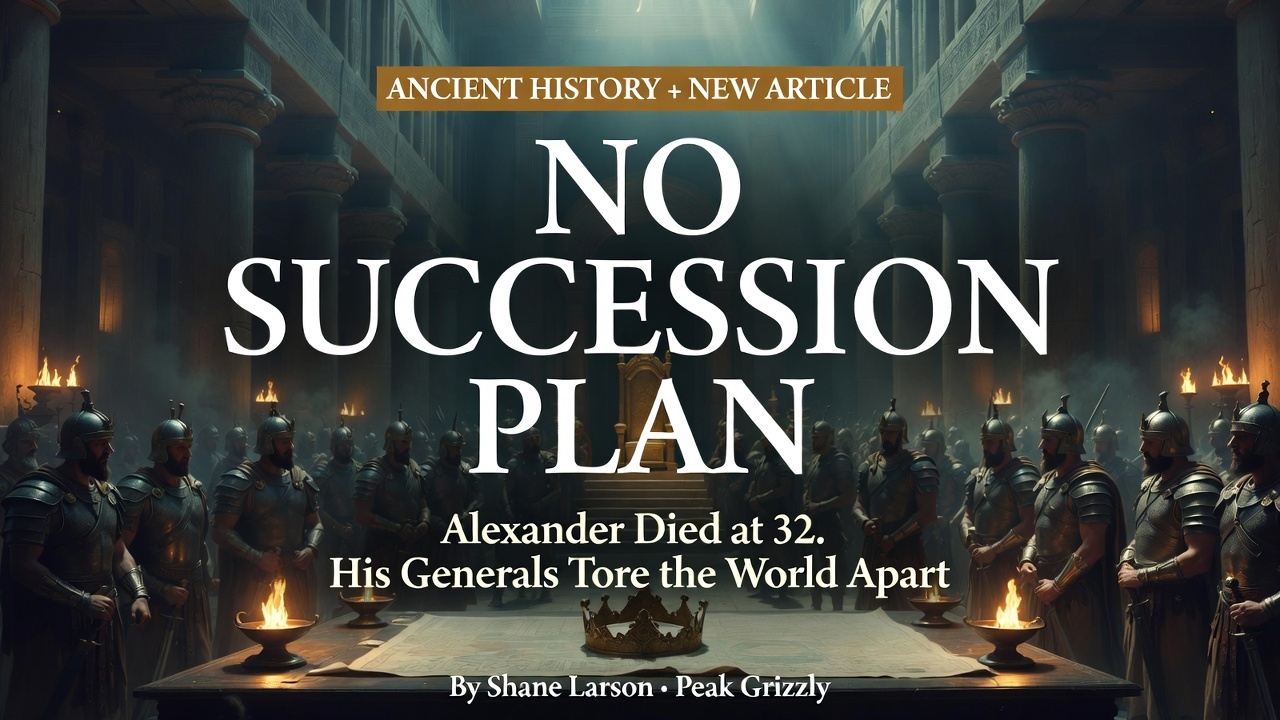
When asked on his deathbed who should inherit the empire, Alexander reportedly said one word: kratisto— "to the strongest." This cryptic response, whether truly uttered in his final delirium or later fabricated by ambitious generals seeking retroactive legitimacy, echoed the raw, Darwinian ethos of the Macedonian court, where power was seized, not inherited through formal lines. But the effect was the same. Within hours of his death, the most powerful men in the ancient world—the Diadochi, or "successors," a group of hardened veterans who had fought alongside him for years—were in a room in Babylon with weapons drawn, their alliances fracturing as quickly as the empire's unity, nearly killing each other over who got what and turning a funeral into a powder keg of betrayal.
The compromise they reached—historians call it the Babylon Settlement—was a masterpiece of creative ambiguity, a hastily cobbled agreement that papered over deep rivalries with vague promises and hollow titles. It installed two figureheads as co-kings: one was Arrhidaeus, Alexander's half-brother, who suffered from a mental disability that made him a pawn in others' hands, and the other was Alexander's unborn child, who would later be born as Alexander IV, an infant whose claim was as symbolic as it was precarious. A regent, Perdiccas, was given theoretical authority but lacked any real enforcement mechanism, such as a loyal standing army or administrative bureaucracy to back his decrees. Provinces were distributed to generals like Ptolemy, Seleucus, and Antipater, men who had no intention of taking orders from anyone, viewing their assignments as springboards for personal empires rather than parts of a whole.
As historian Robin Waterfield put it: "The settlement at Babylon was not a peace agreement. It was a temporary postponement of war, disguised as a distribution of power." He was right, as evidenced by the immediate skirmishes that erupted and the broader conflicts that followed, reshaping alliances and borders in ways that echoed the fragility of earlier Greek city-state pacts. What followed was forty years of warfare that reshaped the ancient world more profoundly than Alexander's conquests ever did, with battles that not only redrew maps but also scattered cultural influences, blending Greek, Persian, and local traditions in ways that birthed the Hellenistic era.
The Empire Was a Machine That Only One Man Could Operate
The core problem wasn't that Alexander's generals were incompetent or disloyal—they were brilliant, having honed their skills in the crucible of constant warfare, with some like Ptolemy rising from relative obscurity to command vast regions through cunning and battlefield prowess. Individually, they ranked among the most capable military and political operators in ancient history, their strategies influencing tactics for centuries. The problem was structural, rooted in Alexander's failure to institutionalize his rule beyond his own persona.
Alexander had spent thirteen years building the most spectacular personal empire in history—beginning with his invasion of the Persian Empire in 334 BC and culminating in his push into India—yet devoted zero time to building the institutions that might have sustained it, such as a centralized tax system or a network of governors bound by loyalty oaths. He conquered the Persian Empire but never replaced its administrative systems with anything more durable than his own charisma; for instance, he retained Persian satraps in key posts, relying on their local knowledge while expecting their allegiance, a gamble that worked only as long as he was alive to enforce it. The Macedonian monarchy had no written constitution, no formal council of succession as seen in some earlier Greek states like Sparta, and no established regency procedure, operating instead on the principle that kings ruled because they were strong enough to hold the throne—a system that had sufficed for a small kingdom in northern Greece but proved disastrous when applied to an empire spanning three continents, from the Mediterranean to the Himalayas.
This had worked tolerably well when the kingdom was a small territory in northern Greece, where personal bonds and tribal loyalties kept things stable amid occasional infighting. Applied to an empire spanning three continents, it was catastrophic, as the lack of infrastructure meant that supply lines collapsed, local rebellions flared up without a central authority to quell them, and the diverse populations—Persians, Egyptians, Bactrians—had no reason to remain loyal once Alexander's shadow lifted. Alexander had, in effect, built a machine that could only be operated by one man, a war engine fueled by his vision and terror; when that man died, the machine did not stop—it exploded, splintering into chaotic pieces that his successors scrambled to claim.
The army itself was the first problem, a force that had marched over 20,000 miles under Alexander's command, from the Granicus River to the Hydaspes, but without him, it was not a unified force but a collection of private armies, each tied to its general through years of shared victories and spoils. Each general commanded troops whose loyalty was personal—men he had trained in the phalanx formations that Alexander perfected, led in battles against overwhelming odds, and rewarded with gold from plundered treasuries—making the army more like a federation of warbands than a cohesive institution. The Babylon Settlement distributed provinces, but it also distributed the military power that went with them, turning satraps into warlords; for example, Antipater in Europe controlled Macedonian levies that were battle-hardened from earlier conflicts, while others like Lysimachus in Thrace wielded Thracian auxiliaries loyal only to him. Every satrap was, in effect, being given an independent army, a setup that invited defiance.
The first serious violence came within a year, as tensions boiled over in a series of opportunistic grabs that tested the settlement's weaknesses. Ptolemy, the satrap of Egypt, intercepted Alexander's funeral procession—which was en route to Macedonia with an elaborate cortege of soldiers and priests—and stole the corpse, a bold move that exploited the chaos of the moment. He diverted it to Alexandria, where he would install it in a magnificent tomb, turning the city into a pilgrimage site that bolstered his rule and symbolized his claim to legitimacy. It was a breathtaking act of political theater, especially in a world where relics like Alexander's body represented divine favor; by stealing it, Ptolemy was announcing that Egypt was not a province of anyone's regency but an independent kingdom, complete with its own cults and coinage bearing Alexander's image, and setting a precedent for how symbols could be weaponized in power struggles.
The other satraps watched, calculating their own risks; for instance, if Perdiccas, the regent, couldn't protect the procession, how could he enforce decrees in distant lands? If Ptolemy could defy the regent and get away with it, so could they, leading to a domino effect of insubordination that unraveled the settlement entirely.
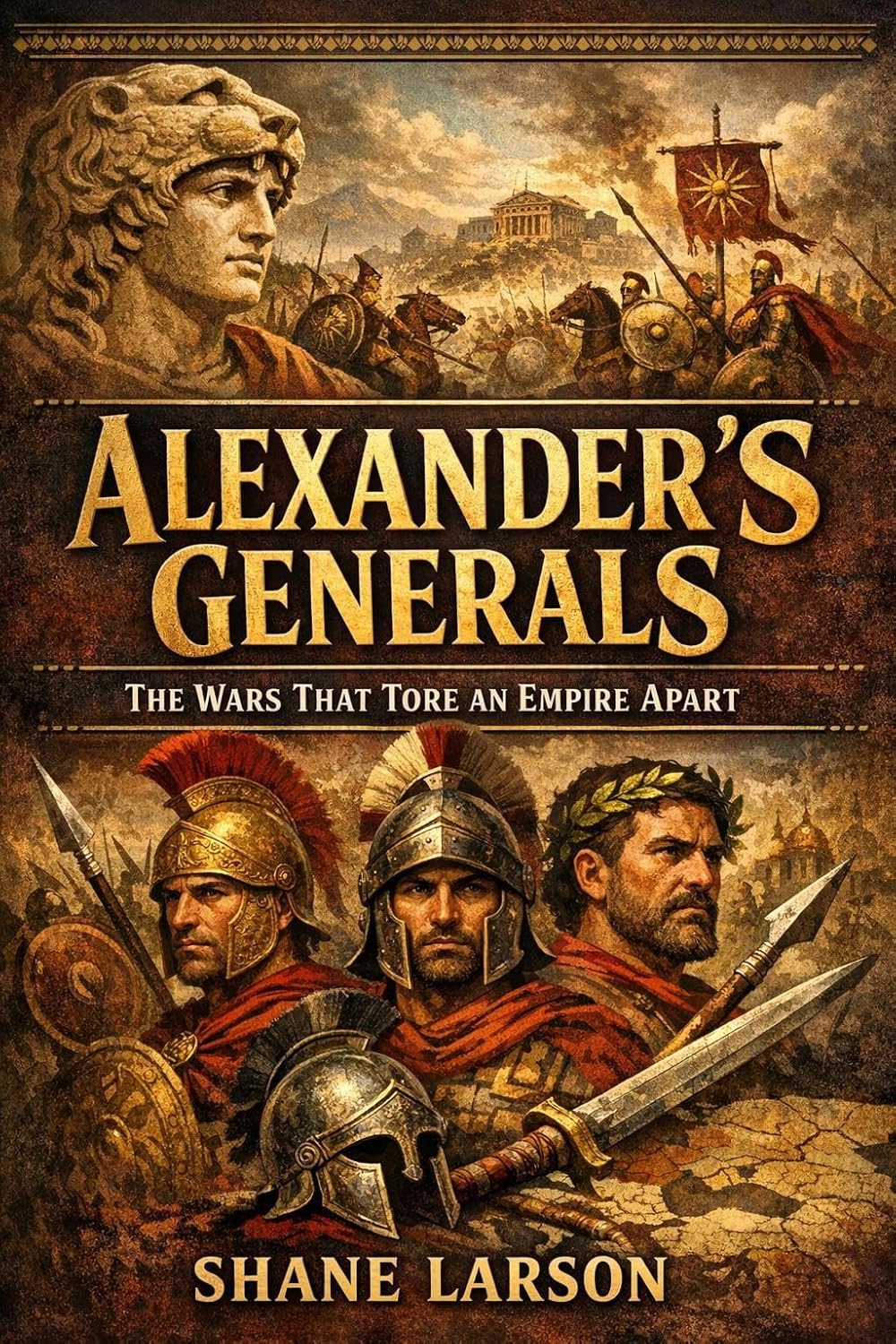
Alexander's Generals
Antigonus One-Eye: The 81-Year-Old Who Almost Reunified Everything
The most spectacular figure of the Successor wars was Antigonus Monophthalmus—Antigonus "One-Eye." He was already in his sixties when Alexander died, a veteran of decades of skirmishes dating back to the conquest of Asia Minor, and he had lost an eye early in his military career during a siege in Cilicia, fighting on with unyielding grit for over fifty years. And he was the last man who genuinely believed he could hold Alexander's empire together, drawing on his experience as a governor to envision a restored whole rather than fragmented parts.
While the other Diadochi were cavalrymen and battlefield commanders, Antigonus had spent over a decade governing a large, complex province like Phrygia, managing everything from grain supplies to border defenses, which gave him a rare grasp of the logistical challenges that Alexander had ignored. He understood administration, logistics, and the practical mechanics of holding territory, such as maintaining roads and forts to secure trade routes; when the dust settled from the first round of wars, Antigonus controlled most of Alexander's Asian territories, including key cities like Sardis and the treasury of Susa, which held millions in gold bullion from Persian hoards, and the largest army in the post-Alexander world, numbering tens of thousands of infantry and cavalry.
He began to act like it, issuing orders to other satraps and demanding financial accountings to centralize resources, a move that recalled earlier imperial administrators but clashed with the Diadochi's growing independence. When Seleucus, the satrap of Babylon, refused to submit and fled to Egypt with a handful of followers in 316 BC—leaving behind his province's archives and garrisons—Antigonus pursued him relentlessly, seeing it as a direct threat to his vision. (Seleucus would eventually return and build the largest successor kingdom from nothing, founding the Seleucid Empire that stretched from Syria to Bactria, but in 315 BC, he was a fugitive, relying on alliances and the very administrative skills Antigonus prized.)
Antigonus's response to the coalition that formed against him was a masterstroke of propaganda, as he proclaimed the freedom and autonomy of all Greek cities—a policy that played on the ideals of democracy from Athens' golden age while masking his own ambitions. It was cynical, since Antigonus had no intention of allowing genuine independence, as his garrisons in key ports demonstrated; but every other Diadochi immediately copied the strategy, turning it into a bidding war for Greek loyalty that accidentally established a political principle—Greek civic autonomy within larger kingdoms—that persisted for centuries, influencing everything from city charters to alliances against Rome.
The showdown came at the Battle of Ipsus in 301 BC, a clash in the heart of Anatolia that pitted Antigonus's forces against a multinational alliance, with the landscape dotted by hills that funneled troops into kill zones. Antigonus, now eighty-one years old and still commanding from the front lines, faced the combined forces of every other major power in the Hellenistic world, including Lysimachus and Cassander. He had his army, hardened by years of campaigns, and his son Demetrius, one of the most brilliant tactical commanders of the age, whose innovative use of siege engines had won previous victories. What he did not have was the weapon Seleucus brought from the east: five hundred war elephants, massive beasts imported from India that could trample formations and sow panic, giving his enemies a decisive edge in mobility.
The elephants screened off Demetrius's cavalry after they won their wing, preventing them from wheeling back to aid the infantry in a maneuver that exposed Antigonus's center, and leaving the old general surrounded amid the dust and chaos. Antigonus was left exposed, outnumbered, and surrounded, yet he refused to leave the field, his one eye scanning the battlefield as he fought on, a testament to the warrior ethos that defined his generation. He died fighting, at eighty-one, because he could not conceive of doing anything else, his body found amid the fallen, symbolizing the end of an era.
Ipsus settled the question permanently, as the defeat scattered Antigonus's territories and forced a new division of spoils, ensuring Alexander's empire would not be reunified. The successor kingdoms—Ptolemaic Egypt, the Seleucid Empire, Antigonid Macedonia—became the political geography of the ancient world for the next three centuries, their rivalries fostering cultural exchanges like the spread of Greek philosophy to the East, until Rome absorbed them all in the 2nd century BC.
Why This Story Matters
The wars of the Diadochi are the most consequential historical episode that almost nobody knows about, overshadowed by Alexander's dramatic conquests yet far more influential in shaping everyday life, from trade networks to religious practices. Alexander's conquests are among the most famous stories in history, celebrated in texts like Plutarch's Lives for their audacity, but what happened immediately afterward—which determined the actual shape of the ancient world, from the establishment of Alexandria as a learning center to the diffusion of Hellenistic art—is treated as an afterthought, if it's mentioned at all, perhaps because it lacks the heroic narrative of a single protagonist.
The reason matters beyond historical curiosity, as the Successor wars serve as a case study in what happens when a brilliant founder builds something extraordinary on the foundation of personal charisma and fails to create the institutional structures to sustain it, a pattern that echoes in the fall of other empires like that of Genghis Khan. For example, just as Alexander's neglect led to fragmentation, modern corporations or nations often crumble when reliant on a charismatic leader; the pattern repeats across centuries and contexts: empires, companies, movements that depended on one person's vision and energy, then shattered when that person was gone, as seen in the rapid decline of some tech startups after their founders depart.
Alexander could have designated a successor, perhaps by grooming a trusted general or establishing a council as the Romans later did with their Senate. He could have built administrative systems, like codifying laws or creating a treasury bureau, drawing from Persian models he encountered. He could have done what Ptolemy would later do in Egypt—create institutions durable enough to outlast any individual, such as the Library of Alexandria that preserved knowledge for generations. He chose not to, perhaps blinded by his own invincibility after victories like Gaugamela, and fifty million people paid the price, enduring decades of instability, famine, and cultural upheaval.
The Diadochi themselves offer a range of strategic archetypes that still resonate, each representing a different approach to power vacuums. Ptolemy the pragmatist, who took the defensible prize of Egypt with its Nile-fueled economy and held it for three centuries by focusing on defense and cultural integration, blending Greek and Egyptian traditions. Antigonus the maximalist, who went for everything—risking overextension in his quest to reunite the empire—and lost it all at eighty-one, a cautionary tale for leaders who prioritize ambition over sustainability. Seleucus the opportunist, who rebuilt from nothing when the moment was right, leveraging alliances and eastern resources to create a vast domain that controlled key Silk Road routes. Cassander the operator, who murdered an entire royal family to secure his throne—eliminating Alexander's mother and son in a bid for legitimacy—and then watched his own family collapse within a generation, as internal betrayals mirrored the very chaos he sought to end.
These aren't just ancient personalities; they're strategic templates that play out whenever power is contested and institutions are weak, from boardroom coups to revolutionary movements, reminding us that without solid foundations, even the greatest achievements can unravel.
Alexander's Generals is available now on Amazon Kindle. Alexander's Generals
Alexander's Generals
New posts and releases, straight to your inbox. No spam, unsubscribe anytime.