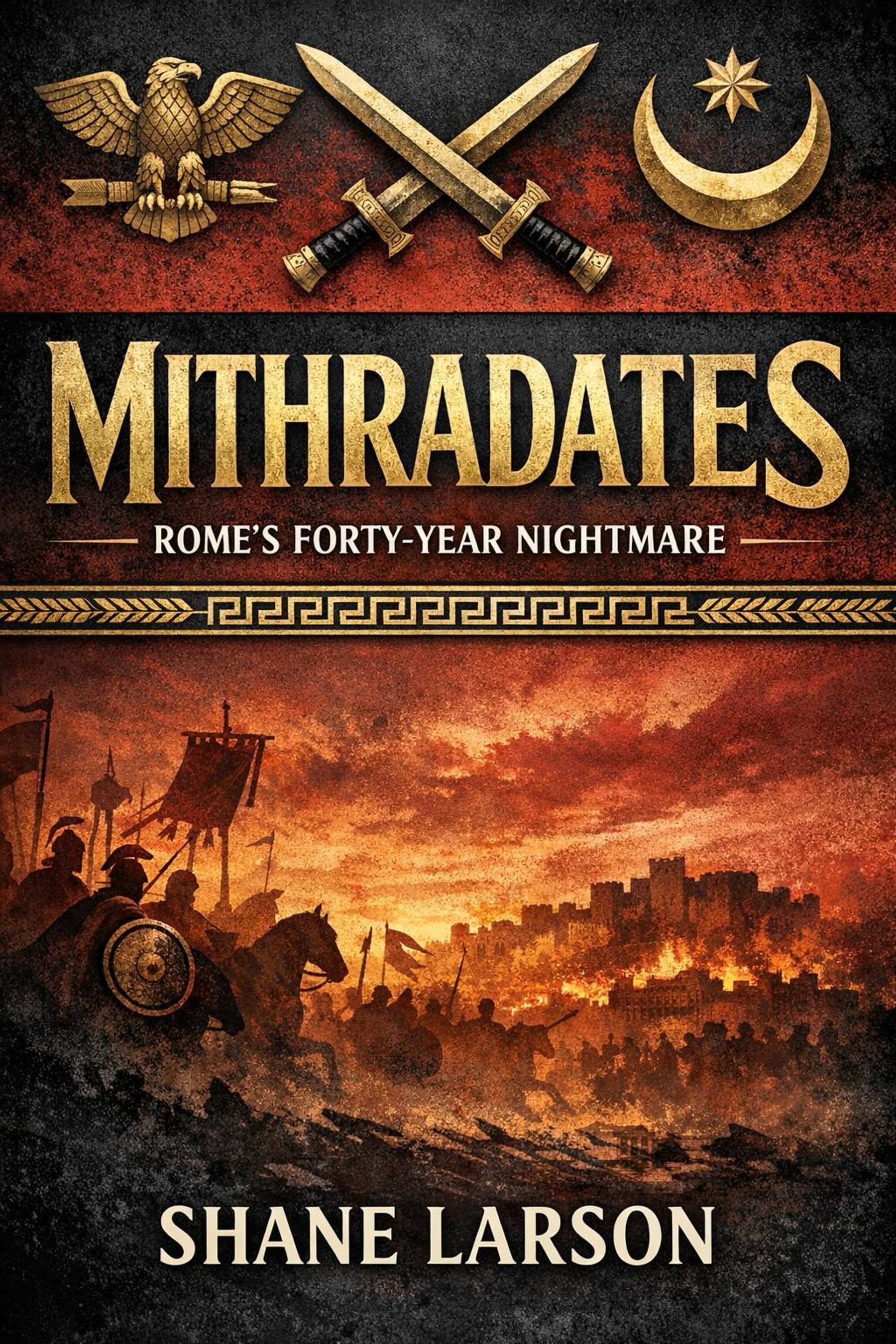
Mithradates
Rome's Forty-Year Nightmare
By Shane Larson
About This Book
Picture a scene in March of 63 BCE. A man in his late sixties is standing in a tower in the citadel of Panticapaeum, the Greek city on the Crimean side of the strait that connects the Black Sea to the Sea of Azov. His own son has just declared for Rome. The garrison has gone over. Below the tower, the new regime is already moving in. The man has spent his entire adult life — and most of his childhood — taking small daily doses of poison to make his body immune to assassination. It worked. He has just tried to kill himself by drinking what should have been a lethal dose, and nothing has happened. He has to call in his Gallic bodyguard and ask the man to run him through with a sword.
This is how Mithradates VI Eupator, king of Pontus, dies. He has been at war with Rome, on and off, for forty years. He has fought three of Rome's greatest generals — Sulla, Lucullus, and Pompey — and outlasted two of them in the field. He has commanded armies in Anatolia, mainland Greece, the Caucasus, and the steppes north of the Black Sea. He has ordered the largest coordinated massacre of Romans in the entire history of the Republic. He has been one of the central figures of his age, and within two thousand years he will be almost forgotten outside of graduate seminars in classical history.
This book is the recovery operation.
The Argument
The standard story of how the Roman Republic fell runs through familiar names: the Gracchi, Marius, Sulla, the slave revolts, Caesar, Pompey, the Rubicon, the Ides of March, Actium. The eastern wars sit in the margins of that narrative — a backdrop against which the real action happens in Italy and Gaul. Mithradates: Rome's Forty-Year Nightmare argues that the margin is the main event. The wars Mithradates forced on Rome between 89 and 63 BCE are what broke the Republic open. Sulla marched on Rome the first time because the command against Mithradates was at stake. The political career of Pompey was built on finishing the war Sulla and Lucullus could not. The huge eastern fortunes that flooded back into Italian politics in the 60s and 50s — and warped them past the point of repair — were Pontic and Armenian gold. The Republic's last generation grew up in the long shadow of one man.
The book tells his life from the beginning. It opens in the Hellenistic Black Sea — a world Western readers tend to skip over, where Greek colonial cities sat on a coastline dominated by Iranian dynasts and steppe nomads, and where a Persian-descended royal house in Pontus had been quietly building power since Alexander's death. It tracks Mithradates through the family violence of his childhood, the seven years of mountain exile that produced both the poison-immunity legend and a king who understood the territory of his own kingdom better than anyone else alive. It covers the coup that brought him to the throne, the two decades he spent absorbing client kingdoms and building a Black Sea empire from the Crimea to the Caucasus, and the moment in 89 BCE when he decided that Rome — distracted, broke, and at war with its own Italian allies — could finally be challenged.
The narrative carries through all three Mithradatic Wars, the Asiatic Vespers, the sieges of Athens, the campaigns in Pontus and Armenia, and the final pursuit into the Crimea. It does not stop at the death. The last chapters trace the long afterlife of the man — the antidote that bore his name and was sold in European pharmacies for fifteen hundred years, the seventeenth-century French tragedy Racine wrote about him, the Mozart opera, and the slow modern recovery of the historical figure underneath.
What's Inside
- The Hellenistic Black Sea on the eve of Mithradates' birth — Greek cities, Iranian aristocrats, and steppe cavalry, and how the Pontic royal house positioned itself between them
- The poison childhood and the family politics that produced it, including the murder of his father and the seven-year exile in the mountains
- The coup against his mother and brother, the consolidation of the kingdom, and the absorption of the Crimean Bosporan kingdom into a Pontic Black Sea empire
- The Asiatic Vespers of 88 BCE in detail — how the coded letters were sent, why so many Greek cities complied, what Appian and Cassius Dio say about the death toll, and what the modern reassessments have done with those numbers
- The First Mithradatic War: Sulla's invasion of Greece, the sieges of Athens and the Piraeus, the battles at Chaeronea and Orchomenus, and the Treaty of Dardanus that ended a war neither side had won
- The strange interwar decade and the brief Second War under Murena
- The Third War: Lucullus's invasion of Pontus, the long campaign into Armenia against Tigranes the Great, the sieges of Cyzicus and Tigranocerta, and the mutiny that broke one of Rome's most capable commanders
- Pompey's appointment under the Lex Manilia, the final pursuit, and the eastern settlement that redrew the map of Roman power from Pontus to Judaea
- The flight to the Crimea, the revolt of Pharnaces, the failed suicide, and the body shipped back to Pompey at Amisus
- The Roman literary tradition — Appian, Plutarch, Cassius Dio, Cicero — and the long medieval and early modern afterlife of the mithridate antidote and the Mithradates legend
Why I Wrote This
I came to this story sideways. I had been reading around the late Republic for years — the standard Holland-and-Goldsworthy shelf — and kept noticing the same gap. Sulla marches on Rome in 88 BCE and the narrative treats it as a domestic political crisis, which it was. But the command Sulla and Marius were fighting over was the command against Mithradates, and the Asiatic Vespers had happened earlier that same year, and somehow none of the popular accounts I was reading would stop and explain who this Pontic king actually was or why he mattered enough to break Roman politics.
So I went looking. What I found was a figure who is genuinely first-rank — a polyglot, a soldier, an administrator, a strategist who outlasted two of the three Roman generals sent against him and was undone in the end mostly by his own son. He is not minor. He is not a footnote. He has been treated as one for reasons that have more to do with the Latin sources surviving better than the Greek ones, and with the long Western habit of reading Roman history from inside the Roman point of view. This book is my attempt to give him the standard biographical treatment the figure has always deserved, in the same accessible narrative register I use for the rest of the catalog.
Frequently Asked Questions
Do I need to know Roman history to follow this?
A general sense of where the late Republic sits in the timeline helps, but the book builds its own context. The Roman generals — Sulla, Lucullus, Pompey — are introduced as they appear, and their place in the larger Roman political story is explained in the prose. Readers who have read general histories of Rome will see how the eastern wars fit into the narrative they already know. Readers who haven't will pick up everything they need.
Is this a military history or a biography?
Both. The structure is biographical — birth, exile, accession, reign, wars, death, afterlife — but the three wars take up roughly half the book, and the campaigns are described in enough operational detail for readers who want to follow what actually happened on the ground. Battles, sieges, and logistics get real attention. So do the political maneuvers in Rome that shaped which general was sent and when.
How does this compare to Adrienne Mayor's The Poison King?
Mayor's 2010 book is the standard modern academic biography in English and is excellent. Rome's Forty-Year Nightmare is shorter, more narrative-driven, and weighted somewhat more toward the Roman political consequences and the eastern campaigns. Mayor goes deeper on the cultural and religious world of Pontus. They complement each other; this is the accessible entry point.
What sources does it draw on?
The principal ancient sources are Appian's Mithradatic Wars, Plutarch's Lives of Sulla, Lucullus, and Pompey, Cassius Dio, Memnon of Heraclea (in fragments), and references in Cicero. Modern scholarship by B.C. McGing, Brian McGing, Adrienne Mayor, and others is reflected throughout. The book is written for general readers, not scholars, so the citation apparatus is light, but the underlying source work is current.
Is it part of a series?
It stands alone. It also fits naturally next to several other Peak Grizzly titles on the late Republic and the Hellenistic east — see the related reading below.
Is it on Kindle Unlimited?
Yes. The ebook is in Kindle Unlimited at launch.
If You Liked This, You Might Like
- Hannibal's War — the other great forty-year struggle Rome fought, against an enemy who also nearly broke them and is now better remembered than Mithradates ever was
- The Persian Empire — the dynastic and cultural ancestor that Mithradates claimed descent from and modeled his kingship on
- Alexander's Generals — the Hellenistic world that produced Pontus and the dynasties Mithradates inherited, allied with, and fought
- The Fall of Rome — the long structural decline that begins, in the argument of this book, with the eastern wars and the civil wars they triggered
Closing
He was Rome's longest-running foreign enemy. He helped end the Republic without ever setting foot in Italy. He has been almost invisible in the popular history of his own age for two thousand years. Mithradates: Rome's Forty-Year Nightmare is the full-length narrative biography that the figure has always warranted — accessible, current with the scholarship, and unwilling to treat the eastern Mediterranean as a backdrop.
Included with Kindle Unlimited — read it free if you're a member.
New Ancient History releases and free chapters — no spam, unsubscribe anytime.