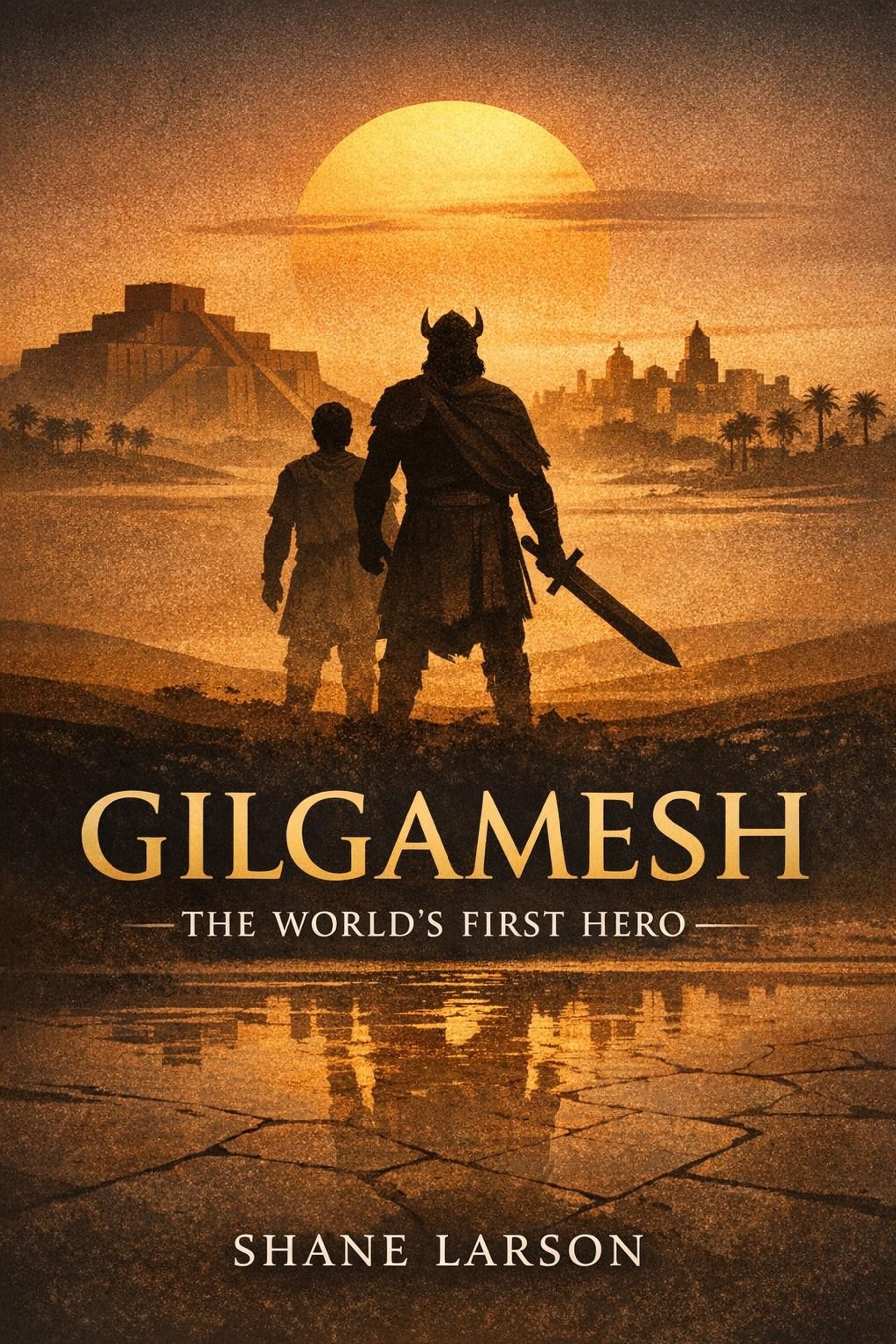
Gilgamesh
The World's First Hero
By Shane Larson · The Bronze Age Collapse Chronicles (Book 8)
About This Book
A self-taught engraver from Chelsea picked up a broken piece of clay in the basement of the British Museum, in the late autumn of 1872, and recognized a word he should not have been able to read. The word was flood. The clay was thirty centuries old. By the time he finished translating the fragment, he had to step outside and walk the corridor to compose himself, because what he was holding was not a Babylonian copy of Genesis. It was older than Genesis. It was the source.
His name was George Smith, and on December 3rd of that year he stood up in a London hall — the Prime Minister of Great Britain in the audience — and read aloud from Tablet XI of the Epic of Gilgamesh. It was the first time the world's oldest substantial work of literature had been heard in any living language since the temples of Mesopotamia fell silent.
This book is about the king who became its hero, the four-thousand-year transmission that preserved his story, and the strange chain of accidents — a burning library, a basement of forgotten tablets, a Victorian newspaper expedition — that put the poem back into our hands.
The Story
The historical Gilgamesh was real. A Bronze Age king named Bilgames who ruled the Sumerian city of Uruk around 2700 BCE, his name appears on the Sumerian King List with a reign improbably long but a place in history that is concrete enough. Uruk's walls — the same walls the closing lines of the epic ask the reader to admire — still rise out of the Iraqi desert near the modern town of Warka.
The poem about him grew slowly. First came five separate Sumerian compositions about Bilgames and his deeds, performed at courts in the third millennium. Then, sometime after 1900 BCE, a Babylonian poet pulled the threads together into a single Akkadian epic that opened with the line Surpassing all other kings. Five centuries later, around 1200 BCE, a scholar-priest named Sîn-lēqi-unninni produced the version that became canonical — twelve clay tablets, copied into temple libraries across the Near East for the next thousand years. Sîn-lēqi-unninni is the first author in human history whose name we still attach to a work of literature. Homer is a guess. Sîn-lēqi-unninni is a colophon.
The story he gave us is the source code of nearly every narrative tradition that followed. A wild man raised among animals, civilized by a woman. A friendship between two equals that drives the whole plot. A quest into a forbidden forest. A monster killed. A goddess scorned. A divine bull slain. The death of the friend, and the king's collapse into grief — the first sustained literary meditation on mortality in the human record. The journey across the Waters of Death to find the one man who survived the flood. And the homecoming, with its devastating closing image: a broken king staring at the walls of his city, finally understanding that the work he built is the only immortality available to anyone.
The recovery story is almost as remarkable. The library of King Ashurbanipal at Nineveh — the largest collection of cuneiform tablets ever assembled — burned in 612 BCE when a coalition of Medes and Babylonians sacked the city. The fire that destroyed the library also fired its tablets harder, baking them into something close to permanence. Two thousand five hundred years later, when Henry Layard and Hormuzd Rassam dug into the mound of Kuyunjik, what they pulled out by the cartload was preserved precisely because the city had burned. Tens of thousands of tablets were shipped to the British Museum and left in storage. Most of them are still being read for the first time today. George Smith was one of the first people to look at them carefully. The afternoon he picked up the right fragment is one of the great accidents of nineteenth-century scholarship.
What's Inside
- The fourth-millennium world that produced Uruk — the rise of the first cities, the invention of writing, the agricultural surplus that made literacy possible, and the political theology that made kings into something more than chieftains
- What we can responsibly say about the historical Bilgames, separating the king from the legend without dismissing either
- The five Sumerian Bilgames poems — Bilgames and Huwawa, Bilgames and the Bull of Heaven, Bilgames and Akka, The Death of Bilgames, Bilgames, Enkidu and the Netherworld — and what they tell us about the oral tradition behind the epic
- The Old Babylonian Surpassing All Other Kings and the long process of editing that produced the Standard Babylonian Version
- A tablet-by-tablet reading of the epic itself, in plain English: Enkidu's civilization, the cedar forest, the killing of Humbaba, the Bull of Heaven, the death scene, the quest, the Waters of Death, Utnapishtim, the plant of youth, and the return
- The flood narrative on Tablet XI in detail — what it shares with Genesis, what it doesn't, and the careful scholarly conversation about the relationship between the two
- The nineteenth-century recovery — Layard at Nimrud, Rassam at Kuyunjik, the British Museum basement, George Smith's afternoon, and the Daily Telegraph expedition that funded the search for the missing tablets
- The modern reception of the epic, from N. K. Sandars's 1960 Penguin paperback that introduced Gilgamesh to a popular English-speaking audience, through Andrew George's definitive 2003 critical edition
Why I Wrote This
I have been writing about the ancient Near East for years, and Gilgamesh has been the gravitational center of every one of those books — the thing they kept circling back toward. Twilight of the Ziggurats is about the world that produced the poem. Sargon: Rise of Akkad is about the empire that inherited it. The Bronze Age World is about the civilization that copied it across two thousand miles. I kept writing toward Gilgamesh and never quite landing on it.
The reason, honestly, was that I was intimidated. The poem deserves better than a chapter, and a whole book on it requires getting the king, the recovery, and the close reading all into one volume without any of them feeling like filler. I read Andrew George's edition cover to cover, then read it again, before I felt I had any right to write this book.
What I wanted, in the end, was the version I wished had existed when I first read the epic in college and did not understand half of what I was reading. Not a translation — Andrew George already wrote the translation. A guide. The book that explains why it matters, how it survived, and what it sounds like when you actually sit down with it.
Frequently Asked Questions
Do I need to read the Epic of Gilgamesh first?
No. The book is built to work for a reader who has never opened a translation, and also for a reader who has read Sandars or George multiple times. The close-reading section walks through the whole epic in order with enough detail that you'll come away knowing the story; if you want to read the actual poem afterward, Andrew George's Penguin edition is the recommended starting point.
Is this a translation of the epic?
It is not. Translating Gilgamesh is its own decade-long project, and the existing translations by Andrew George, Benjamin Foster, and Stephen Mitchell are excellent. This book is a guide to the epic — the history behind it, the readings of its key scenes, and the recovery story.
How does this book treat the connection between Gilgamesh and the Bible?
Carefully. The flood narrative on Tablet XI predates the Genesis flood account by at least a thousand years and shares specific details — the warning from a god, the boat, the animals, the mountaintop, the bird sent out to find dry land. The book walks through the parallels honestly and explains the scholarly consensus about the relationship between the two traditions without overclaiming or dismissing.
What other books of mine does this connect to?
It is the keystone of the Mesopotamian thread. Twilight of the Ziggurats is the political-economic background. Sargon: Rise of Akkad covers the empire that came after Uruk's pre-eminence. Rise of the Cup Bearer is set in the same general world. The Bronze Age World is the wide-angle view of the civilization in which Gilgamesh was copied and transmitted.
How long is the book?
Standard length for the catalog — long enough to do the king, the poem, the close reading, and the recovery story justice without padding. Most readers finish it in two or three sittings.
Is this on Kindle Unlimited?
Yes. The ebook is enrolled in Kindle Unlimited at launch. Print and audiobook editions are in production.
If You Liked This, You Might Like
- Twilight of the Ziggurats — the long unraveling of Sumerian civilization that produced the world Gilgamesh ruled.
- Sargon: Rise of Akkad — the empire that inherited Uruk's literary tradition and carried it across the Near East.
- The Bronze Age World — the wider civilization in which the Standard Babylonian Version of the epic was copied, taught, and preserved.
- Rise of the Cup Bearer — a different angle on the same Mesopotamian world, focused on the court rather than the king.
Closing
The library that preserved the poem burned in 612 BCE. The fire fired the tablets harder. Twenty-five hundred years later, a self-taught engraver in a London basement read the world's oldest story aloud to a hall of Victorian gentlemen, and the longest silence in literary history ended.
This is the book about how that happened, and what he was reading.
Part of the Mesopotamian thread of the Peak Grizzly catalog.
Included with Kindle Unlimited — read it free if you're a member.
New Ancient History releases and free chapters — no spam, unsubscribe anytime.
More in The Bronze Age Collapse Chronicles
View series →