America Was Paying for the Vietnam War Eleven Years Before the Marines Landed
September 27, 2026 · 7 min read
On 6 May 1954, a C-119 cargo plane crossed the rim of a valley in northwestern Vietnam carrying artillery shells for a French garrison that had one day left to live. The pilot was an American civilian named James B. McGovern Jr., known across half of Asia as Earthquake McGoon, flying under contract for a CIA-owned airline because the French air force no longer had enough crews to make the run. Anti-aircraft fire caught the aircraft on its approach. McGovern held it in the air long enough to clear the valley, and he and his co-pilot, Wallace Buford, died when it went into a hillside in Laos.
By any straightforward accounting, they were among the first Americans killed in combat in the Vietnam War. It was eleven years before the Marines landed at Da Nang.
Most Americans date their country's war in Vietnam from 1965, when the combat battalions arrived; or from 1964 and the Tonkin Gulf; or, if they have read a little, from the advisors of the Kennedy years. All three dates miss the same thing. By 1954, the United States was paying roughly three-quarters of the cost of the French war in Indochina — the Pentagon Papers' own accounting puts it at 78 percent in the war's final year — while spending nine years declining to call the war its own. The shells McGovern died delivering were American shells. So were most of the aircraft, the trucks, and a large share of the francs that paid the garrison below.
The American war did not begin. It was inherited. And the estate had been accumulating for a decade.
The check Washington wrote
The paperwork starts in 1950. In January of that year, newly communist China recognized Ho Chi Minh's Democratic Republic of Vietnam and began arming it. In February, the United States recognized the rival French-sponsored State of Vietnam under the former emperor Bao Dai. In May — six weeks before the Korean War began — Washington approved its first package of military aid for the French effort. Korea then did what Korea did to every Cold War budget line: the aid grew, year over year, until the United States was carrying most of a war being fought under someone else's flag.
The logic behind the money was made explicit at the top. On 7 April 1954, with the garrison at Dien Bien Phu already under siege, President Eisenhower stood before the press and described what he called the falling domino principle: knock over the first in a row of dominoes, and the last will go over with great certainty and great speed. Behind that image stood a domestic political fact that would constrain every administration for the next twenty years. The fall of China in 1949 had produced a poisonous and durable argument in American politics about who lost it, and no president from Truman onward could afford to be the one who lost the next country. That constraint had nothing to do with Vietnam itself. It governed American policy there anyway.
What the money could not buy was a way to win, and the reason for that had been settled years earlier — not on a battlefield, but in the rice villages of the north.
Rice and authority
In the winter of 1944–45, famine killed an enormous number of people in Tonkin and northern Annam. How enormous is genuinely unknown. The estimates run from several hundred thousand — the low end descends from French administrative figures — up to the two million that Ho Chi Minh himself declared in September 1945. The spread exists partly because no one was counting: two colonial administrations were collapsing at once, and the dead of a famine are not tallied the way the dead of a battle are. And it persists because every party to the subsequent argument has had a use for a particular number — a larger toll indicts the colonial administration, a smaller one defends it. Modern demographic scholarship tends toward a figure of a million or more, but the honest statement is a range, and serious histories give it as one.
A War Inherited
What is not contested is the mechanism. The French administration requisitioned rice at fixed prices below the market. Farmers had been compelled to convert paddy land to jute and other industrial crops for the Japanese war economy. Allied bombing had cut the rail and coastal shipping that moved surplus rice from the south to the chronically deficit north. Then two harvests failed. Each element was survivable alone; together they were not, and through the worst of it the French and Japanese administrations — running the colony jointly, Vichy France keeping the machinery while Japan held the guns — continued to argue over requisition quotas.
Into that gap moved the Viet Minh, the national front Ho had founded in 1941. In the spring of 1945 its cadres led villagers in breaking open rice granaries and distributing the stocks. As politics, the act was almost embarrassingly simple, and it worked precisely because of what it was set against: one authority in the countryside was taking rice out of villages while people starved, and another was putting it back in. When the Japanese destroyed the French administration outright in a single night that March, and then surrendered in August, the Viet Minh took Hanoi against no serious opposition. On 2 September 1945, in front of a vast crowd, Ho declared Vietnamese independence in a speech that opened with words borrowed from Thomas Jefferson, with American intelligence officers in attendance.
This is the most under-told causal link in the entire story of Vietnam. The movement the United States would spend twenty years fighting did not build its rural authority on ideology. It built it on rice, in a famine, while the colonial power argued about quotas. Everything after — the failed negotiations of 1946, the shelling of Haiphong, nine years of war — was fought against a movement that had already won something no amount of American aid could purchase for the other side.
The valley and the table
The French war ended in a valley the French chose. The camp at Dien Bien Phu rested on specific, named assumptions: that the Viet Minh could not move heavy artillery through the mountains, could not supply an army corps in the remote highlands, and could not sustain a siege. All three were wrong. Vo Nguyen Giap's army moved its guns by hand, dug them into the reverse slopes overlooking the airstrip, and fed the siege with a porter corps tens of thousands strong. After fifty-six days, on 7 May 1954, the garrison surrendered — a Western army beaten decisively, in the open field, in front of the world's press.
The settlement was signed at Geneva that July, and it is the settlement, not the battle, that made the next war. The country was divided at the seventeenth parallel by a line the conference's own Final Declaration insisted was a military demarcation and not a political or territorial boundary, pending nationwide elections set for July 1956. The elections never happened. One side treated the line as a truce; the other, and its American sponsor, as a border. The United States declined to sign the accords — while undertaking not to disturb them — and then set about sustaining the new government in Saigon, headed by a newly appointed premier named Ngo Dinh Diem.
Consider what Washington now held. A southern government assembled by the French as an answer to a French problem, owing its existence to foreigners and needing legitimacy anyway. An opponent with a quarter-century of organizational depth and a proven ability to defeat a Western army. A partition that was provisional in its text and permanent in practice. And a domestic politics in which no administration could afford to lose a country. Every hard problem of the American war of the 1960s was already on the table in the summer of 1954 — before a single American combat unit had landed, and after four years in which America had quietly paid for most of the fighting.
No one at Geneva called it a handover. That is nevertheless what it was.
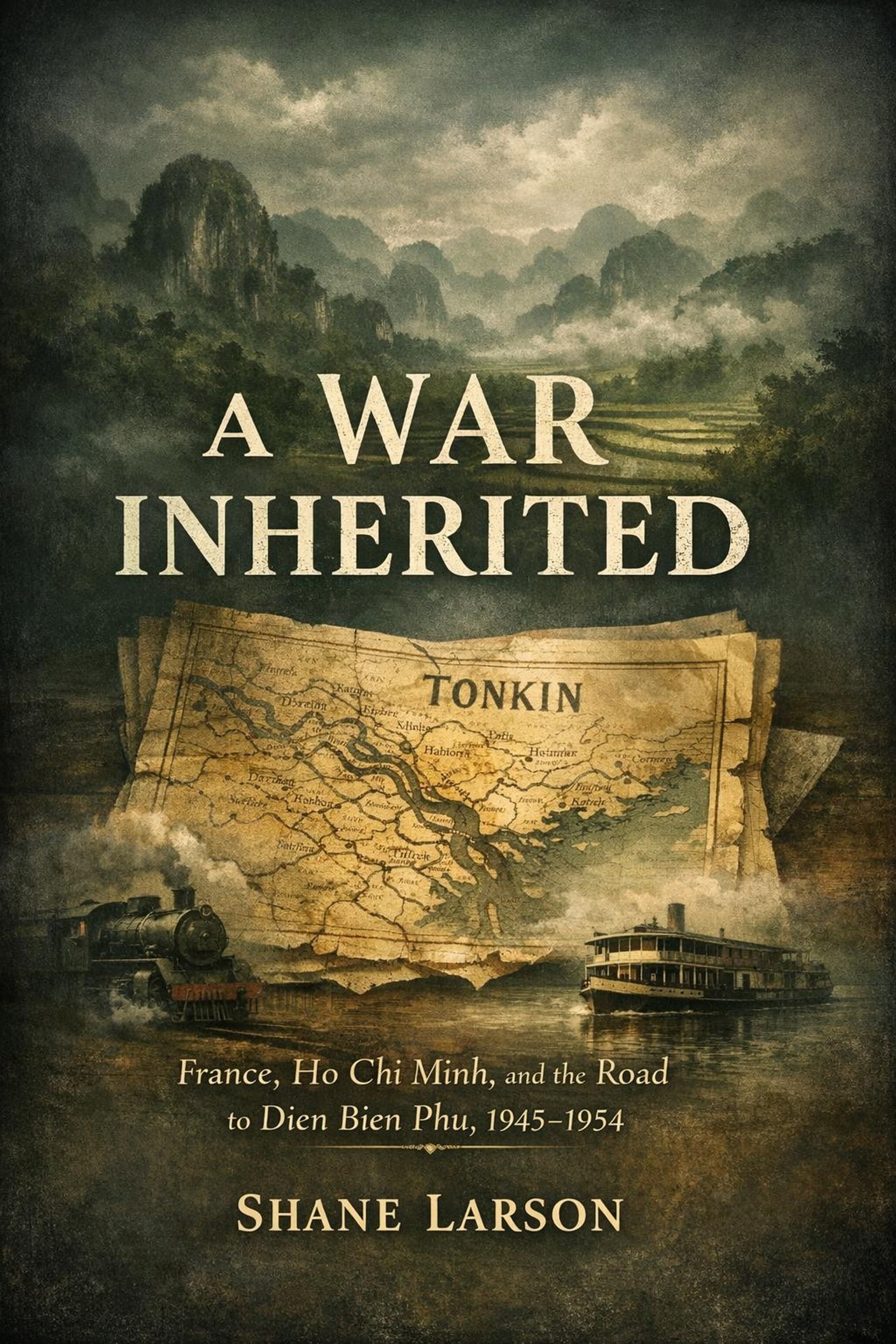
This article draws on the research behind A War Inherited: France, Ho Chi Minh, and the Road to Dien Bien Phu, 1945–1954, the first volume of The Vietnam War Chronicles from Peak Grizzly Publishing. The book covers the full decade — the double occupation, the famine, the August Revolution, and the nine-year war that followed — with every contested figure given as a range and a full chapter told from the Vietnamese side.
A War Inherited
New posts and releases, straight to your inbox. No spam, unsubscribe anytime.