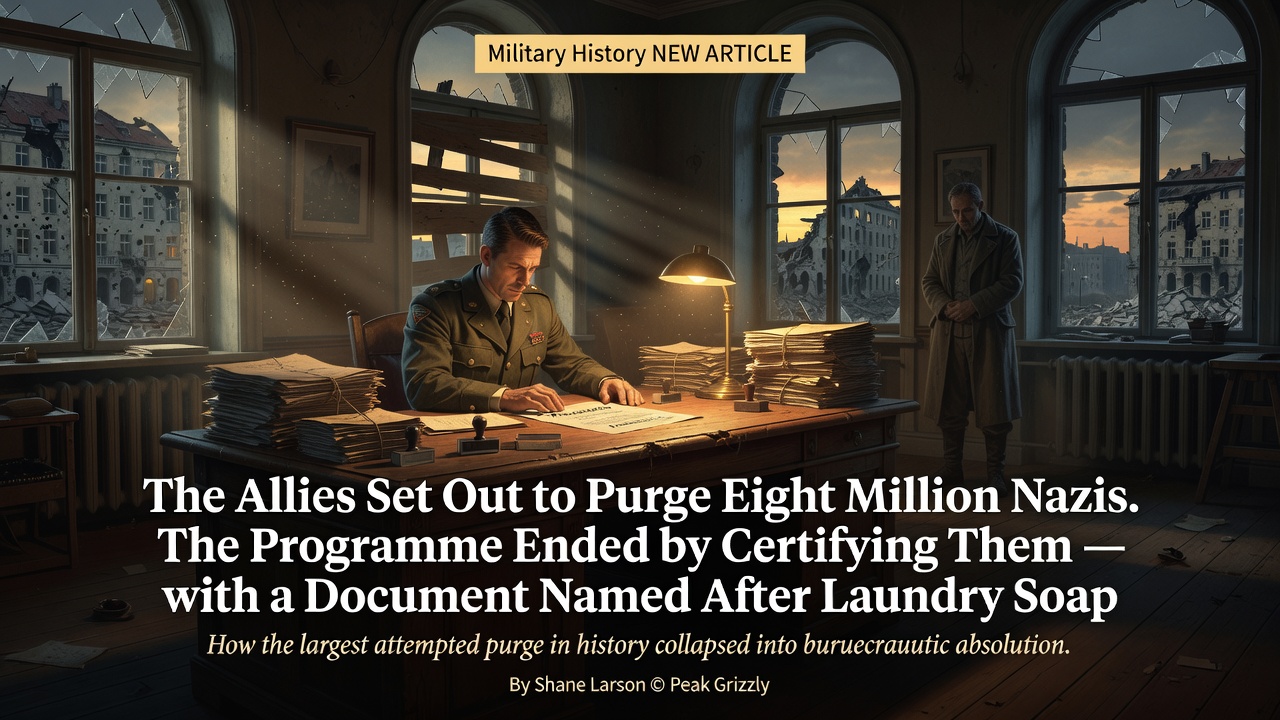
The Allies Set Out to Purge Eight Million Nazis. The Programme Ended by Certifying Them — with a Document Named After Laundry Soap
September 17, 2026 · 7 min read
In May 1945 the Allies took custody of a country whose ruling party had roughly eight million members. Not eight million war criminals — the party had absorbed teachers, postmen, engineers, clerks, and everyone whose career had required a membership card, alongside the men who had run the camps. But eight million people formally enrolled in the organisation the occupation existed to destroy, in a population of about sixty-five million, concentrated precisely in the professions that make a state function.
That is the arithmetic that killed denazification, and it was visible from the first week. A country with no food distribution, no coal, no trains, and forty per cent of its urban housing gone had to be administered starting immediately — and the people who knew how to administer it were, in very large proportion, the people the programme was designed to remove. You can purge a state or you can run it. The occupation of Germany is the great documented experiment in trying to do both at once, and the way it resolved is one of the most instructive institutional failures on record. It is worth telling properly, because it is almost never told as what it was: not a scandal, but a capacity problem that had to break somewhere, and did.
The questionnaire
The American instrument was the Fragebogen — a questionnaire of 131 questions covering party membership, its affiliated organisations, employment history, income, writings, even dueling scars. Every adult seeking employment or a ration-relevant position in the American zone filled one out, under penalty for false statements. More than thirteen million were eventually collected in the US zone alone.
On the basis of the answers, each respondent was to be sorted into one of five categories: major offenders, offenders, lesser offenders, followers — Mitläufer, the ones who went along — and the exonerated. The top categories faced prison, property confiscation, and permanent exclusion from public life; followers faced fines and restrictions; the exonerated walked free. On paper it was a rational triage. In practice it was a machine that required individualized justice at a scale no judicial system in history had attempted: millions of adjudications, each demanding evidence, in a country where the records were burned, scattered, or in another zone.
The caseload wins
The numbers did what numbers do. Of the thirteen million questionnaires in the American zone, roughly three and a half million people were found chargeable — a caseload that would have occupied the available tribunals for decades. So in March 1946 the Americans handed the whole apparatus to the Germans: the Law for Liberation from National Socialism and Militarism created German-staffed civilian tribunals, the Spruchkammern, to judge their own countrymen. It was presented as a step toward self-government, and it was also the only arithmetic that had any chance of closing the books.
It still didn't. The tribunals needed politically clean chairmen and investigators, and politically clean Germans with legal training were exactly what eight million party memberships had made scarce. Amnesties followed within months — first for the young, those born late enough to have been formed entirely inside the regime, then for low-income followers — removing millions of cases at a stroke. And as the Cold War hardened through 1947 and 1948, the occupation's priorities shifted visibly from purging western Germany to rebuilding it, and the instruction that filtered down was, in effect: finish.
The tribunals finished the only way they could — by grading almost everyone into the bottom categories. Of the millions initially chargeable in the American zone, the number ultimately classed in the top category of major offenders came to fewer than two thousand. The overwhelming majority of those actually tried were ruled followers or exonerated. A programme built to remove people had become a programme that processed them — and a processed person came out the other side holding an official document certifying that he was not what the paperwork of 1945 had suggested.
The Persilschein
Germans, who had watched the whole trajectory from below, named that document with some precision. The exculpatory affidavit — a statement from a pastor, a neighbour, a Jewish acquaintance if one could be found, attesting that the subject had been privately decent all along — became the Persilschein: the Persil certificate, after the laundry detergent. The document that washed a brown past white.
A market in them developed, naturally. Affidavits were traded, reciprocated, and in some cases simply sold. The joke was bitter and exact, and it needs no editorial help: when a certification system's output is worth more than its scrutiny, the certificates become the commodity and the scrutiny becomes the formality. By 1948 the tribunals were working through the most serious cases last — a scheduling inversion that meant the biggest fish were reached precisely when the will to prosecute had drained away — and by 1951 the new Federal Republic had legislated most of the remaining consequences out of existence.
The Ruins of Victory
Meanwhile, both superpowers were hiring
The programme's other solvent was applied from outside, and it is important to state it symmetrically, because the symmetry is the point.
While the tribunals were sorting postmen into categories, the United States was running Operation Paperclip: the recruitment of German scientists and engineers — more than sixteen hundred of them over the programme's life — for American military research, rocketry above all. Some of them had documented records that would have placed them well up the five-category scale; the dossiers of the most valuable were revised by the recruiting agency to make them admissible. Wernher von Braun, who had held SS rank and whose V-2 had been assembled by concentration-camp labour at Mittelbau-Dora, ended his career as an American national hero.
The Soviet Union did the same thing with less paperwork. In a single night in October 1946, Operation Osoaviakhim put some two thousand two hundred German specialists — with their families, several thousand more people — on trains east from the Soviet zone to work in Soviet aviation, rocketry, and nuclear programmes. They were not asked.
Neither superpower believed its own denazification rhetoric enough to outbid it. When the choice was between the principle of exclusion and a man who could shorten a missile programme by five years, the principle lost — in Washington and in Moscow, in the same years, for the same reasons. Any account of denazification's collapse that treats it as a purely German evasion has left out the two governments that ran the auction.
The accounting, in numbers
The honest verdict is delivered by the Federal Republic's own personnel rolls a decade later — and it was not hidden; much of it was done openly, by statute. A 1951 law implementing an article of the new constitution obliged the state to re-employ the career civil servants removed in 1945, excepting only the top categories. The results compounded. Official studies commissioned by the German government itself, published decades later, found that in the late 1950s roughly three-quarters of the senior officials of the Federal Justice Ministry were former party members, and that the postwar Foreign Office employed a higher proportion of former party members than it had during the Third Reich. Large majorities of the judges and prosecutors of the 1950s had served on the bench under the regime. The men the questionnaire was written to find were, by 1955, administering the state that had inherited the questionnaires.
What that meant is genuinely argued over, and the argument is worth stating fairly. One reading is straightforward failure: the guilty were recycled, and West Germany's serious reckoning with its past was postponed a full generation, until the 1960s forced it. Another reading, advanced by serious historians of the period, is more uncomfortable: that the amnesties and the quiet reintegration were the price of binding a compromised population into a functioning democracy — that a Federal Republic which had actually excluded eight million people and their families would have created a permanently aggrieved third of the electorate, and that the stability of postwar West German democracy was purchased, in part, with the Persilschein. Both readings fit the evidence. Neither is comfortable. The one position the record does not support is that there was an available policy that was both a real purge and a functioning state.
What it proves
Denazification is usually filed as hypocrisy, which is the least interesting thing about it. Read as an institutional story, it is something better: a programme designed in abstraction colliding with an arithmetic nobody had done, administered by exhausted people under deadline, patched with amnesties, undercut by its own sponsors' recruiting programmes, and finally converted — by sheer caseload — into the opposite of itself. Nobody decided that. It resolved that way because the tension between purging a state and running it had to resolve somewhere, and caseload is where impossible policies go to die.
That pattern — improvisation under pressure hardening into permanence — is the story of the entire postwar settlement, and denazification is only its sharpest case.
Denazification's collapse is one chapter of my book The Ruins of Victory: Europe and Japan After 1945, the postwar volume of The Second World War Chronicles — an account of the five years in which exhausted people, in a hurry, on incomplete information, improvised the trials, the occupations, the constitutions, and the alliances we still live inside. If the Persilschein strikes you as the most honest document of 1948, the book gives the full accounting — with the contested numbers presented as ranges and the disagreements named.
The Ruins of Victory
New posts and releases, straight to your inbox. No spam, unsubscribe anytime.