By January 1945 Everyone Running Germany Knew the War Was Lost. It Went On for Four More Months.
September 16, 2026 · 8 min read
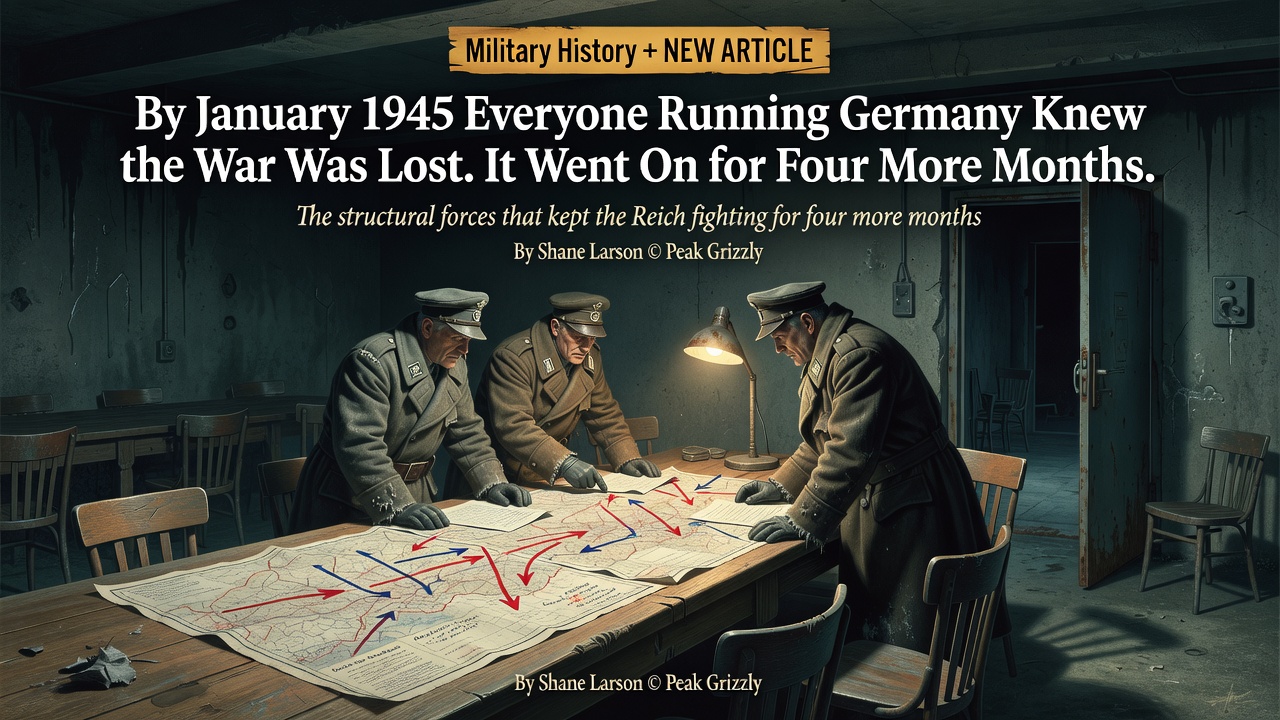
Four days before the Soviet winter offensive opened on 12 January 1945, the German general staff's own intelligence branch put the enemy's superiority on the Vistula front in writing: roughly eleven to one in infantry, seven to one in tanks, twenty to one in artillery. Albert Speer, the armaments minister, told Hitler in writing that the loss of Silesian coal that same month removed the basis of war production, and by mid-March he was giving the economy four to eight weeks before final collapse. Nobody in authority in Germany believed the war could be won. Not the generals, not the ministers, not the field commanders reading their own returns.
The war went on anyway, for four more months. And those four months cost more than any comparable period of the entire conflict. The standard demographic accounting of German military deaths — a reconstruction commissioned by the German armed forces' own military history research office and published in 2000 — finds that nearly half of Germany's roughly 5.3 million military dead fell in the war's final year, and that January 1945 was the deadliest single month of the war for the German army: somewhere in the region of 450,000 dead, more than the United States lost in the whole war in every theatre combined. More German civilians died between January and May 1945 than in the entire strategic bombing campaign that preceded those months.
That is the puzzle worth sitting with. Wars are supposed to continue because their outcome is in doubt. This one continued after its outcome was in doubt to no one — least of all to the people running it. Why?
The answer it is not: fanaticism
The popular explanation is a nation fighting to the death for its Führer. The German army's own behaviour refutes it. In April 1945, in the Ruhr pocket, some 300,000 men — an entire army group — laid down their arms in the largest single capture of German troops of the war. In the war's last fortnight, whole German armies marched west for the specific purpose of surrendering to the Americans rather than to the Red Army. Formations that fought house by house on the Oder in April gave themselves up in ordered columns in the west in May.
That is not a fanatical army. It is an army reading its situation with complete clarity — including the part of its situation its own side had created, which we will come to. Fanatics do not queue to surrender. The men of 1945 surrendered readily wherever surrendering was survivable, and fought wherever it was not, and the difference between the two is where the real explanation lives.
Surrender is a collective act
Here is the observation that reorganises the whole question: an individual can stop fighting, but a state cannot stop a war without an authority capable of performing the act — someone with the standing to order the guns silent and make the order bind. Ending a war is not a mood. It is a decision, and decisions require machinery.
By 1945 the Nazi state had dismantled every piece of that machinery in itself. It had not had a functioning cabinet for years. What existed instead was a set of competing fiefdoms — the party, the SS, the armed services, the armaments ministry, the regional Gauleiters — held together at the top by one man and by nothing else. There was no body with the standing to reach a collective decision and no procedure by which one could have been reached. And the one man who could have acted regarded the surrender of November 1918 as the founding crime of his political life, the act his movement existed to avenge, and the one thing history would not record of him. Within his frame, capitulation was not a bad option to be weighed against worse ones. It was not an option at all — a preference that stopped being abstract in March 1945, when he ordered the demolition of Germany's own remaining infrastructure ahead of the advancing Allies.
So the system produced exactly what its structure dictated: not surrender, but separate, personal, unauthorised peace feelers. Himmler negotiated through a Swedish intermediary. Göring inquired by telegram whether he should assume the leadership. An SS general opened his own channel in Italy. Each initiative was pursued in secrecy, each was treated as treason when discovered, and none was capable of stopping anything, because none of these men could deliver the thing a surrender requires — an army that obeys the order. The fiefdoms could negotiate only for themselves, and a fiefdom's surrender ends nothing.
This is the part of the story that generalises beyond 1945. A state that concentrates all decision in one person, and makes the questioning of that person's resolve a crime, has not made itself strong. It has made itself incapable of the one decision that ends a catastrophe. The war did not continue because Germany willed it to continue. It continued because no one remained who could will it to stop.
The Reich Comes Down
The machinery that still worked
One apparatus of the German state functioned to the end, and it is telling which one: the machinery of coercion, turned inward. Roughly fifteen thousand German soldiers were executed by their own side for desertion and defeatism — against forty-eight executions in the Kaiser's army across the whole of the First World War, a single American soldier shot for desertion in this one, and none in the British army. Flying courts-martial worked the roads behind the front with authority to try and hang within the hour, and they were still hanging men from Berlin lampposts while Soviet troops were three streets away. For an ordinary German, hanging a white sheet from a window could be a capital offence until the moment enemy troops actually arrived — and in the regime's final week, sometimes it was.
The regime's other killing did not stop either. The evacuations of the camp system — the death marches — took somewhere between a quarter and a third of a million lives in the war's final months, with killings recorded even after surrender orders had been issued. A state that could no longer feed its cities, fuel its aircraft, or communicate with its armies could still execute. That inversion — everything failing except compulsion — is the clearest single portrait of what the Third Reich had become.
Why the same army fought east and surrendered west
The asymmetry in German surrender behaviour was not mysterious to anyone involved. What the Wehrmacht and the SS had done in the Soviet Union between 1941 and 1944 — a war of annihilation waged as policy, in which some 3.3 million of 5.7 million Soviet prisoners of war died in German custody — was known, in outline and often in detail, both to the army that had done it and to the army now advancing through the country where it had happened. That knowledge sent millions of German civilians onto the winter roads heading west. It shaped the conduct of the Red Army when it arrived, which included killings and mass rape on a scale historians still work to bound. And it dictated the war's last strange fortnight, in which the Dönitz government at Flensburg tried to surrender to the western Allies only, while holding the eastern front open long enough for troops and civilians to move west — an offer the Allies refused, insisting on surrender to all of them at once.
Even the ending was not one ending. There were two signing ceremonies — at Reims on 7 May and at Karlshorst in Berlin on 8 May — which is why Western Europe and Russia still mark different VE Days. And the fighting did not stop cleanly at either signature: Prague's battle ran past the surrender, and German garrisons held scattered positions for days after. A war that could not be stopped by its own side did not stop crisply even when the other side stopped it.
The bill
The cost of those four months fell overwhelmingly on people who had no say in continuing them: the soldiers of both sides, the civilians on the roads and under the bombs, and the prisoners of a camp system being marched west as it collapsed. The numbers themselves became battlegrounds. Dresden's death toll circulated for fifty years in a form descended from Nazi propaganda inflation, until a German historical commission established the credible range in 2010 — a fraction of the figure most people had heard. Meanwhile the largest number the war produced in Europe, the roughly 27 million Soviet dead, remains barely contested and barely known in the West. Both facts about our memory of 1945 say something worth thinking about: contested numbers are usually contested because someone wanted them large or small, and honest accounting means stating who produced each figure, from what evidence, and what drives the spread.
The last four months of the war in Europe are usually told as an ending — the fall of Berlin, the bunker, the flags. Told properly, they are something more useful: a study of how a state fails, and of what happens when a political system deliberately removes from itself every mechanism by which it could change course. The war did not run to May 1945 because Germany was strong. It ran because Germany had made itself incapable of stopping, and so it had to be stopped from outside, building by building.
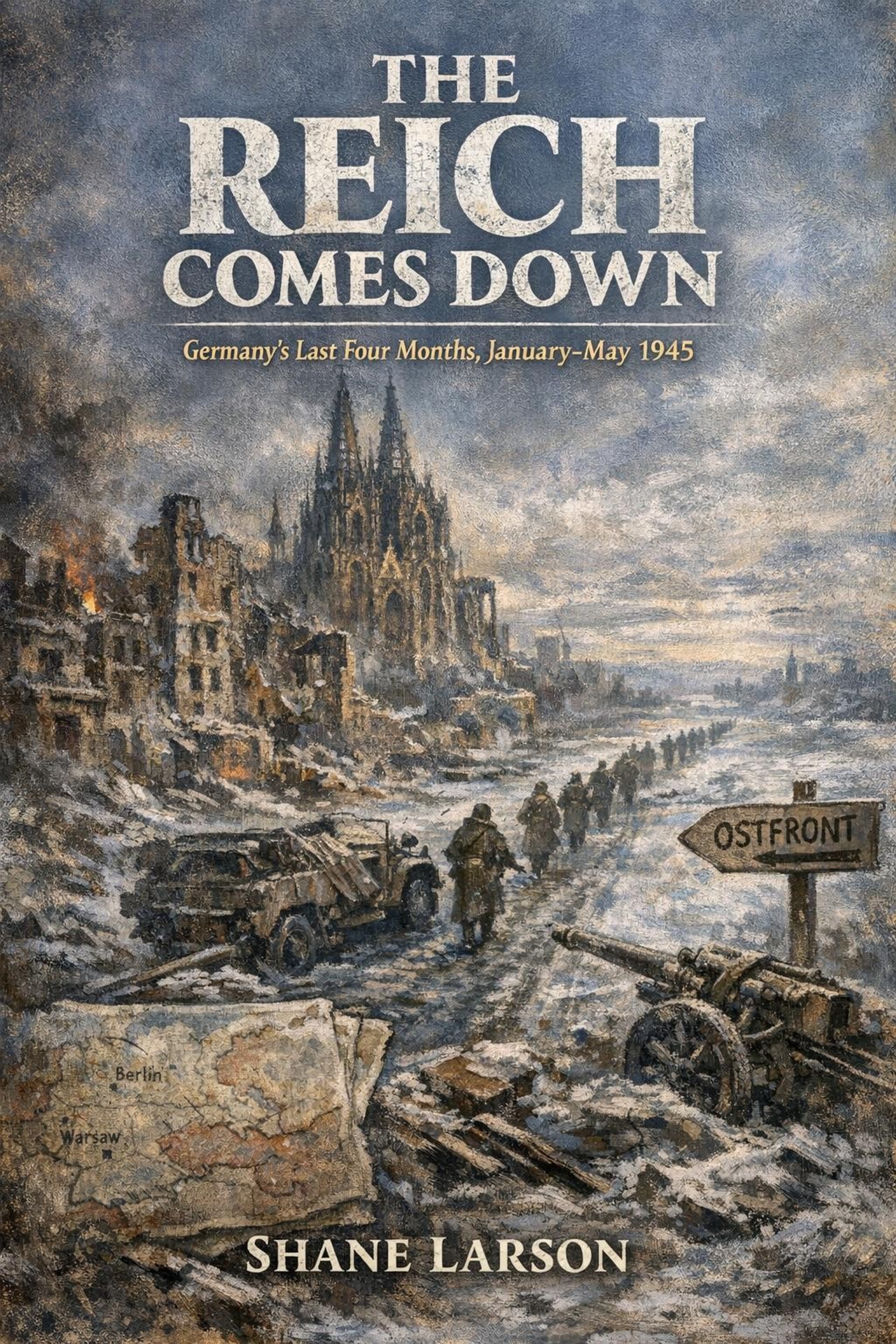
This article draws on the research behind The Reich Comes Down: Germany's Last Four Months, January–May 1945, Volume 9 of The Second World War Chronicles by Shane Larson, which follows the war from the Vistula–Oder offensive to the two surrenders — with every contested figure given as a range and every claim tied to the documentary record. It's available in Kindle, paperback, and audiobook editions.
The Reich Comes Down
New posts and releases, straight to your inbox. No spam, unsubscribe anytime.