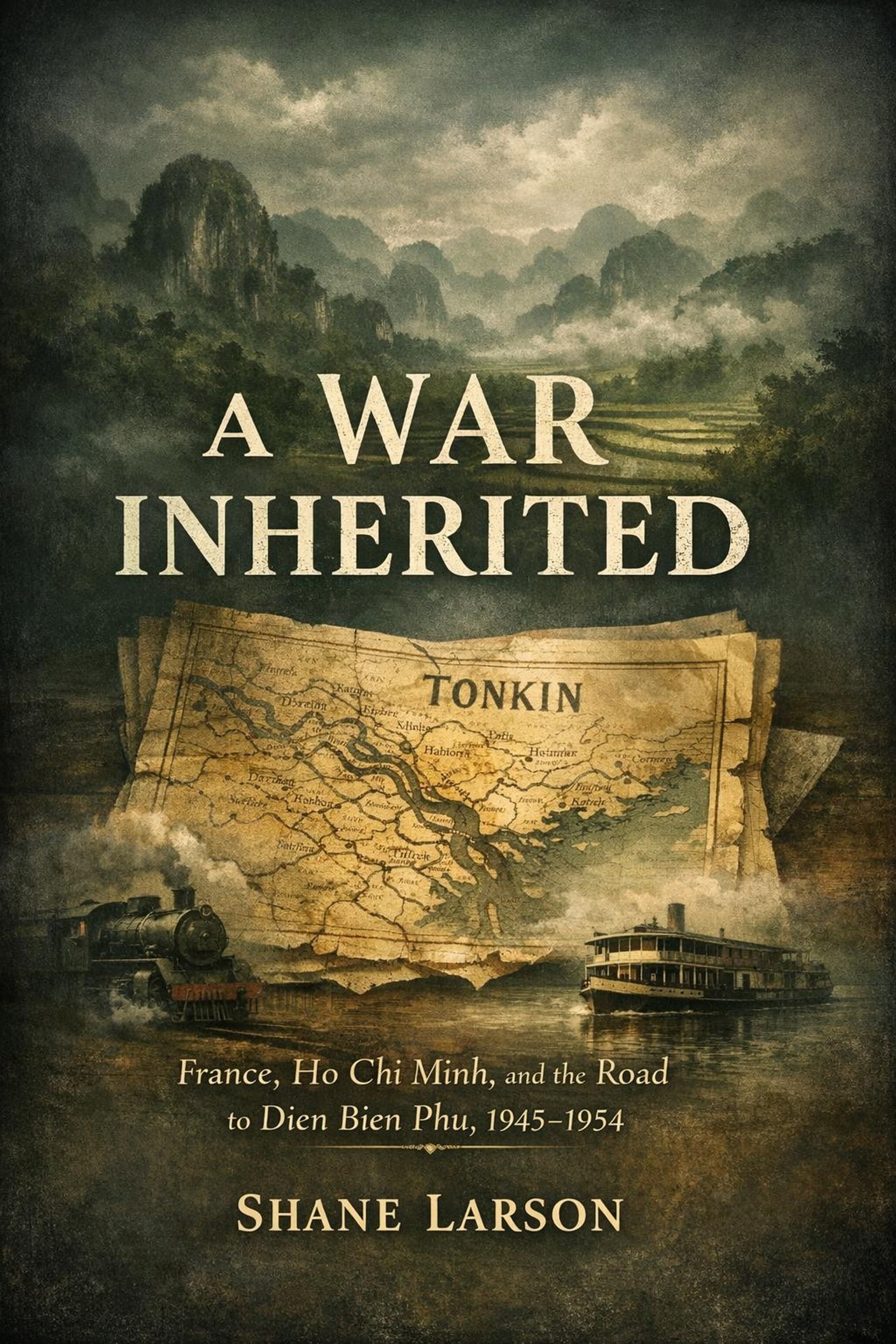
A War Inherited
France, Ho Chi Minh, and the Road to Dien Bien Phu, 1945-1954
By Shane Larson
About This Book
In the winter of 1944–45, rice grew scarce in the villages of northern Vietnam, and then it disappeared. A colonial requisition system was still collecting paddy at fixed prices; farmland had been switched by decree from rice to jute; Allied bombing had cut the routes that moved southern rice north; and two harvests had failed. The administrators of French Indochina — a Vichy French bureaucracy and the Japanese army occupying the colony over it — spent that winter disputing who owed what to whom. Somewhere between four hundred thousand and two million people starved, a spread this book examines source by source rather than flattening into one number.
Into that catastrophe walked a small revolutionary front, founded in a border cave four years earlier, that did the one thing neither administration would do. Its cadres led villagers to the granaries where requisitioned rice sat under guard, and opened them.
That decision, more than any battle, is why the Viet Minh held mass authority across the northern countryside by August 1945 — and why, when Japan surrendered, a movement with a few thousand rifles could take Hanoi in a week and declare a republic in front of half a million people, quoting Thomas Jefferson, with American officers in the crowd. Nine years later its army destroyed a French entrenched camp at Dien Bien Phu, and the First Indochina War ended at a table in Geneva. What did not end was the war. This is the history of those nine years — France's war, 1945 to 1954 — and of how the United States came to own its consequences.
The argument of the book is in its title. The American war in Vietnam was not begun; it was inherited, the way an estate is inherited — assets, debts, and obligations taken together, mostly unexamined. Well before any Marine landed, Washington had recognized one Vietnamese government and refused to deal with the other, had financed a growing share of the French war until it carried most of the cost, and had declined to sign the Geneva settlement while quietly assuming responsibility for the southern state it produced. No later administration reopened those choices.
And every structural problem the Americans would spend two decades failing to solve was already fixed in place by 1954: a Saigon government founded by the colonial power as an answer to a French problem, carrying a legitimacy deficit no amount of aid could repair; an opponent with a quarter-century of organizational depth that had just beaten a Western army in the open field; a demarcation line at the seventeenth parallel that was temporary in the documents and permanent on the ground; and an American domestic politics, poisoned by the argument over who lost China, in which no president could afford to preside over the loss of anything else.
Telling that story honestly requires telling it from both sides of the wire, and the English-language shelf mostly does not. This book gives the Viet Minh's decade a full chapter of its own, written from Hanoi's official military history in translation and from scholarship grounded in Vietnamese sources — including the parts of the record the Party itself later acknowledged as excesses. It is a history of two states built under fire, not a history of one army's misfortunes.
What's Inside
- The revenue machine of French Indochina — the salt, alcohol, and opium monopolies, the head tax, the corvée — and why a colony's fiscal design explains its politics better than its proclamations do.
- Five years of double occupation, from the Japanese entry in 1940 to the single March night in 1945 when Japan destroyed the French administration and created the vacuum the August Revolution filled.
- The famine of 1945 treated as mechanism, not backdrop: how requisition, crop conversion, and severed transport combined, and how food became authority.
- The OSS Deer Team in Ho Chi Minh's jungle camp — American medics and weapons instructors alongside the Viet Minh in the summer of 1945, and the fate of the reports they sent home.
- The road from negotiation to war: Ho's startling 1946 bargain accepting French troops to get Chinese ones out, the failed conferences, Haiphong, and the December night the fighting became general.
- A full chapter from the Viet Bac — Chinese aid and the transformation of a guerrilla force into an army, a state run on rice taxation and porter logistics, and the land reform campaign with its contested execution toll stated as a range, sources named.
- The valley and the table: the specific assumptions behind the Dien Bien Phu plan, who made each one, the fifty-six-day siege from both sides, and a Geneva settlement the winners were pressured by their own allies to accept.
Why I Wrote This
I came to this war from another one. I had just finished eleven volumes on the Second World War, and the pattern that kept surfacing in that work was institutions that had the information they needed and could not act on it. The American reports out of the Viet Bac in 1945 — filed by officers who had sat with Ho, taken his measure, and said so plainly — are that pattern at its purest. They went nowhere, and I wanted to understand the machinery that sent them nowhere.
The other reason is the shelf. The English-language literature of this war is written almost entirely from one side of it, and I did not want to add another book that treats the Vietnamese as scenery. That is why every volume of this series carries a full chapter from the Vietnamese side, built from Hanoi's own record in translation and kept honest about what that record contains.
Frequently Asked Questions
Do I need to know anything about Vietnam to read this?
No. The introduction lays out what French Indochina was, who the Vietnamese nationalist movements were, and why the story starts in 1940, assuming the reader knows none of it. Appendix C carries a who's-who of the people and factions.
Is this book about the American Vietnam War?
No — it is about the war the American war inherited. The fighting here is French and Viet Minh, and the Americans appear as they actually appeared: first as observers in the jungle, then as bankers, never as combatants. The American war begins in Volume 2, and this volume explains the situation it began in.
Does it take a side on whether Ho Chi Minh was a nationalist or a communist?
No, deliberately. Serious historians divide on it, and the book presents both readings and the evidence each rests on — including Ho's 1946 decision to accept returning French troops, which cuts against the easy version of either answer. It also argues the either/or framing is worse posed than it looks: Ho spent his career refusing to treat the two as alternatives.
How does it handle disputed numbers like the famine death toll?
As ranges with a named source at each end, never as single confident figures. The famine toll, the Haiphong casualties, the land reform executions, and the losses on both sides all circulate in wildly different versions. Appendix B collects every contested figure with the basis of each estimate and who has had an interest in a larger or smaller one.
Is this the first book in a series, and does it stand alone?
Both. It opens an eight-volume history running from the Japanese occupation of Indochina to the fall of Saigon in 1975 — but it is a complete account of the French war with its own beginning and end, assuming nothing from any other book.
If You Liked This, You Might Like
- The Trung Sisters — the rising against Han China in the year 40 that founded the Vietnamese resistance tradition Ho invoked in 1945; the natural prologue to this series.
- The Institutional Collapse Pattern — a structural study of how governing systems lose legitimacy, the disease the Saigon state was born with.
- The Empire Collapse Pattern — why imperial powers come apart from within, of which France in Indochina is one case.
By the time the first American combat units arrived in Vietnam, every choice that would define their war had already been made — this book is the record of who made them, and when, and why. Volume 1 of The Vietnam War Chronicles.
What You'll Learn
- How a famine that killed between several hundred thousand and two million people handed the Viet Minh its political authority
- Why American officers were in Ho Chi Minh's jungle camp in 1945 — and what became of the reports they filed
- How the Viet Minh built a state — taxation, courts, conscription, arms workshops — while fighting for its life
- Why the French chose Dien Bien Phu, and how tens of thousands of porters with reinforced bicycles broke every assumption the plan rested on
- How American aid grew from a first package in 1950 to most of the cost of the war by 1954, anchored to the Pentagon Papers
- What was actually signed at Geneva — and why a line meant to last two years lasted twenty-one
Included with Kindle Unlimited — read it free if you're a member.
New Military History releases and free chapters — no spam, unsubscribe anytime.
More in This Genre
View all →