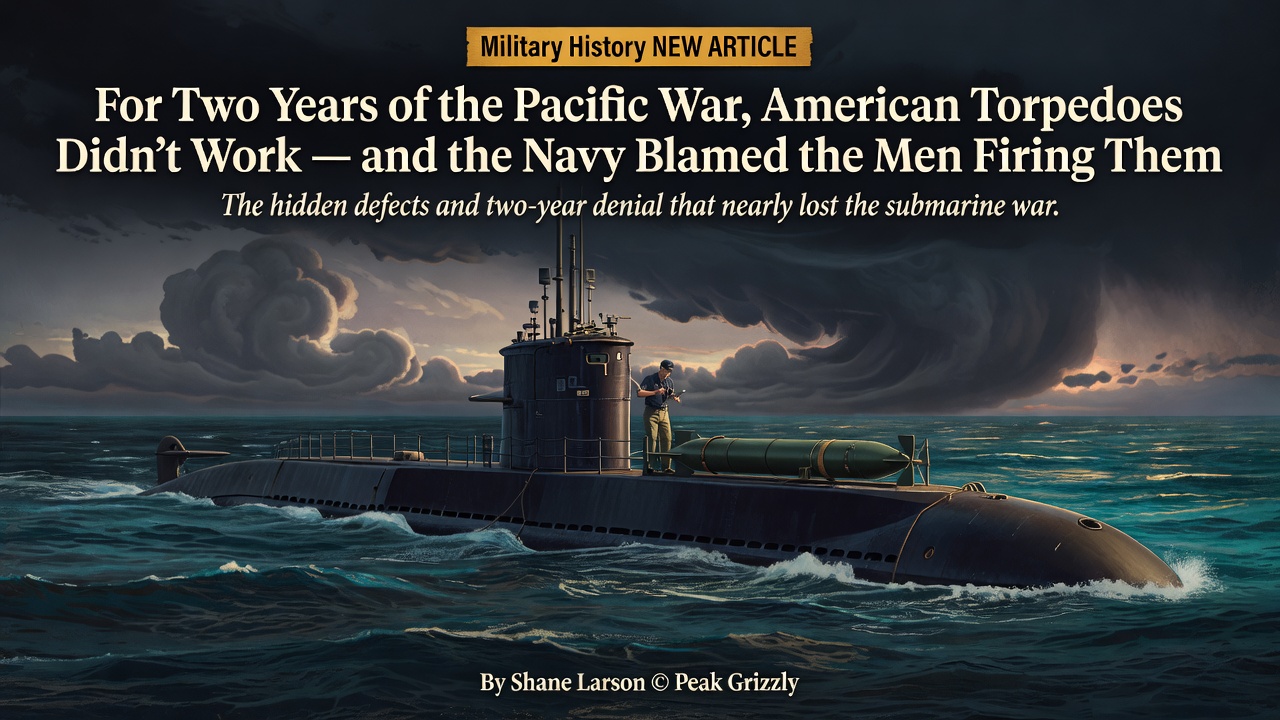
For Two Years of the Pacific War, American Torpedoes Didn't Work — and the Navy Blamed the Men Firing Them
September 16, 2026 · 7 min read
In December 1941, in the opening weeks of the Pacific war, the American submarine Sargo attacked Japanese shipping off Indochina. Her captain fired thirteen torpedoes under good conditions at slow, unescorted targets. Every one of them missed, or seemed to. He was an ordnance specialist by training, and he came home convinced the weapons were broken. The Navy's Bureau of Ordnance concluded instead that the problem was him.
That exchange — a captain reporting a defective weapon, a bureau explaining that the captain was the defect — then repeated itself, boat after boat, patrol after patrol, for nearly two years. It is one of the most consequential institutional failures in American military history, and almost nobody outside the submarine literature has heard of it. It deserves to be better known, partly because of what it cost, and mostly because of what happened the moment it ended.
A weapon nobody had ever really tested
The standard American submarine torpedo of 1941 was the Mark 14, designed and built at the Naval Torpedo Station in Newport, Rhode Island — the same institution that would later sit in judgment on complaints about it. In the Depression-era Navy a torpedo cost about ten thousand dollars, real money at the time, and live-fire testing was treated as waste. The Mark 14 went to war without ever having been proof-fired against an actual ship hull in realistic conditions.
Its secret weapon was supposed to be the Mark 6 magnetic exploder, developed in such secrecy during the 1920s that many of the captains carrying it to war had never been trained on it. The idea was elegant: instead of striking a ship's armored side, the torpedo would pass beneath the keel, sense the hull's magnetic field, and detonate under the ship's unarmored bottom, breaking her back with one shot. The live testing behind this elegant idea amounted to a handful of shots against a single target hulk in 1926. The exploder then sat in guarded storage for fifteen years while the earth's magnetic field — which varies by latitude, a fact that matters enormously to a magnetic sensor — waited to be encountered in the operational Pacific.
Three defects, each hiding the next
What made the Mark 14 scandal so durable was not one flaw but three, stacked so that each one masked the next. This is worth walking through slowly, because it explains how intelligent people managed to be wrong for two years.
First, the torpedo ran deep — roughly ten feet deeper than its set depth, because its depth-sensing mechanism had been calibrated with light exercise heads rather than the heavier live warhead. A torpedo set to pass six feet under a keel passed sixteen feet under, far outside the magnetic exploder's reliable envelope. Result: clean misses that looked, from the periscope, like inexplicable failures to explode.
Second, the magnetic exploder itself was erratic. Depending on conditions it detonated early — throwing up a spectacular column of water that damaged nothing and alerted the escort — or not at all. But so long as the torpedoes were running ten feet too deep, most of them never got close enough to the target's field for anyone to isolate this defect. Fixing the depth problem was what exposed it.
Third, and most damning, the backup contact exploder — the simple mechanism that fires when the torpedo physically hits the ship — was defective in the worst possible way. On a square, direct, textbook hit, the firing pin's guides crushed under the deceleration before the pin could strike, and the torpedo crumpled against the hull without detonating. A glancing, badly aimed hit often worked; a perfect one usually didn't. The weapon punished good shooting. And so long as the magnetic exploder was armed, contact duds were buried in the general noise of failure. Deactivating the magnetic exploder was what exposed the contact pistol.
Three defects, in series, each discoverable only after the one in front of it was fixed. A bureau inclined to doubt its own product might have unwound the chain in months. This bureau was not so inclined.
The two years of denial
The Bureau of Ordnance's position, maintained against an ocean of patrol reports, was that the torpedoes were sound and the crews were not: bad marksmanship, nervous approach officers, poor maintenance. Some skippers were relieved of command over results their weapons had made impossible.
The men on the firing end eventually stopped arguing and started measuring. In June 1942, submariners under Rear Admiral Charles Lockwood in Australia ran the test Newport had never run — firing Mark 14s through fishnets in a quiet bay and reading the depth off the holes. The torpedoes were running about ten feet deep, exactly as the captains' results implied. The Bureau's first response was to fault the test procedure. Only under pressure from Washington did it concede the depth error, in August 1942 — eight months into the war.
The End in the Pacific
The magnetic exploder took another year. Not until June 1943 did Admiral Nimitz order it deactivated across the Pacific Fleet's boats — and even then the Southwest Pacific command kept it in service for months longer, so that for a stretch of the war, whether an American torpedo's magnetic exploder was switched on depended on which port the submarine had sailed from.
The contact pistol fell last, and it took a nearly perfect experiment to do it. In July 1943 the submarine Tinosa found a huge Japanese whale-factory ship, stopped and alone. Her captain fired his torpedoes deliberately, at ideal range and angle, and watched hit after hit against a stationary target produce nothing. He brought his last torpedo home for the ordnance officers to examine. At Pearl Harbor that September, test warheads dropped from a crane onto steel plate reproduced the failure on demand: square impacts crushed the firing mechanism before it could fire. The fix was a lighter firing pin — some of the first ones, the story in the submarine force ran, machined from the propellers of Japanese aircraft destroyed at Pearl Harbor.
By the autumn of 1943 — some twenty-one months after the war began — American submarines were finally taking reliable torpedoes to sea. The information needed to reach that point had existed inside the Navy almost from the first patrol. What failed was not detection. Captains detected the problem immediately and said so in writing. What failed was an institution's arrangements for believing its own people: the same organization designed the weapon, manufactured it, and judged the complaints against it, and at every step it preferred the hypothesis that protected the design.
What happened when the torpedoes worked
The Japanese empire of 1942 was a maritime empire in the strictest sense: an island nation holding conquests scattered across thousands of miles of ocean, all of it — oil, food, troops, everything — moving by merchant ship. Japan began the war with about six million tons of merchant shipping, no meaningful convoy doctrine, and no serious plan for defending its sea lanes. It had gone to war, above all, for oil.
Once the torpedoes worked, the arithmetic was short. In 1944 alone American submarines sank more Japanese shipping than in the first two years of the war combined. The postwar accounting credited the submarine force — never as much as two percent of the Navy's personnel — with over eleven hundred merchant ships of roughly 4.8 million tons, more than half of all Japanese merchant tonnage lost in the war, plus warships up to and including a battleship and the largest aircraft carrier ever sunk by a submarine. The cost was proportionally the heaviest of any branch of the American armed forces: fifty-two boats lost with some 3,500 men.
The strategic result can be stated in one sentence: by the spring of 1945 a nation that had gone to war over oil could no longer move oil, and what remained of its fleet lay immobilized in home waters for want of fuel before American aircraft sank it at its moorings. Aerial mining of the home ports in 1945 closed the last gaps, but the strangulation was overwhelmingly the submarines' work — and its foundation was laid in the eighteen months after the torpedoes were fixed.
How much that blockade, by itself, would have decided is genuinely contested. The US Strategic Bombing Survey concluded after the war that Japan would have been forced to surrender before the end of 1945 without invasion — a judgment historians have argued about ever since, and one that cannot be separated from the bombs, the firebombing, and the Soviet entry into the war. What is not contested is the ledger: the most decisive American campaign of the Pacific war was its least famous, it was delayed roughly two years by a weapon its own users had correctly diagnosed almost at once, and no one was ever court-martialed for the delay.
The submarine war is where my new book The End in the Pacific: Island Hopping, Okinawa, and the Bomb, 1943–1945 — the tenth and final volume of The Second World War Chronicles — begins its argument, ahead of the famous islands, because everything that follows runs on the shipping ledger the submarines were writing. The book gives the campaign its full weight in figures, quarter by quarter, alongside the airfields, the bombing, and the decision of August 1945, laid out as the evidence stood at the time. If the idea that a torpedo scandal helped shape the end of the Second World War is new to you, the rest of that story lives there.
The End in the Pacific
New posts and releases, straight to your inbox. No spam, unsubscribe anytime.