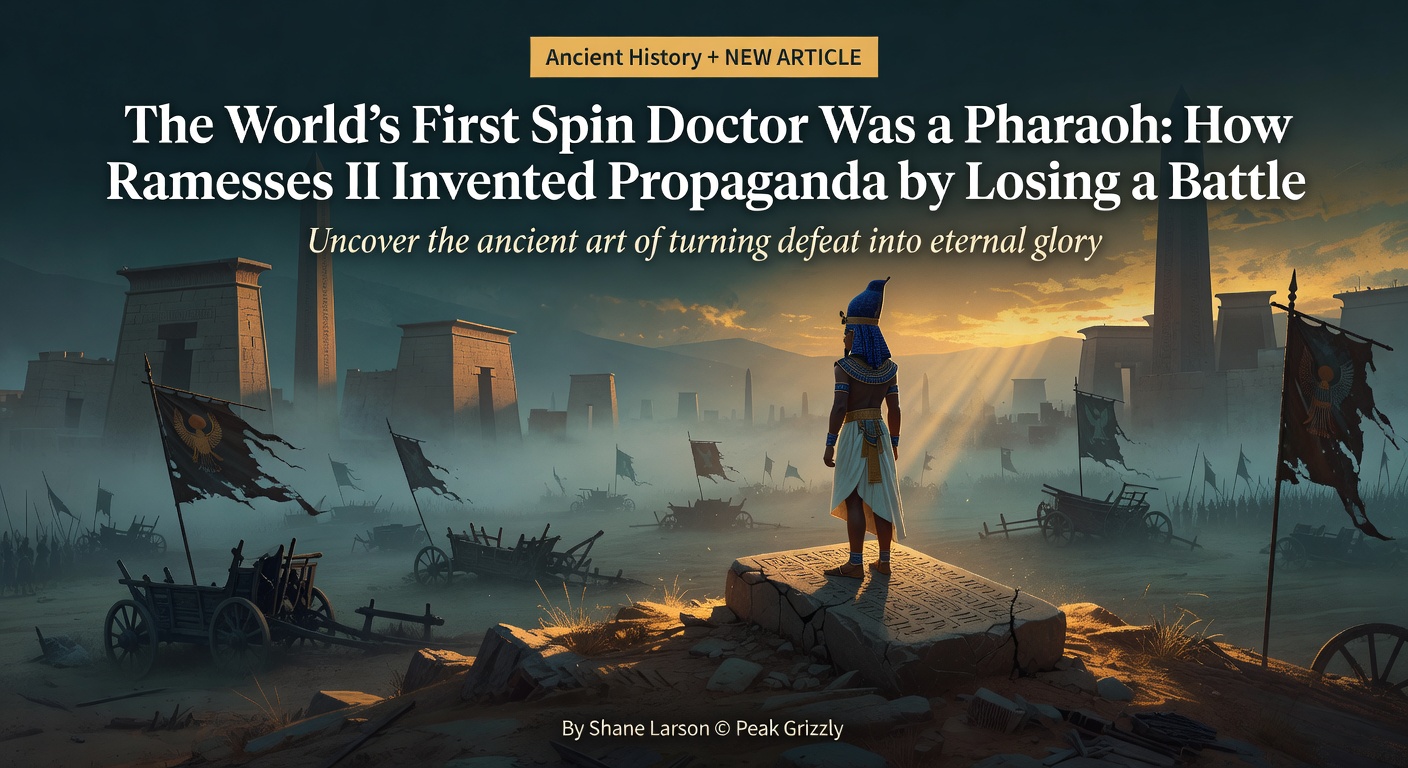
The World's First Spin Doctor Was a Pharaoh: How Ramesses II Invented Propaganda by Losing a Battle
April 17, 2026 · 9 min read
The World's First Spin Doctor Was a Pharaoh
In the spring of 1274 BCE, a twenty-five-year-old pharaoh named Ramesses II marched out of Egypt at the head of twenty thousand men. He was going north to fight the Hittite Empire for control of a city called Kadesh, in what is now western Syria. He came home a few weeks later having lost the battle, nearly lost his life, and failed to take the city.
He then spent the next sixty years of his reign convincing the world he had won the greatest military victory in human history.
He succeeded so thoroughly that for three thousand years, nobody could publicly remember Kadesh any other way. The story he carved onto the walls of five separate temples — a story in which he was betrayed by his own army, surrounded alone by thousands of enemy chariots, and defeated the entire Hittite host through personal valor and divine favor — became the story. It was the first detailed battle narrative in recorded history. It was also one of the most successful lies ever told.
If you want to understand how propaganda actually works — not the cartoon version, the real thing, the thing that shapes what a civilization believes about itself for generations — you should know the story of what Ramesses did after Kadesh. Because the techniques are exactly the same techniques still being used today. They were invented, or at least perfected, on the banks of the Orontes River thirty-three centuries ago.
What actually happened at Kadesh
Let's start with the facts, as best we can reconstruct them from the combined Egyptian and Hittite sources.
Egypt and the Hittite Empire had been fighting for two generations over the region we now call the Levant — roughly modern Lebanon and Syria. The fortified city of Kadesh, on the Orontes, was the hinge. Whoever held Kadesh controlled the overland trade routes and the buffer between the two empires. In 1274 BCE, the Hittites held it. Ramesses intended to take it back.
He marched north with four divisions — roughly 20,000 soldiers — each named for a god: Amun, Ra, Ptah, and Sutekh. He divided them on the march, which was standard practice. A column of 20,000 men on a single road stretches for miles; you move them in staggered groups, sometimes a full day's march apart.
About a day's march south of Kadesh, two local men were brought into his camp. They claimed to be deserters from the Hittite coalition. Their message was exactly what a young pharaoh wanted to hear: the Hittite king, Muwatalli II, had been terrified of the Egyptian advance and had fled more than a hundred miles north to Aleppo. The road to Kadesh was open.
Ramesses believed them. He raced ahead with the Amun division, leaving the other three columns hours or days behind, and set up camp just north of Kadesh to wait for the rest of the army.
The two "deserters" were Hittite agents. Muwatalli was not in Aleppo. He was three miles east of Kadesh with the largest chariot force the Bronze Age had ever assembled — by some counts, three thousand chariots to Ramesses' projected fifteen hundred, plus forty thousand infantry.
The Hittite chariots crossed the Orontes, smashed through the Ra division as it was still arriving, and rolled directly into Ramesses' camp while the pharaoh and his Amun division were still setting up. For a few minutes, Ramesses was surrounded and nearly captured. Egyptian officers died within feet of him. His personal bodyguard was scattered.
What saved him, honestly, was a combination of three things. A contingent of Egyptian allied troops arrived from a different road at exactly the right moment and hit the Hittite chariots on the flank. The Hittites, having broken the Egyptian camp, stopped to loot it — a classic Bronze Age chariot-force mistake. And the third Egyptian division, Ptah, came up in time to stabilize the line.
At the end of the day, the Hittites withdrew into Kadesh. The Egyptians held their ground on the field. Both sides took heavy casualties. Neither force could finish the other. The next morning, Ramesses negotiated a withdrawal and marched home. Kadesh stayed in Hittite hands. Egypt's territorial gains from the campaign were zero.
That's the honest version, reconstructed from carefully reading both the Egyptian inscriptions (which carved the battle in enormous detail) and the Hittite archives at Hattusa (which mention the outcome almost casually, in a way that only makes sense if they thought they'd won, or at least hadn't lost).
Now here's what Ramesses did with it.
The five walls
When Ramesses got home, he commissioned what we now call the Kadesh Inscription — actually two texts, usually called the "Bulletin" and the "Poem" — and had them carved, in huge scale, on the walls of five separate temples: the Ramesseum, Abu Simbel, Karnak, Luxor, and Abydos.
Think about the logistics of that. These are not small carvings. They are monumental reliefs, hundreds of feet of stone across, with accompanying images showing Ramesses alone in his chariot, scattering enemies, drawing his bow against a mass of Hittite forces. Every major religious and administrative center of Egypt was stamped with this image of the pharaoh as singular, superhuman warrior. Every priest who walked past it, every pilgrim who visited, every scribe who copied it for the archives was being fed the same story.
The story itself has specific rhetorical moves worth pulling apart, because you can see every single one of them being used in modern political communications.
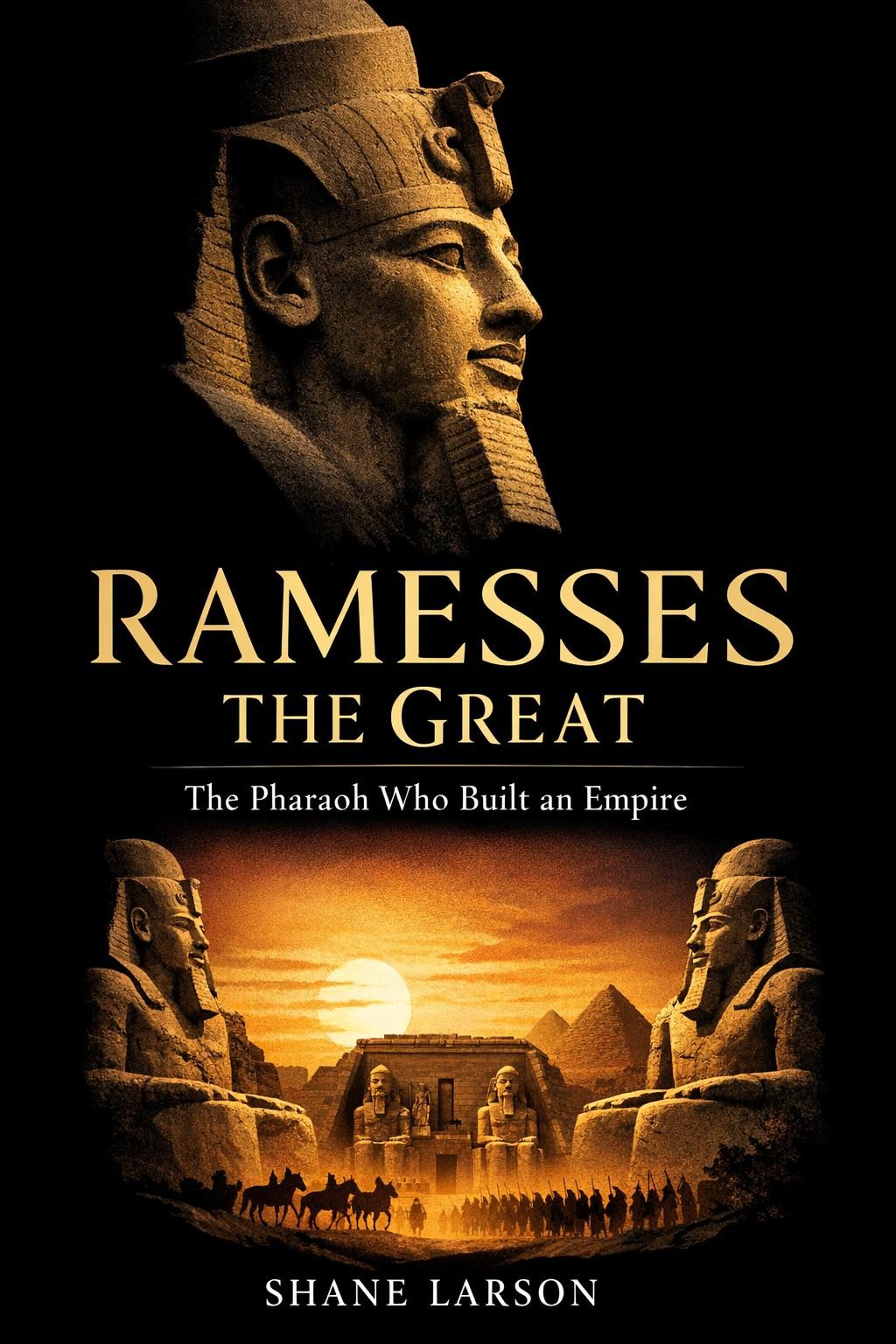
Ramesses the Great
Move one: shift the blame. The defeat of the Ra division isn't a pharaoh's tactical error. It's attributed to cowardice by the troops and officers, who "fled" and "abandoned" him. Ramesses isn't presented as the commander who made a mistake; he's presented as the betrayed hero whose subordinates failed him.
Move two: personalize the crisis. The chaos of the Hittite ambush becomes a single dramatic scene in which Ramesses, alone, calls out to the god Amun for help. Amun answers. Ramesses draws his bow and the entire Hittite army falls before him. It's not a battle anymore. It's a legend, and the legend has exactly one protagonist.
Move three: erase inconvenient outcomes. The fact that Kadesh stayed Hittite is simply not mentioned. The fact that Egypt gained no territory is not mentioned. The fact that the Hittite king was on the field with his army and survived the engagement is erased — Muwatalli appears in the Egyptian account only as a cowering observer on the far bank.
Move four: repeat until true. The text isn't carved once. It isn't carved in one place. It is carved in five temples, in the two most prestigious cities of the kingdom, in the two most dramatic southern temples (Abu Simbel itself), and in the pharaoh's own mortuary complex. It is read aloud at festivals. It is copied onto papyrus as a scribal exercise — we have student copies from later centuries, which is how we know it was used as a standard text. It becomes the version a kid in Thebes learns in school.
Move five: make the monuments do the work. Abu Simbel, with its four colossal seated statues of Ramesses, was constructed in the decades after Kadesh. Every time a visitor saw it, they were seeing not just a temple but a political statement: this is what the victor of Kadesh looks like. The scale of the monument was the proof of the scale of the victory. The architecture did the arguing.
The treaty that proves the lie
There is one piece of evidence, above all others, that tells you Ramesses himself knew he hadn't won at Kadesh.
Fifteen years after the battle, in 1259 BCE, Ramesses signed a peace treaty with the Hittite king Hattusili III. We have the text of this treaty from both sides — the Egyptian version carved on the wall of Karnak, and the Hittite version preserved on clay tablets dug out of the ruins of Hattusa. The two versions match almost perfectly.
If you won Kadesh, you don't sign a treaty fifteen years later ceding the contested region to the people you supposedly defeated. You don't sign a mutual-defense pact with a vanquished enemy. You don't marry your son to the vanquished king's daughter — which Ramesses also did, a few years after the treaty.
You only do those things if you and the other side both understand that the war was a stalemate and that both of you need peace. The treaty is diplomatic evidence that the Kadesh Inscription is propaganda. Both documents are signed by the same king. Both were carved into his temples. Most Egyptians would have encountered both. Somehow nobody asked the obvious question.
That's how propaganda works. It doesn't need to make sense. It needs to be everywhere, louder than anything else, and connected to the symbols people already trust.
Why it worked
Here's the part that matters most, and the part the book I just finished goes deep on: Ramesses' propaganda operation worked because it wasn't really aimed at convincing anyone of anything specific. It was aimed at flooding the available space.
When every temple has the same battle scene, when every scribal student copies the same poem, when every festival hymn praises the same victory, when the biggest monuments in the kingdom are built on the back of the same claim — the claim stops being a claim. It becomes the background. Questioning it would be like questioning whether the Nile floods in summer. You can do it, technically, but you'll sound like a lunatic.
Ramesses ruled Egypt for sixty-six years. That's three full generations. By the time he died in 1213 BCE, every adult in Egypt had grown up with Kadesh as the defining military victory of their civilization. There were no living witnesses to the actual battle left. The record had been, in every practical sense, rewritten.
This is the mechanism every long-tenured autocrat has used since. Flood the channel. Repeat the story. Let monuments and rituals do the work that argument can't. Outlive the skeptics. You don't change people's minds. You change what there is to have minds about.
What this has to do with you
You don't have five temple walls. You don't have a sixty-six-year reign. But the underlying dynamic — that story displaces fact when the story is repeated often enough by a trusted-enough source — has never gone away. It is, if anything, more powerful now than in 1274 BCE, because our temples are made of algorithms and our carvings refresh every fifteen seconds.
The value of knowing the Kadesh story isn't that it makes you cynical. It's that it gives you a template. When something is being repeated everywhere, in slightly different forms, by sources that all benefit from the repetition — that's Kadesh. When the inconvenient outcome is missing from the official version, but visible in the structural evidence (who signed what, who ceded what, who married whose kid) — that's Kadesh. When the monuments are doing the arguing because the facts can't — that's Kadesh.
Ramesses II was a spin doctor who happened to be a king. Or a king who happened to be a spin doctor. The fact that we're still calling him "the Great" three thousand years later tells you which part stuck.
Ramesses the Great
New posts and releases, straight to your inbox. No spam, unsubscribe anytime.