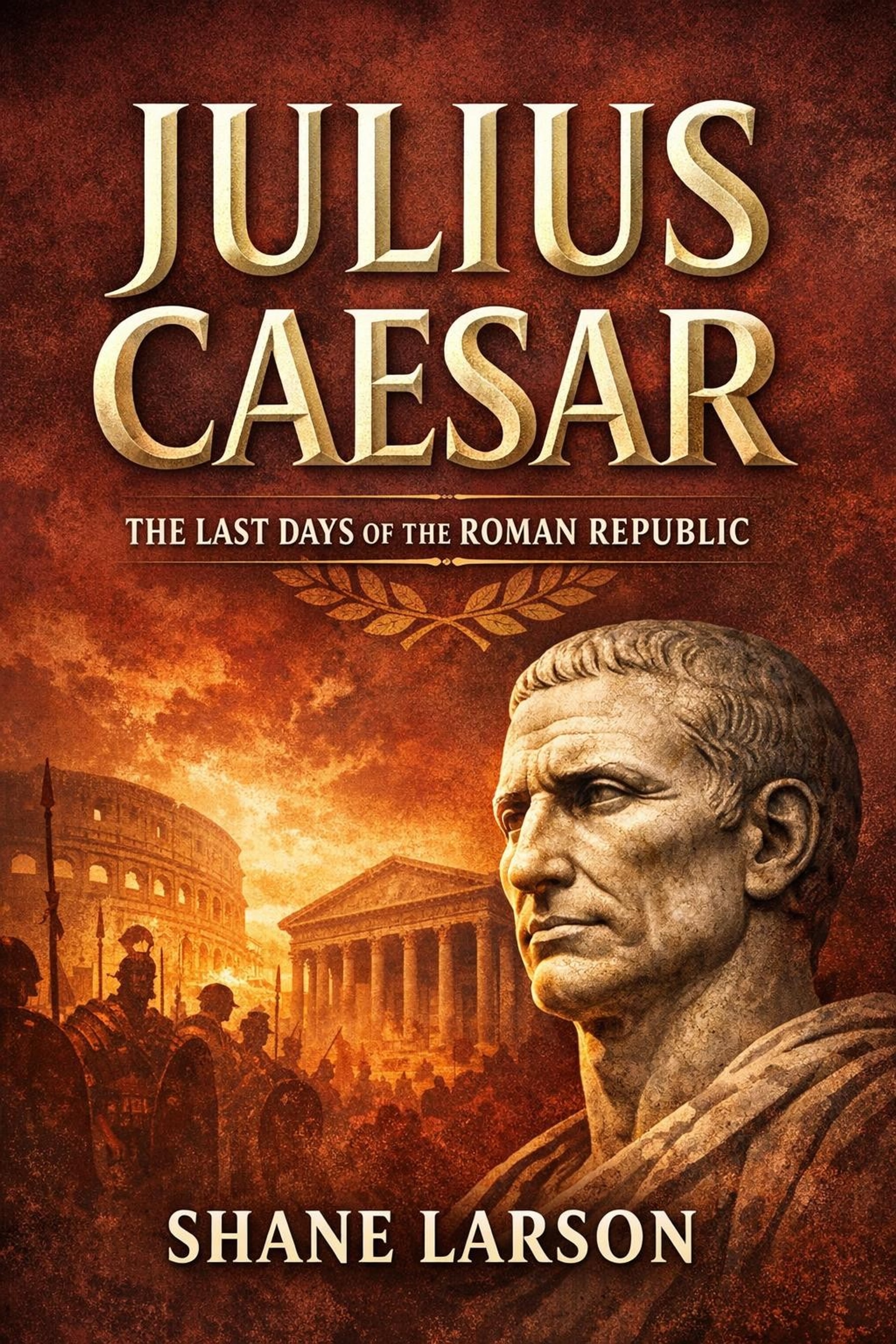
Julius Caesar
The Last Days of the Roman Republic
By Shane Larson
About This Book
The blade went in below the collarbone. Casca, hesitating, struck first and badly — Caesar caught his arm and snarled at him in Latin. Then the others closed in. Twenty-two more wounds. The body slumped at the foot of a statue of Pompey, the man Caesar had defeated and outlived, and the assassins stood there with bloody daggers and waited for Rome to thank them.
Rome did not thank them. Rome panicked, then mourned, then turned on them. Within three years most of the conspirators were dead. Within thirteen, Caesar's adopted heir was sole ruler of the Mediterranean world. The Republic the Liberators had killed Caesar to save did not return. It had, in fact, been gone for a long time. They simply had not noticed.
This is the story of how Rome got to that morning in March — and of the man whose life, more than any other single life in antiquity, ended one political world and began another.
The Argument
Most accounts of Julius Caesar fall into two camps. The first treats him as a kind of force of nature: brilliant, ruthless, inevitable, the man who could not have been stopped. The second treats him as a usurper: the breaker of an otherwise functional Republic, the villain of the late first century BCE.
Both are wrong, and the truth between them is more interesting than either.
The Roman Republic was, by the time Caesar came of age, already deeply sick. Five generations of expansion had broken its institutions. The legions had become loyal to their generals rather than the state. The Senate had lost the ability to discipline its own ambitious members. Sulla had marched on Rome. Marius had marched on Rome. The Gracchi had been beaten to death in the Forum. Slaves under Spartacus had nearly broken the peninsula. Pirates had blockaded the grain supply. The system was failing under loads it had not been designed to carry.
But sick is not dead. The Republic could have stabilized. Reform was possible. Other late careers — Cicero's, Cato's, even Pompey's at moments — show that the institutional muscle memory was still there. What the Republic could not survive was a particular kind of man at a particular kind of moment: a politician of extraordinary intelligence who was also a general of extraordinary success, who had populist credibility, aristocratic lineage, and absolute personal nerve. It could not survive Julius Caesar.
That is the argument of this book. Caesar did not destroy a healthy Republic. He destroyed a sick one that might otherwise have recovered. The men who killed him on the Ides of March understood the first half of that sentence. They did not understand the second.
What's Inside
- The world before Caesar. The Marian–Sullan civil wars, the proscriptions that nearly ended his life as a teenager, and the political vocabulary he inherited — populares, optimates, the cursus honorum, the constitutional theatre that was already breaking down.
- The apprenticeship. The capture by pirates. The early prosecutions. The pontificate. The aedileship and the games that bankrupted him into political survival. The proconsulship in Spain that made him solvent and gave him his first real military command.
- The First Triumvirate. Caesar, Pompey, and Crassus — three men who carved up the Roman world in private because they could no longer get what they wanted through the Senate. The arrangement that proved the Republic was running on side deals.
- Gaul. Eight years of conquest, treated honestly: the strategic brilliance, the genuine innovation in legionary warfare, and the mass killing. Hundreds of thousands of Gauls dead, a million enslaved. The Commentaries as a masterpiece of self-presentation, and what they leave out.
- The Rubicon. The political and personal calculation behind the most famous river crossing in Western history. Why a man inside the system chose to break it.
- The civil war. Pharsalus, Alexandria, Zela, Thapsus, Munda — the campaigns that turned a constitutional crisis into a war for the Mediterranean.
- Egypt and Cleopatra. The political alliance behind the romance. Cleopatra's own remarkable career and the strategic logic of the relationship on both sides.
- The dictatorship. The reforms — the calendar, the colonies, the citizenship grants — that were, ironically, exactly what the Republic needed. And the autocratic posture that made them intolerable.
- The Ides of March. The conspirators, the warnings, the assassination itself, and the political vacuum the killers walked into and could not fill.
- The afterlife. The thirteen-year civil war, the rise of Augustus, and the linguistic legacy — Kaiser, Tsar, Caesarism — that has shadowed every strongman since.
Why I Wrote This
I have a low tolerance for books that treat Julius Caesar as either monster or hero. Both readings flatten him — and more importantly, both flatten the Republic he ended.
The thing that drew me back to this material, after years of reading on Bronze Age and Iron Age history, was the realization that Caesar's career is the cleanest case study we have of a specific phenomenon: how a political system that has lost the ability to enforce its own rules gets finished off by the first sufficiently capable individual to test those rules. It is not a comforting story. It is also not one that ends in 44 BCE — the pattern recurs, and the language Rome left us for it (Caesarism, the Rubicon, the Ides of March) is still the vocabulary we use when we talk about the death of constitutional government anywhere.
I also wanted to write a Caesar that was readable. The standard biographies are extraordinary works of scholarship, but they are doorstops. This book is built to be read in a week, not a month, without sacrificing what matters about the man and the moment.
Frequently Asked Questions
Do I need a background in Roman history to read this?
No. The book opens with the political world Caesar was born into — the Marius–Sulla wars, the structure of the late Republic, the basic vocabulary of Roman politics — and builds from there. Anyone who has read general ancient-history popular books, or none at all, can follow it.
How does this compare to Tom Holland's Rubicon or Mary Beard's SPQR?
Holland's Rubicon covers the broader fall of the Republic across multiple lifetimes and is brilliant on the cultural mood. Beard's SPQR is a thousand-year history of Rome and treats Caesar as one chapter among many. This book is narrower than either: a single life, told in detail, with the death of the Republic as the through-line. If you have read either of those and wanted more on Caesar specifically, this is the book for you.
Is the Gallic War campaign covered honestly?
Yes — and that is one of the points of the book. The Gallic Wars were a campaign of mass killing, enslavement, and ethnic destruction on a scale that genuinely should disturb modern readers. Caesar's own Commentaries sanitize the campaigns thoroughly. This book does not.
How long is the book?
Roughly the length of a short biography — readable in a week of evenings. Not a doorstop. The aim was to do justice to the life without padding it.
Is this on Kindle Unlimited?
Yes. The Kindle edition is enrolled in Kindle Unlimited and is free to read for KU members.
Is this part of a series?
It is part of the author's broader ancient history catalog rather than a formal series, and pairs especially closely with Cleopatra's Egypt (the other side of Caesar's last years), The Fall of Rome (the long-arc sequel — the empire Caesar's heirs built and what eventually killed it), and Hannibal's War (the previous Roman near-extinction event, two centuries earlier).
If You Liked This, You Might Like
- Cleopatra's Egypt — Caesar's last years from the other end of the Mediterranean, with Cleopatra as protagonist rather than supporting cast.
- The Fall of Rome — the long-arc sequel: the empire Caesar's heirs built, and the four centuries of erosion that brought it down.
- Hannibal's War — the earlier near-death experience of the Roman state, and the war that forged the legions Caesar would inherit.
- Marcus Aurelius — what the Caesarian template looked like a hundred and fifty years later, in the hands of a philosopher rather than a general.
Closing
The Republic was sick before Caesar. He was the man who finished it. This is the story of how — told as a single life, in full, without the marble and without the myth.
Included with Kindle Unlimited — read it free if you're a member.
New Ancient History releases and free chapters — no spam, unsubscribe anytime.