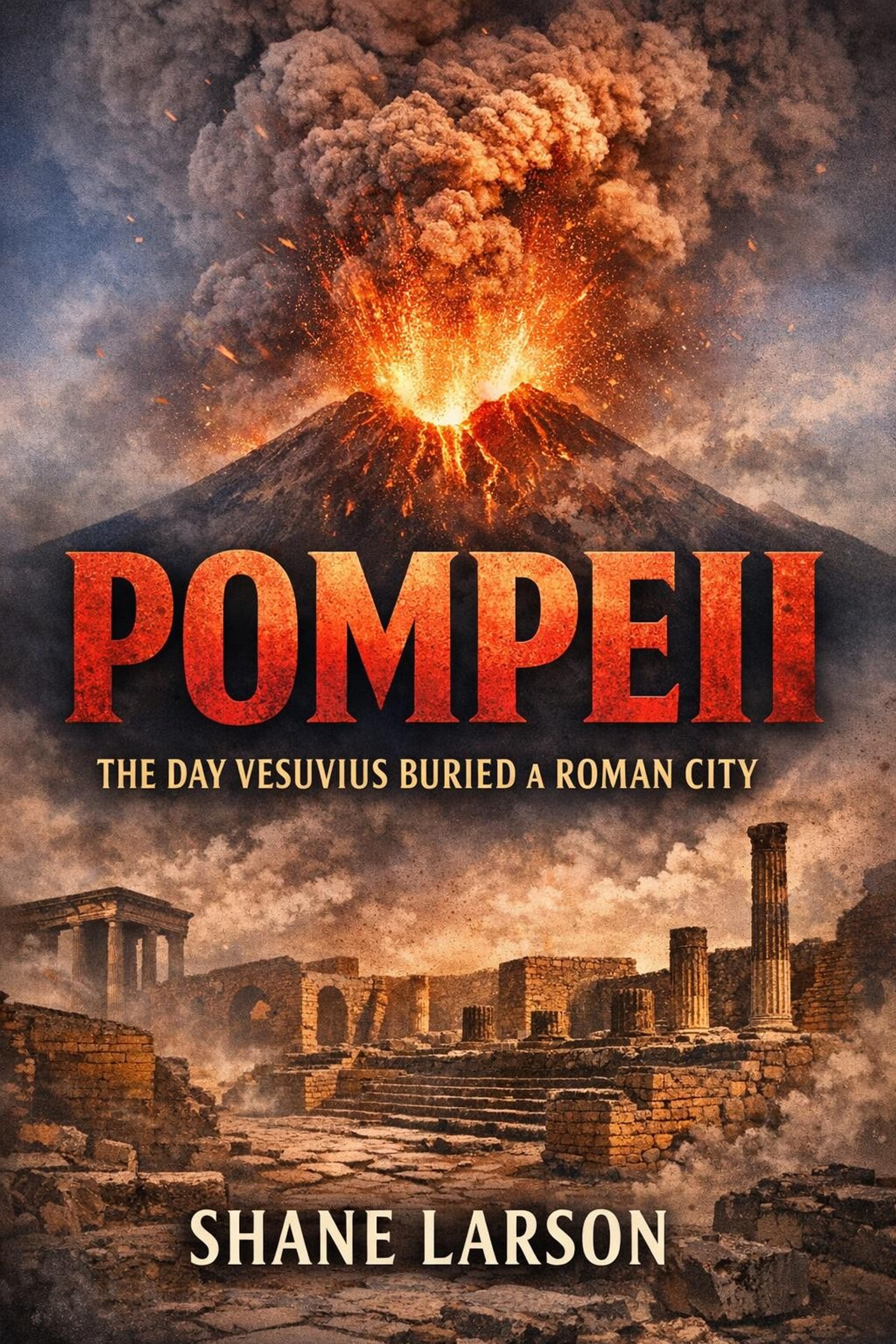
Pompeii
The Day Vesuvius Buried a Roman City
By Shane Larson
About This Book
A baker shoved a tray of round loaves into his oven and scored them into eight wedges, the way Pompeian bakers always did. He pulled the iron door shut to let them rise. He never came back. Seventeen centuries later, archaeologists opened that oven and found eighty-one carbonized loaves still inside, still bearing the baker's stamp.
That oven is not unusual. Pompeii is full of moments like it — the unfinished meal on the table, the coins on the bar counter waiting for change, the dog still chained outside the front door, the lovers in the back room of the brothel scratching their names into the plaster. The eruption of Vesuvius in 79 CE killed a Roman city in a single afternoon. The ash that killed it then sealed it, in place, in relation, exactly as it was. Every other Roman town we know is a scatter of broken stones. Pompeii is a photograph.
This is the full story of that city — before, during, and for the seventeen centuries after.
The Story
Pompeii sat on the Bay of Naples, ten miles south of modern Naples, at the foot of a mountain nobody understood was a volcano. Around twelve thousand people lived there: bakers, fullers, gladiators, brothel-keepers, magistrates, slaves, freedmen who had grown rich on garum and wanted everyone to know it. The town had a forum, two theaters, an amphitheater older than the Colosseum, public baths, brothels, eighty-nine bakeries, and a thriving political culture you can still read on the walls because Pompeians wrote everything down — endorsements, insults, prices, love poems, reviews of the local food.
In 62 CE a major earthquake hit the city. Buildings cracked. The forum collapsed in places. Pompeians dug out and rebuilt. Seventeen years later, the warning paid off only for the people who had taken it as a warning to leave. On the morning of the eruption, Vesuvius sent a column of pumice and ash twenty miles into the sky. By that night the column had begun to collapse in waves of superheated gas and rock, traveling sixty miles an hour, hot enough to vaporize flesh on contact. By the following morning Pompeii, Herculaneum, Oplontis, Stabiae, and dozens of villas in between had been buried under up to twenty feet of volcanic material.
Then the city was forgotten. Not lost — forgotten. For seventeen hundred years its name appeared in old texts and nobody connected those texts to the lump of vineyards and farmland on top of it. The rediscovery began in the 1740s under the Bourbon kings of Naples, who treated the site as a treasure hunt. It accelerated in the 1860s under Giuseppe Fiorelli, who realized that the soft spaces in the hardened ash were the shapes of people, and that those spaces could be cast in plaster. The casts of the dead at Pompeii are not statues. They are the people themselves, in the moment of their dying.
Excavation continues now. The 2018 discovery of a charcoal graffito has rewritten the date of the eruption from August to October. The recent work in Regio V — a slave bedroom with three beds, a perfectly preserved fast-food counter still painted with images of the chicken on the menu, a black-walled banquet hall, a ceremonial chariot at the nearby villa of Civita Giuliana — is rewriting our picture of the city in real time. AI-driven analysis of the carbonized scrolls at neighboring Herculaneum, through the Vesuvius Challenge, is reading texts that have been unreadable since the day they burned.
And underneath all of it sits the harder question. Vesuvius is not extinct. Six hundred thousand people now live inside the Red Zone — the area that would be killed by the next eruption on the same scale. The volcano is overdue. The site itself is fragile, exposed to weather and tourism in ways the ash never exposed it to. We have a finite window to learn what Pompeii has to teach us. This book is about what it has taught us so far.
What's Inside
- Pliny the Younger's letters to Tacitus, the only eyewitness account of any major eruption from the entire ancient world — and the first scientific description of a volcanic event in Western literature
- The earthquake of 62 CE, the seventeen-year warning Pompeians chose to interpret as an end rather than a beginning
- An hour-by-hour reconstruction of the eruption itself, from the morning column to the pyroclastic surges that killed the people who stayed
- The death of Pliny the Elder at Stabiae, leading a naval rescue that he never returned from
- The Bourbon excavations of the 1740s — part archaeology, part royal treasure hunt — and how they shaped what we kept and what we lost
- Fiorelli's plaster casts, the technique that turned the absence of bodies into the bodies themselves
- Regio V and Civita Giuliana, the recent excavations producing the slave bedroom, the thermopolium, the Black Room, and the ceremonial chariot
- The Vesuvius Challenge and the AI-assisted reading of the Herculaneum scrolls
- The conservation crisis — what is being lost to weather, tourism, and time, and why the next century will decide how much survives
Why I Wrote This
I went to Pompeii expecting ruins. What I found was a market town with the lights on. The graffiti on the walls is the part that did it for me — the political endorsements, the brags, the complaints about the food at a particular bar, the schoolboy who had clearly just learned to write his own name and wrote it everywhere. None of it survives anywhere else in the Roman world at this density, in this state. Pompeii is the only Roman city where the people are still talking.
I wanted to write a book that did the whole arc: the city as a living place, the eruption as the event that ended it, and the seventeen centuries since as the slow process by which we have been trying to read it back. Most Pompeii books pick one of those three. The eruption book skips the rediscovery. The archaeology book skips the day the people died. I wanted the full thing in one volume, with the recent excavations and the Vesuvius Challenge included, because the story is not over. The site is still telling us things. It is also still in danger.
Frequently Asked Questions
Do I need to know Roman history to follow this book?
No. The book explains what you need to know about Roman daily life, politics, and religion as it goes. If you've read Mary Beard's SPQR or Tom Holland's Rubicon you'll be ahead of the curve, but neither is a prerequisite.
Is this a narrative history or an archaeology book?
Both. The first half reads as narrative — the city, the warning, the eruption, the deaths. The second half is closer to archaeology, walking through how the site was rediscovered, what we have learned from it, and what the recent excavations are still telling us. The two halves are designed to work together.
How does this book treat the date of the eruption?
The traditional date is August 24, 79 CE, from one manuscript reading of Pliny the Younger. A 2018 charcoal graffito found at the site shows a date in mid-October of that year, which fits other evidence — autumn fruit on the tables, heating braziers in use, heavy clothing on the bodies. The book uses the October date and explains the evidence.
Does it cover Herculaneum and the Vesuvius Challenge?
Yes. Herculaneum gets its own chapter — it was killed differently than Pompeii (by surge rather than ashfall) and preserved differently (organic material survived). The carbonized scrolls of the Villa of the Papyri and the ongoing AI-driven Vesuvius Challenge to read them are covered in detail.
Is this book available on Kindle Unlimited?
Yes — the ebook is enrolled in Kindle Unlimited.
What about the danger to the modern city?
Naples and the towns ringing the bay sit inside the Red Zone of a volcano that is statistically overdue for another major eruption. The book closes with what an eruption of similar scale would mean for the roughly 600,000 people now living within range, and what civil defense plans currently exist (and don't).
If You Liked This, You Might Like
- The Fall of Rome — the long collapse of the empire that built Pompeii, told as a structural unraveling rather than a single dramatic event.
- Nero — the emperor who ruled Rome a decade before the eruption, and whose reign shaped the Pompeii that died.
- The Ancient World's Greatest Engineers — the Roman aqueducts, roads, and concrete that made cities like Pompeii possible.
- Marcus Aurelius — Rome a century after Vesuvius, ruled by the philosopher-emperor whose Stoicism reads differently when you've stood in front of the casts at Pompeii.
Closing
A city stopped on a single afternoon. Seventeen centuries of silence, then two and a half centuries of digging, and we are still pulling the past out of the ash. Pompeii is the full story of how a Roman town died, what its death preserved, and the long human work of giving it back its voice.
Included with Kindle Unlimited — read it free if you're a member.
New Ancient History releases and free chapters — no spam, unsubscribe anytime.