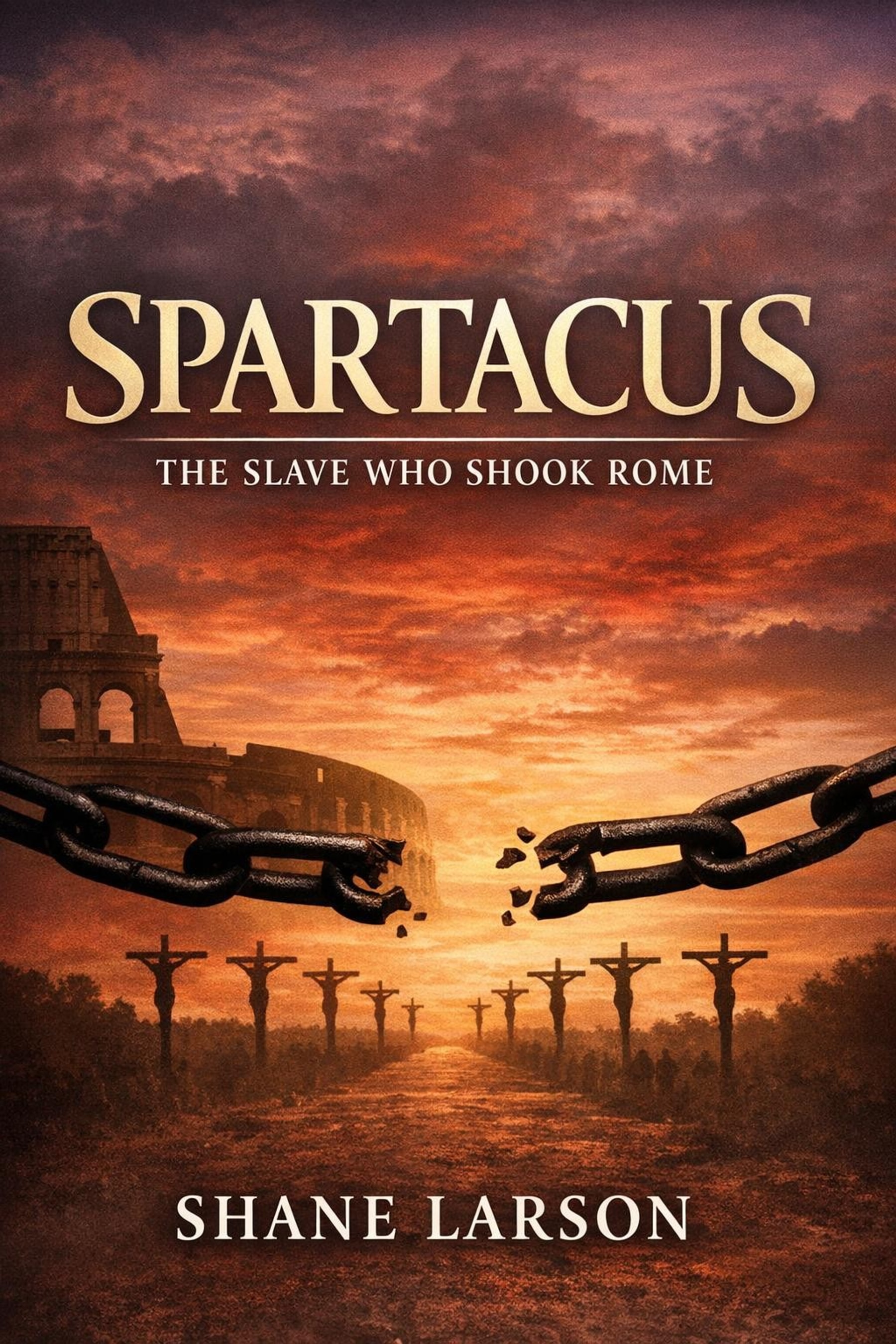
Spartacus
The Slave Who Shook Rome
By Shane Larson
About This Book
The Horse Before the Battle
The morning of the final battle in Lucania, Spartacus killed his own horse.
The gesture was read clearly by everyone present. If he won, he would have no need of a horse. If he lost, he did not intend to leave the field. He had commanded armies now for two years. He had beaten two Roman consuls in sequence. He had marched the length of Italy twice. And he understood exactly what Marcus Licinius Crassus had been hired to do to him.
What happened next is mostly lost. Plutarch says he fought toward Crassus in the line and was surrounded and cut down. Appian says the body was never identified. What survived, and what Crassus arranged to survive, was the road — a hundred and twenty miles of crucified men from Capua to Rome, one every hundred feet, for the traveler to count on the way up from Campania to the city.
What Rome Tried to Forget
The Third Servile War should have been a catastrophe worth analyzing. A gladiator's revolt had turned into a full-scale war that tied down Roman armies for two years, defeated consular forces in pitched battle, and at one point threatened Rome itself. And yet the senatorial class, after Crassus's crosses came down, simply stopped writing about it.
Cicero, who was in his thirties and politically active during the war, barely mentions Spartacus. Julius Caesar, in Rome during the fighting and later a relentless memoirist of his own campaigns, never writes about it in any surviving work. What we have comes from Plutarch's life of Crassus and Appian's Civil Wars, both composed more than a hundred and fifty years after the events they describe, and they disagree on nearly every specific — numbers, geography, motivation, even the manner of Spartacus's death.
The silence is the story. The war was not forgotten because it was small. It was forgotten because the Republic could not absorb what it meant: that the economic foundation of Roman life — mass enslaved labor on a scale the world had never seen — could turn against Rome, produce a commander equal to any Rome had fielded that generation, and very nearly win.
Spartacus: The Slave Who Shook Rome is the full narrative, built from what the surviving sources do say, what they carefully do not say, and what the archaeology of the late Republic confirms.
What's Inside
- The Thracian world Spartacus came from — not the Hollywood version, but the real border culture between the Roman frontier and the steppe, with its own warrior traditions and its own uneasy relationship with Rome.
- His service in a Roman auxiliary unit before he was enslaved. This is the single most important fact in the whole story, and most popular accounts skip over it. The tactical sophistication of the revolt becomes inexplicable without it.
- The breakout at Capua — seventy men, kitchen weapons, a single night — and the early core of followers who made the rebellion into something more than a jailbreak.
- The descent from Vesuvius on ropes woven from wild vine, the engagement that followed, and why this single episode established Spartacus as a commander the Roman state would have to take seriously.
- The victories of 72 BCE, when two Roman consular armies were defeated in sequence — the last time a foreign or domestic enemy had managed that was Hannibal.
- The split with Crixus, the march north, and the central mystery of the war: why, with the Alps and freedom in sight, the rebel army turned around.
- The funeral games at which captured Romans were forced to fight each other as gladiators — one of the most deliberate acts of symbolic reversal in ancient warfare.
- Crassus, his wealth, his ambition, and his revival of decimation — the archaic Roman punishment of executing one man in ten in a failed unit, performed on his own soldiers.
- The rivalry between Crassus and Pompey that the war created and the civil wars that rivalry would help produce twenty years later.
- The crucifixions along the Appian Way, what Roman crucifixion actually was as state theater, and why Crassus chose exactly this punishment for exactly these prisoners.
- The long afterlife: how Spartacus went from senatorial embarrassment to Karl Marx's "most splendid fellow in the whole of ancient history," to the Hollywood blacklist, to the Starz series.
Why I Wrote This
I came to Spartacus the way most people do — through the Kubrick film. And like most people, I came away with a version of the story that is mostly wrong. The real Spartacus is not a symbol. He is a specific man, with specific training, making specific decisions in a specific campaign that any military historian can follow on a map.
What drew me to write this book was the silence in the sources. Cicero was there. Caesar was there. Neither of them wanted to talk about it. That kind of silence in Roman writing is never accidental, and once I started pulling on it, the whole late Republic looked different — Crassus's careerism, Pompey's opportunism, the generational politics that would produce the civil wars, all of it visible in how Rome decided to remember, and not remember, the two years when an enslaved Thracian held the peninsula hostage.
I wanted to tell the story the way the sources we have actually tell it — with the gaps acknowledged, the disagreements named, and the man at the center restored to the ordinary human scale of someone who made a series of difficult decisions under impossible pressure and came astonishingly close to winning.
Frequently Asked Questions
Do I need to have read other books on the late Roman Republic first?
No. Spartacus is written to stand on its own. Background on the Republic, the social order, and the military system is built into the narrative where it matters. If you have read widely in the period, the book will extend what you know rather than repeat it.
How does this compare with Barry Strauss's The Spartacus War?
Strauss's book is a fine military history and a natural companion. This one gives more weight to the political aftermath — the Crassus-Pompey rivalry, the silence of the sources, and the long afterlife of the story — and less to speculative tactical reconstruction.
Is this a narrative history or an academic study?
Narrative, written for general readers. The sources and scholarship are discussed openly where they matter, but the book reads as a story. Endnotes and further reading point interested readers to the specialist literature.
What does the book do with the missing sources?
It names the gaps. Where Plutarch and Appian disagree, the disagreement is explained. Where Cicero and Caesar are conspicuously silent, that silence is treated as evidence about Roman politics, not skipped over. The goal is to let the reader see the story being reconstructed, not to paper over the reconstruction.
Is this book available on Kindle Unlimited?
Yes. Spartacus is available through Kindle Unlimited as well as for individual purchase on Kindle and in paperback.
Does it cover the Hollywood and political afterlife of Spartacus?
Yes — the final section traces Spartacus from the senatorial blackout through Marx, the 1960 Kubrick film, the Hollywood blacklist, and the recent Starz series. The afterlife is a significant part of why the historical Spartacus is so hard to see clearly, and the book treats it directly.
If You Liked This, You Might Like
- Hannibal's War — the other great commander who humiliated Rome in the field, told with the same narrative approach.
- The Last Days of Carthage — the destruction of a rival civilization by the same Roman state that would later crucify six thousand on the Appian Way.
- The Fall of Rome — the long ending of the empire whose slave economy Spartacus nearly broke.
- Nero — the emperor a century later who inherited the state Crassus, Pompey, and Caesar built out of the Republic that Spartacus shook.
The Slave Who Shook Rome
Two years, two consular armies, seventy thousand men, and a silence that told its own story. This is Spartacus as the sources let us see him — commander, strategist, and the man Rome could not afford to remember.
Included with Kindle Unlimited — read it free if you're a member.
New Ancient History releases and free chapters — no spam, unsubscribe anytime.