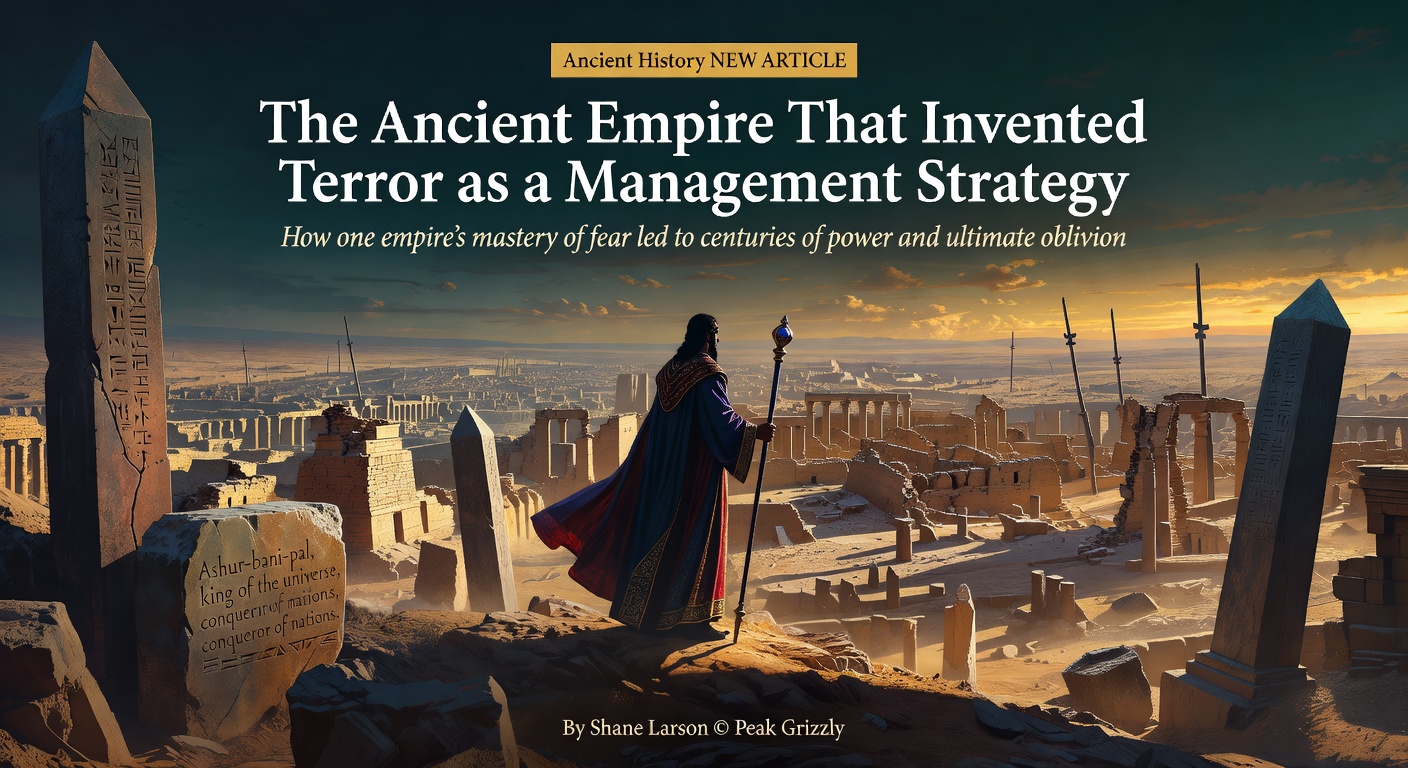
The Ancient Empire That Invented Terror as a Management Strategy
April 5, 2026 · 6 min read
The Assyrians impaled prisoners on stakes outside conquered cities. They flayed rebel leaders alive and displayed the skins on the walls. They deported entire populations -- an estimated four to five million people over three centuries -- across hundreds of miles of hostile terrain.
And they wrote it all down. In detail. On stone monuments designed to last forever.
This was not mindless cruelty. It was policy. The Assyrian kings documented their atrocities because the documentation was the point. Terror was a communication strategy. Every impaled body was a press release. Every mass deportation was a memo to the next city in the army's path: submit or this happens to you.
The strategy worked for roughly three hundred years. Then it stopped working, and the empire that had perfected fear discovered the fatal flaw in ruling through terror: when you fall, nobody helps you up. The Assyrians were destroyed so completely that their greatest cities were buried and forgotten for over two thousand years. A Greek army marched past the ruins of Nineveh in 401 BC without recognizing them.
But between the founding and the annihilation, the Assyrians built something remarkable -- not just a war machine, but the world's first modern empire.
They Started as Merchants, Not Warriors
The origin story of Assyria is not what you'd expect. The city of Ashur, perched on a limestone bluff overlooking the Tigris River, began as a trading town. Around 1900 BC, Assyrian merchants operated one of the most sophisticated commercial networks in the ancient world.
They established colonies called karum across central Anatolia. The business model was elegant: export textiles and tin eastward from Ashur, sell them for silver and gold, ship the profits home. Archaeologists have recovered over 23,000 cuneiform business tablets from a single site -- contracts, shipping manifests, bills of exchange, debt collection procedures, and joint-venture agreements. One letter from a merchant's wife to her traveling husband captures the tone: "You keep sending letters with promises and excuses. Send the silver you owe or do not bother writing again."
These merchants weren't soldiers. But they were building something that would later support an empire: organizational habits. The same pragmatism, logistical talent, and willingness to project power far beyond home territory that made the karum system work would eventually make the Assyrian military machine unstoppable.
The transition from trading town to military power took centuries and several false starts. Assyria spent long periods under the domination of other powers -- the Hurrian kingdom of Mittani kept Ashur as a vassal for roughly three hundred years. Later Assyrian inscriptions looked back on this period with undisguised hostility. The Assyrians had long memories, and they did not forget what it felt like to be someone else's subject.
The Machine Behind the Conquests
What made the Assyrian Empire genuinely innovative wasn't the violence. Plenty of ancient states practiced violence. What set Assyria apart was the system -- the administrative machinery that turned conquest into governance.
At its height, the empire was divided into roughly seventy provinces, each with a governor who collected taxes, maintained order, raised troops, and reported to the central government. Provincial governors were rotated to prevent them from building local power bases. They were monitored by royal inspectors and intelligence agents who reported directly to the king. Their correspondence was reviewed. Their accounts were audited.
The surviving correspondence reveals a level of micromanagement familiar to any modern bureaucrat. Here's Sargon II writing to a governor: "Regarding the horses you wrote to me about: the horses that are suitable, harness them to a yoke. Those that are not suitable, give them out to graze. Why do you keep writing to me about this? Use your judgment."
Even the king found the paperwork exhausting.
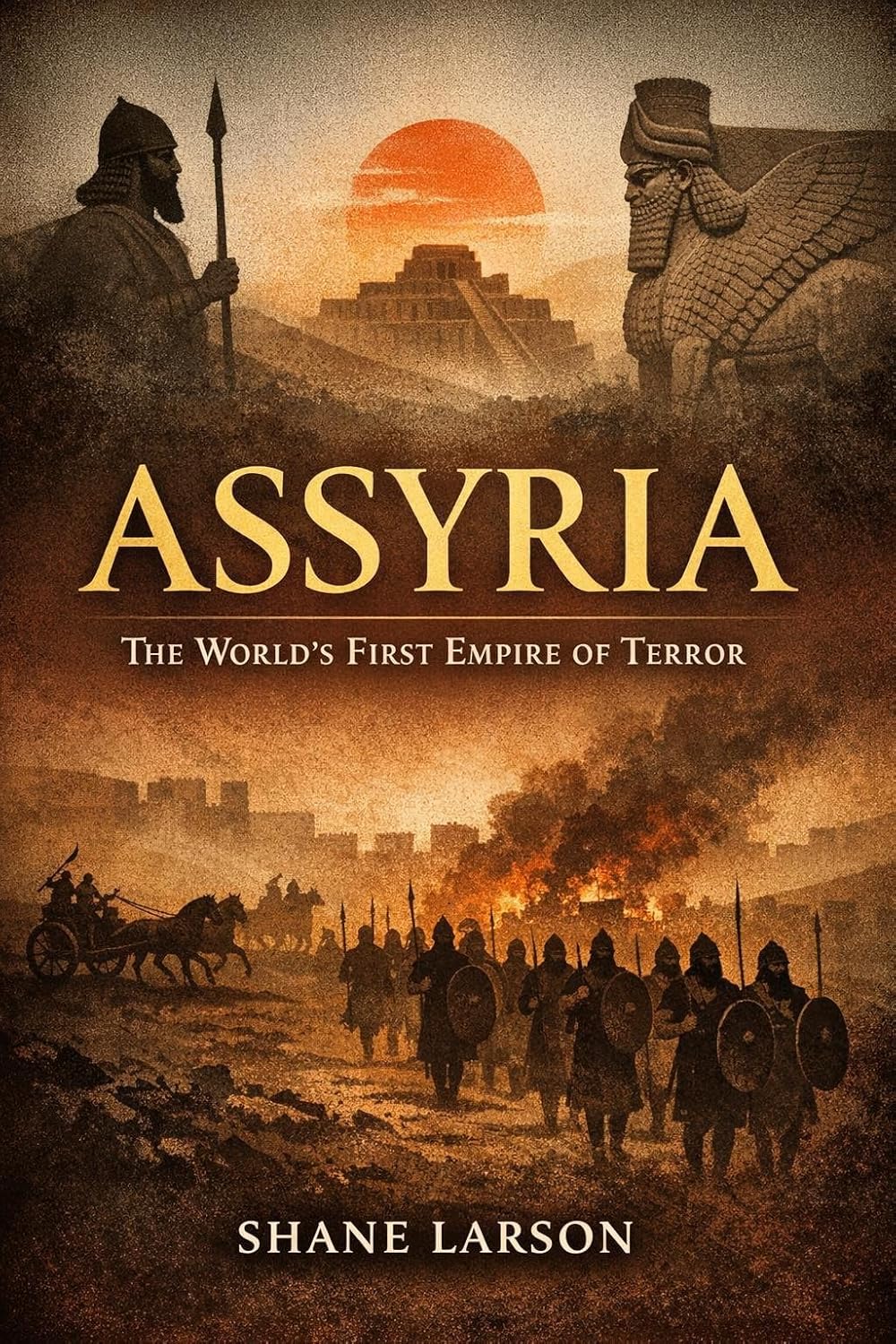
Assyria
The intelligence apparatus was equally systematic. Thousands of letters from spies, informants, and military scouts survive in the royal archives. A typical report from a border agent: "The Urartian army has assembled at Turushpa. They have gathered their forces. The cavalry numbers approximately three thousand. They are provisioning for a march. I will continue to observe and report." This is recognizably modern intelligence work -- observation, force estimation, assessment of intent, and a promise of continued surveillance.
The road system connected Nineveh to every major provincial capital and frontier garrison. Relay stations, spaced at intervals of roughly a day's ride, maintained fresh horses, food, and water. Urgent messages could travel from the Egyptian frontier to Nineveh in about two weeks. The system also moved armies -- when a rebellion erupted in Babylonia, forces from the northern frontier could be redeployed in weeks.
Mass deportation was itself an administrative operation of extraordinary complexity. Deportees had to be gathered, organized, fed for journeys lasting weeks, and resettled with sufficient agricultural land to be productive. Many deportees were skilled craftsmen deliberately relocated to where their skills were needed. The system served multiple strategic purposes simultaneously: it broke the power of conquered elites, populated underdeveloped frontier regions, mixed ethnic groups to prevent coordinated rebellion, and provided labor for massive building projects.
The human cost was incalculable. The biblical account of the deportation of Israel in 722 BC -- an entire people uprooted and scattered -- captures the trauma. That the Israelites survived as a distinct people is remarkable. Most deported populations did not.
The Fall That Proved Terror's Limits
The Assyrian Empire did not decline gradually. It was destroyed in less than twenty years. In 631 BC, Ashurbanipal -- the scholar-king who assembled the ancient world's greatest library while crushing rebellions across the empire -- died. Within four years, his sons were fighting a civil war over the succession.
While Assyrian princes fought each other, two enemies organized. Nabopolassar, a Chaldean leader, seized Babylon in 626 BC and spent years building an alliance. His partner was Cyaxares, king of the Medes, who had his own centuries of grievances. Together, attacking from two directions, they created a strategic problem no Assyrian king could solve.
The Medes struck the symbolic heart first. In 614 BC, they sacked Ashur -- the ancient religious capital from which the empire and the god took their name. Then, in 612 BC, the combined forces converged on Nineveh itself. After a three-month siege, abnormal flooding undermined a section of the walls. The coalition poured through the breach.
What followed was the systematic annihilation of the greatest city in the ancient Near East. The palaces of Sennacherib and Ashurbanipal were burned. The temples were demolished. The destruction was so thorough that within a generation, people had forgotten where Nineveh was.
The last Assyrian general retreated to Harran. Egypt -- which had spent decades trying to escape Assyrian domination -- now tried to prop Assyria up as a buffer against Babylon. It was too late. By 609 BC, the empire was finished. Ashur-uballit II, the last man to claim the Assyrian throne, simply vanishes from the historical record.
The completeness of Assyria's destruction is what distinguishes it from every other ancient collapse. Other empires left successor states, cultural legacies, continuing populations. The Assyrians left ruins so thoroughly buried that they were not rediscovered until the nineteenth century.
Terror had built the empire. Terror also ensured that when the empire weakened, every subject people wanted not just independence but annihilation. Nobody owed the Assyrians anything. Nobody had reason to preserve what they had built. The system that had terrorized half a continent received, in the end, exactly what it had taught its subjects to deliver: total destruction, without mercy.
Assyria
New posts and releases, straight to your inbox. No spam, unsubscribe anytime.