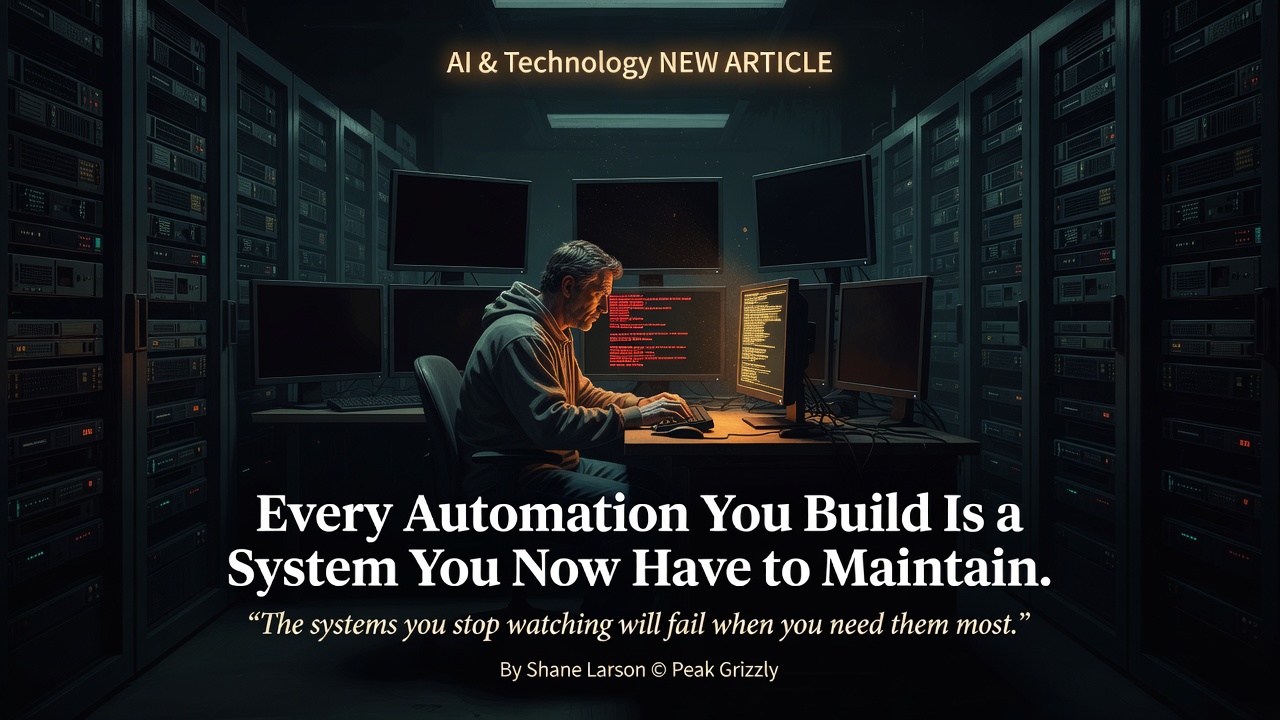
Every Automation You Build Is a System You Now Have to Maintain
August 5, 2026 · 5 min read
The pitch for automated income is build once, earn repeatedly. The appeal is obvious: replace linear effort with a system that keeps producing after you stop working on it.
The part that gets left out is that you did not build an asset. You built a small piece of software that runs unattended, depends on services you do not control, and will break — and when it breaks, it will often do so quietly.
That is not an argument against automation. It is an argument for being deliberate about which ones you build, because the cost is not the afternoon you spent building it.
What an Automation Actually Costs
Three costs, and only the first is visible when you decide.
Build cost. The hours to make it work. This is the one everyone estimates, and it is usually the smallest of the three.
Maintenance cost. Every automation sits on top of things you do not control. An API changes its response format. A service revises its pricing or its rate limits. A site changes its layout. A credential expires. Each of these is somebody else's routine Tuesday and your broken pipeline. A system with five external dependencies has five independent chances per year of needing attention, and they do not coordinate.
Failure cost. This is the one that hurts, and it depends entirely on whether the failure is loud or quiet.
A loud failure stops. You notice, you fix it, you lose a day. Annoying and survivable.
A quiet failure keeps running and produces wrong output. The content pipeline that has been publishing with a broken template for three weeks. The pricing sync that silently stopped updating and has been quoting last quarter's numbers. The report that has been arriving on schedule, looking normal, computed from a data source that went stale in April.
Quiet failures are strictly worse than not automating, because you have replaced work you were doing with confidence you have no basis for. And they are the default failure mode, because the thing you removed from the process was the human who would have noticed something looked wrong.
The Complexity Ladder
Automations are not one category, and the economics change sharply as they get more ambitious.
Level 1 — one trigger, one action. Half an hour to build. A form submission creates a record. Almost no maintenance, almost no risk. These are underrated because they are unglamorous.
Level 2 — sequential workflows. An hour or two. Several steps in order. Still tractable; the failure modes are usually loud.
Level 3 — conditional logic. Several hours. Branching, different paths for different inputs. This is where quiet failures start, because a branch nobody exercises can be wrong for months.
Level 4 — AI-generated content or decisions in the loop. Most of a day. Now the output varies by design, which means "looks plausible" no longer tells you it is working. Verification becomes a genuine problem rather than a glance.
Level 5 — full system integration. Days to weeks. Multiple services, real state, error handling that has to be designed rather than assumed. You have written software, and it needs the things software needs: monitoring, logging, a way to tell whether it ran correctly.

The AI Income Handbook
The mistake nearly everyone makes is jumping to level 4 or 5 for the first build, because that is where the impressive demos live. The level 1 and 2 automations are where the reliable return is, and they are boring enough that nobody sells a course about them.
The Questions Worth Asking First
Before building anything, five questions. If you cannot answer them, you are not ready to build it.
Does it actually save time? Measured honestly, including the build, including the maintenance, amortised over how long you will realistically use it. A great many automations are net negative on this alone and never get evaluated because measuring would be uncomfortable.
Is it reliable enough to trust unattended? Not "does it work today." Does it work when the input is malformed, when the service is slow, when a field is missing?
Does it improve quality, or just speed? Some automations make output more consistent, which is real value. Some make it faster and slightly worse, which is a trade you should make deliberately rather than accidentally.
Can it scale? If volume triples, does it still work, and what does it cost?
What breaks it — and will I know? The most important question and the least asked. List the dependencies. Then decide how you would find out about a silent failure. If the answer is "I'd eventually notice," the automation needs a check before it needs any more features.
The Rule That Matters Most
If a failure would be quiet, build the check before you build the automation.
That check does not have to be sophisticated. A count that should never be zero. A timestamp that should never be older than a day. A weekly summary you actually read. A sanity assertion on the output that fails loudly when violated.
Unmonitored automation is not passive income. It is deferred risk, and the interest compounds silently.
What This Leaves You With
The realistic version of the promise: a small number of well-chosen, well-monitored automations can meaningfully reduce recurring work and produce genuine leverage. That is worth having and it is a real change from a few years ago.
What it is not is passive. It is a portfolio of small systems you own, and ownership means attention — less attention than doing the work by hand, but not zero, and never zero.
The people who do well at this build few things, build them at the simplest level that solves the problem, monitor all of them, and delete the ones that stop earning their maintenance. The people who do badly build many things quickly, find out about the failures from a customer, and quietly abandon the whole approach.
The difference is not skill. It is whether you priced the second and third costs before you started.
The AI Income Handbook: Making Money with AI Systems covers the toolkit, automation principles, the complexity pyramid, prompt engineering for production use, and the testing framework for deciding what is actually worth building.
The AI Income Handbook
New posts and releases, straight to your inbox. No spam, unsubscribe anytime.