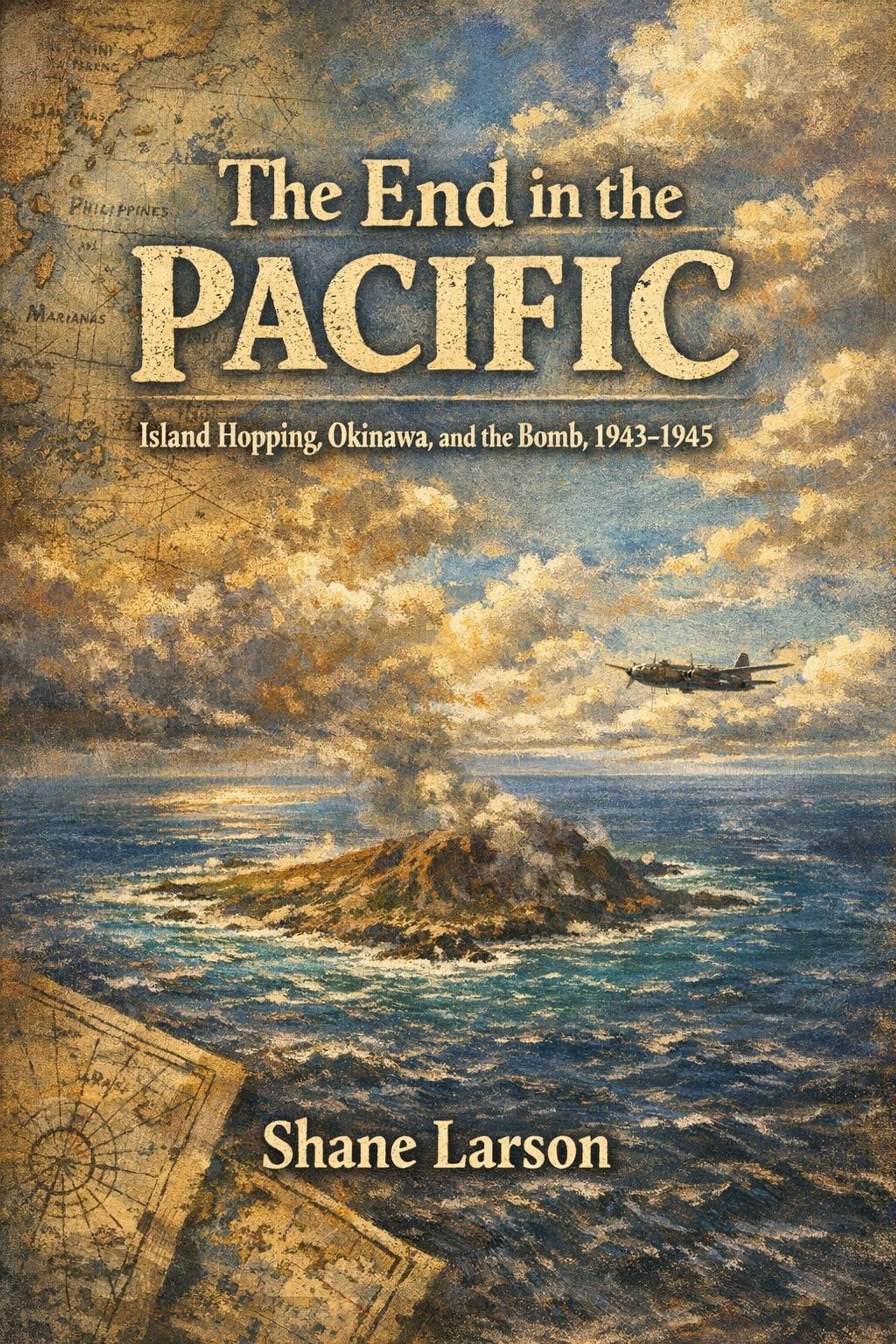
The End in the Pacific
Island Hopping, Okinawa, and the Bomb, 1943-1945
By Shane Larson
About This Book
For nearly two years of the Pacific war, American submarine captains made dangerous approaches on Japanese ships, fired, watched their torpedoes run straight to the target — and watched nothing happen. Some heard the metallic clang of a direct hit carry through the hull, followed by silence. They wrote it up, patrol after patrol. The Bureau of Ordnance, which had designed the Mark 14 torpedo and barely live-tested it, answered that the fault lay with the men firing it.
The weapon was defective three times over: it ran deeper than set, its magnetic exploder detonated early or never, and its contact pistol crushed itself on a square hit. Each fault masked the next. Not until the autumn of 1943 — after Pacific commanders ran their own tests over the bureau's objections — did the submarine force have a torpedo that worked. What followed decided the war: a force never reaching two percent of the Navy's personnel sank more than half of everything Japan lost at sea, and by 1945 the empire's oil had simply stopped moving.
Almost none of that is in the version of the Pacific war most readers carry, which runs from Pearl Harbor through a sequence of terrible islands and ends under a mushroom cloud. The End in the Pacific: Island Hopping, Okinawa, and the Bomb, 1943–1945 makes the case that this version has the emphasis in the wrong places — and that putting it right changes what the atomic bombs were the end of.
Japan seized its empire in five months and then faced the problem that sank it: a scatter of garrisons across thousands of miles of ocean, dependent on merchant shipping it had made no serious plan to protect and could not replace. Once the torpedoes worked, the empire came apart from underneath — not battle by battle but sea lane by sea lane. The famous islands fit inside that process, and they make sense only when read as what they were: airfields. Saipan and Tinian brought Tokyo inside the combat radius of the B-29; Iwo Jima sat under the bombers' route; Okinawa could stage an invasion. The target list looks arbitrary until the aircraft's range is drawn on the map, and then it looks like a design.
The bombing those airfields enabled is a chapter of its own here, placed before Hiroshima on purpose. On the night of 9–10 March 1945, incendiaries burned sixteen square miles of Tokyo, and the number of people who died in those hours exceeded what either atomic weapon killed on the day it fell. That fact is missing from most popular accounts, and its absence distorts everything downstream.
Which brings the book to its most careful work. Hiroshima and Nagasaki occupy two chapters of fourteen — their true proportion in a war Japan had already lost materially — and those chapters equip the reader rather than instruct them. They reconstruct what was actually on the table in the summer of 1945: the Kyushu invasion plans and the casualty projections as planners wrote them then, markedly lower than the numbers cited in later justifications; the intercepted cables showing a cabinet pursuing Soviet mediation while conspicuously not offering to surrender; and the Soviet declaration of war on 9 August, whose weight in Tokyo's deliberations the contemporary record documents alongside the bombs. The strongest postwar objections — several from American commanders — are set out and left standing. No verdict is delivered, because the evidence runs out precisely where a verdict would have to begin, and a book that respects its reader says so instead of bluffing past it.
What's Inside
- Guadalcanal as the war's hinge in attrition rather than territory — what each side lost in aircraft, ships, and trained aircrew, and which side could make good the losses.
- A full chapter on the submarine war, with the complete timeline of the torpedo denial and the quarter-by-quarter destruction of the Japanese merchant marine once it ended.
- Tarawa and the Marshalls as a matched pair: seventy-six hours that exposed every flaw in amphibious doctrine, and the landings ninety days later that proved the lessons absorbed.
- Leyte Gulf told as one battle, its four actions in sequence so the reader tracks what each commander knew and when — including Taffy 3's stand off Samar and the Halsey controversy weighed against the actual signals.
- Okinawa in both of its dimensions: the kamikaze campaign that gave the US Navy its worst casualty figures of the war, and a civilian death toll of a quarter to a third of the island's population — the number planners then applied to Japan itself.
- The Soviet offensive in Manchuria given a chapter of its own — 1.5 million men destroying the Kwantung Army in under two weeks, an operation of Eastern Front scale that English-language histories routinely reduce to a footnote.
- A final accounting of the Pacific war's dead by country, with sources and ranges — a total that was overwhelmingly Asian and overwhelmingly civilian, and that most histories of this war never write down.
Why I Wrote This
This is the tenth and last volume of the series, and finishing it clarified what the whole set had been about. I thought I was writing about campaigns. What kept surfacing, volume after volume, was something narrower: institutions that possessed the information they needed and could not turn it into action. The torpedo scandal is the purest form of that pattern I've found anywhere — two years of patrol reports sitting inside the one bureau that needed to read them.
The other reason is the count. Somewhere in assembling the casualty appendix I realized the Pacific war's dead were overwhelmingly Asian civilians — Chinese, Indonesian, Vietnamese, Filipino, Indian — and that I could not find the full total written down in any of the popular histories on my own shelf. A war's accounting is part of its history. This volume writes it down.
Frequently Asked Questions
Does the book say whether dropping the atomic bombs was the right decision?
No, deliberately. The book establishes everything the record can establish — what planners projected at the time, what the cabinet was doing, what the Soviet entry changed — and then marks the exact spot where the answer stops being a finding and becomes a judgement about paths never taken. That judgement it leaves with the reader.
Do I need to read the other nine volumes of the series first?
No. The introduction opens with a survey of the entire war to date, written to orient a reader starting here, and the Pacific thread is picked up from its beginning at Guadalcanal. Nothing in this book depends on the earlier ones.
Does it cover the Soviet invasion of Manchuria?
Yes — a full chapter, deliberately placed between Nagasaki and the surrender, because that is where it sat in the Japanese cabinet's deliberations. It gives the offensive's scale, its speed, and its documented weight in Tokyo's decision.
How does the book handle death tolls and other disputed figures?
Every contested number — Hiroshima, Nagasaki, Tokyo, Okinawa's civilian dead, Manila, the invasion estimates, the Chinese and famine totals — is given as a range with the disagreement named and the sources identified. Where attribution is unsettled, the book says so rather than picking a number quietly.
Does it cover the war in China and Burma?
Honestly: only partly. The narrative follows the Pacific drives from Guadalcanal to Tokyo Bay; China and Burma appear in the timeline appendix and, decisively, in the final accounting, where China's fourteen-to-twenty-million dead anchor the war's true shape. For a campaign history of those theatres, look elsewhere.
If You Liked This, You Might Like
- The Institutional Collapse Pattern — the torpedo bureau and the deadlocked Tokyo cabinet are both case studies in the failure mode this book examines systematically: trusted systems that stop processing their own bad news.
- Collapse Proof — the mirror of this volume's finding that the side able to admit error fastest won the tonnage war; it asks what lets some institutions metabolise failure.
- The Empire Collapse Pattern — Japan's empire was disconnected rather than conquered, and this book traces the same overextension arithmetic across history's mightiest powers.
Three years of ocean war in their true proportions — and on the century's hardest question, the evidence in honest order and the conclusion left to you.
The tenth and final volume of The Second World War Chronicles.
What You'll Learn
- How a two-year torpedo failure — and the bureau that refused to believe it — delayed the war's most decisive campaign
- Why the island objectives look arbitrary until you draw the B-29's radius on a map
- What the March 1945 Tokyo firebombing did, and why it is missing from popular memory
- The 1945 invasion casualty estimates as planners actually wrote them — and how the postwar figures grew
- What Japan's cabinet actually discussed in August 1945, from the contemporary record
- The Soviet offensive in Manchuria — an operation on an Eastern Front scale, almost unknown in English
- The Pacific war's full death toll, overwhelmingly Asian and civilian, written down with sources and ranges
Included with Kindle Unlimited — read it free if you're a member.
New Military History releases and free chapters — no spam, unsubscribe anytime.