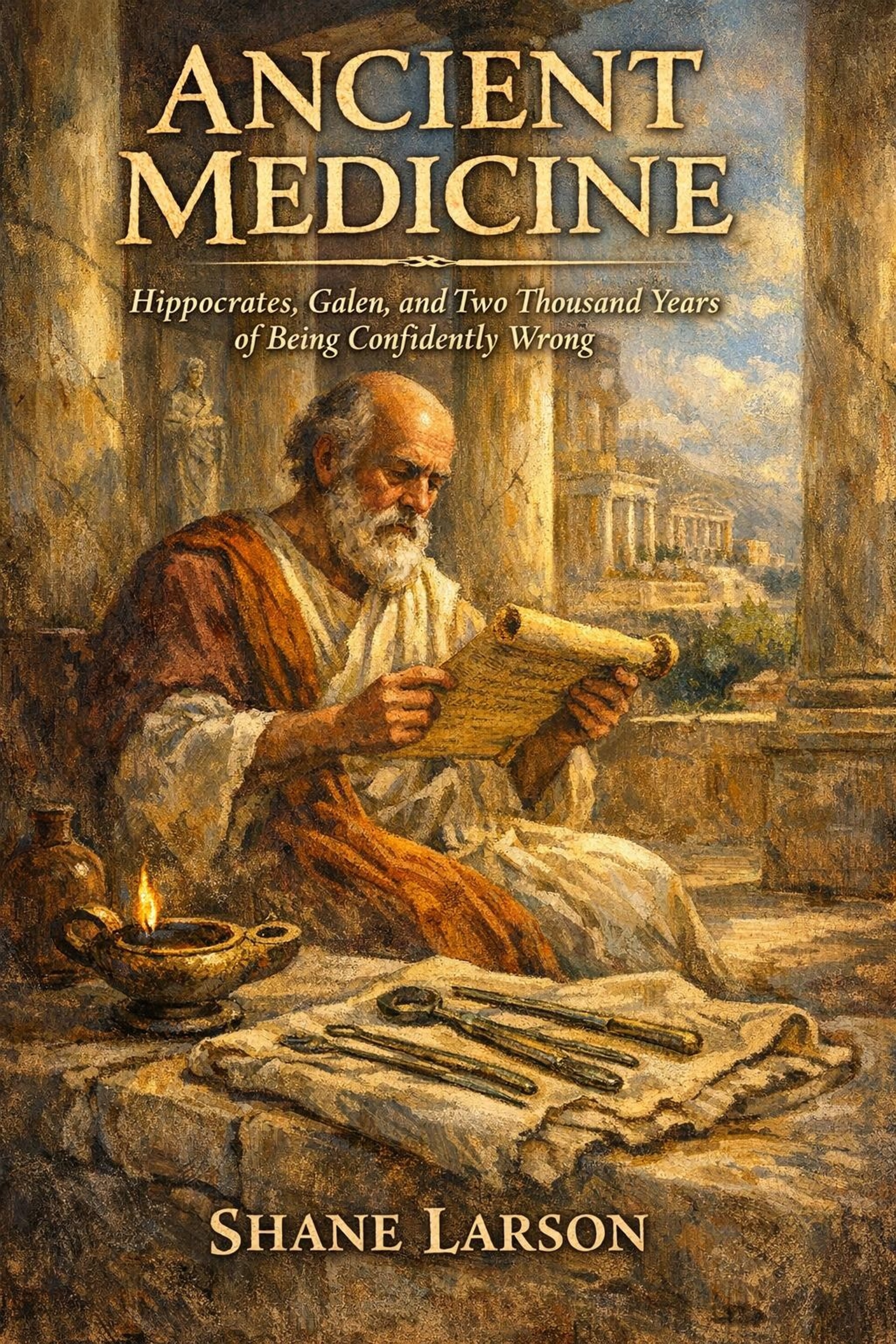
Ancient Medicine
Hippocrates, Galen, and Two Thousand Years of Being Confidently Wrong
By Shane Larson
About This Book
Picture an anatomy lesson at a medieval university — Bologna, say, around 1400. Three men run the room. The lector sits in a raised chair, well away from the table, reading Galen aloud from a manuscript. A demonstrator stands below him with a wand, pointing at whatever structure the text has just named. A barber-surgeon does the actual cutting, because cutting is manual labour and no professor would touch it. And on the table lies the fourth party to the proceedings: the cadaver, the only participant with direct knowledge of human anatomy, and the only one nobody consults.
Nothing about this scene involved bad faith. The students were diligent, the lector learned, the text venerable. When the body on the table failed to match the book — and it failed often, because the book had been written by a man who was never once permitted to open a human being — the discrepancy was read as a defect in the specimen. Bodies varied. Bodies decayed. The text did not. A dissection, the one procedure on earth that could have exposed the oldest error in Western science, had been carefully staged so that it demonstrated the error instead.
That room is where this book was headed all along, and understanding how Europe built it — honestly, rationally, one reasonable decision at a time — takes fourteen centuries of history and every chapter in between.
Ancient Medicine traces the Western medical tradition from an Egyptian surgeon's casebook written a thousand years before Hippocrates to the Paduan anatomists who finally dismantled it in the sixteenth century. Along the way it takes the ancient physicians seriously on their own terms, which turns out to be the hard part. The four humours were not a superstition; they were a sophisticated theory that could account for any clinical outcome whatsoever — and that flexibility, which every practitioner experienced as explanatory power, was precisely what made the system impossible to test. A patient who improved confirmed it. A patient who declined confirmed it. A patient who died confirmed it. For over a millennium, no bedside anywhere produced a result the framework was obliged to reject.
The argument is that this longevity was structural — three separate failures locking together. Dissection was forbidden nearly everywhere and nearly always, so the most direct check on anatomical claims was unavailable. Galen's corpus was so vast and so systematic that challenging it meant fighting a library single-handed. And the humoral framework staked nothing on any individual case, so even the doubters got absorbed: when al-Razi in tenth-century Baghdad filled his notebooks with patients whose courses contradicted Galen, the tradition simply copied his doubts into the canon and carried on. The exception proves the mechanism. For roughly two generations under the early Ptolemies, Alexandria permitted human dissection — and Herophilus and Erasistratus promptly mapped the nervous system, the heart's valves, and the brain's claim to be the seat of thought. Then the permission lapsed, the work survived only where later authors quoted it, and the moment did not come again for fifteen hundred years. Given the chance to look, they looked, and found in decades what the closed system missed for centuries.
Why I Wrote This
The question that pulled me in was not why ancient medicine was wrong. Being wrong is normal; every era's medicine is wrong about something. The question was how a discipline stayed wrong about nearly every mechanism for fourteen hundred years while remaining genuinely useful the whole time — full of careful observers, honest record-keepers, and skilled hands, none of whom could find the wall of the enclosure they were walking in. Most tellings of this story pick one of two easy tones: mockery of the benighted ancients, or the fashionable insistence that they were secretly right all along. Both seemed lazy to me, and both dodge the real subject, which is what happens to a body of ideas when nothing anywhere in it can lose an argument to the evidence. That is a structural question, not a medical one, and it does not stay safely in the past. I wanted to write the version that takes it seriously.
Frequently Asked Questions
Is Ancient Medicine a medical book or a history book?
A history book, unambiguously. It makes no claims about anyone's health, offers no remedies, and evaluates every ancient treatment strictly as a historical practice. Even the pharmacology appendix is a historical assessment, not guidance of any kind.
Do I need a background in medicine or the classics to read it?
No. Every anatomical term, ancient author, and historical setting is explained as it arrives. The book was written for a general reader who likes history told as an argument.
Did ancient medicine actually work?
Mostly it did not, and some of it — bloodletting above all — did harm. A minority of ancient drugs contained genuinely active compounds, and some surgical procedures had real success rates. The crucial point, and one of the book's themes, is that the practitioners had no method capable of telling the effective from the useless, so both sat in the same pharmacopoeia for centuries.
Does the book cover the Hippocratic Oath?
Yes, in a dedicated chapter — including what the text actually says, the clauses that never get quoted, and the scholarly debate over how widely it was ever sworn in antiquity.
Did bloodletting really last into the nineteenth century?
It did. The practice outlived the humoral theory that had justified it, which is itself part of the book's argument about how entrenched practices detach from the ideas that created them.
How long is the book?
About 75,000 words — roughly 253 pages in print — organised as fourteen chapters plus an introduction, a conclusion, and three reference appendices.
If You Liked This, You Might Like
- The Library of Alexandria — The institution that made the Alexandrian anatomists possible; this is the fuller story of the city where, for two generations, medicine was briefly allowed to look.
- Marcus Aurelius: The Emperor Who Chose Wisdom Over Power — Galen served as personal physician to Marcus Aurelius; the emperor's side of that Rome is here.
- Stoicism: A Five-Hundred-Year Conversation — The philosophical world the Greek physicians argued inside, and a school that, unlike humoral medicine, kept its central claims open to challenge.
Sylvius, Galen, and forty generations of physicians between them were never the problem. The problem was a structure with every exit closed — and this is the history of how it was built, and what it finally took to open a door.
What You'll Learn
- The Edwin Smith papyrus, a trauma manual older than Hippocrates by a millennium, whose anonymous author recorded forty-eight injuries case by case — and marked some, without embellishment, as beyond anyone's help.
- A full chapter on the Oath and the *Epidemics* — professional ethics and the day-by-day clinical record as genuine Greek inventions, deaths included.
- The Alexandrian anatomists in detail, including the water clock Herophilus used to time the pulse and the vivisection allegation levelled at him by hostile later sources — weighed rather than repeated.
- Roman practice from the ground up: the surgical kits excavated at Pompeii and Rimini, the operations they supported, the legionary hospital, and the aqueducts and drains that did more for public health than any physician of the era.
- The healers the textbooks ignore — temple medicine at Epidaurus, midwives who attended nearly every ancient birth, root-cutters and amulet-sellers — and what sick people actually did as opposed to what learned doctors advised.
- Dioscorides' catalogue of six hundred plants, in continuous use for sixteen centuries, in which the handful of genuinely active substances sat beside elaborate compounds that did nothing, with no method available to tell them apart.
- Galen across two chapters and two verdicts: the wrong system he built from animal bodies, and the brilliant public experiments — severed nerves, tied arteries — that were real science conducted inside it.
- Baghdad's role told properly: Hunayn ibn Ishaq's exacting translations, Ibn Sina's five-hundred-year textbook, and transmission as interpretation rather than relay.
- Why Vesalius's two hundred corrections dented the system but Harvey's simple calculation about the volume of blood the heart moves per hour destroyed it — and why a number succeeded where anatomy failed.
Included with Kindle Unlimited — read it free if you're a member.
New Ancient History releases and free chapters — no spam, unsubscribe anytime.