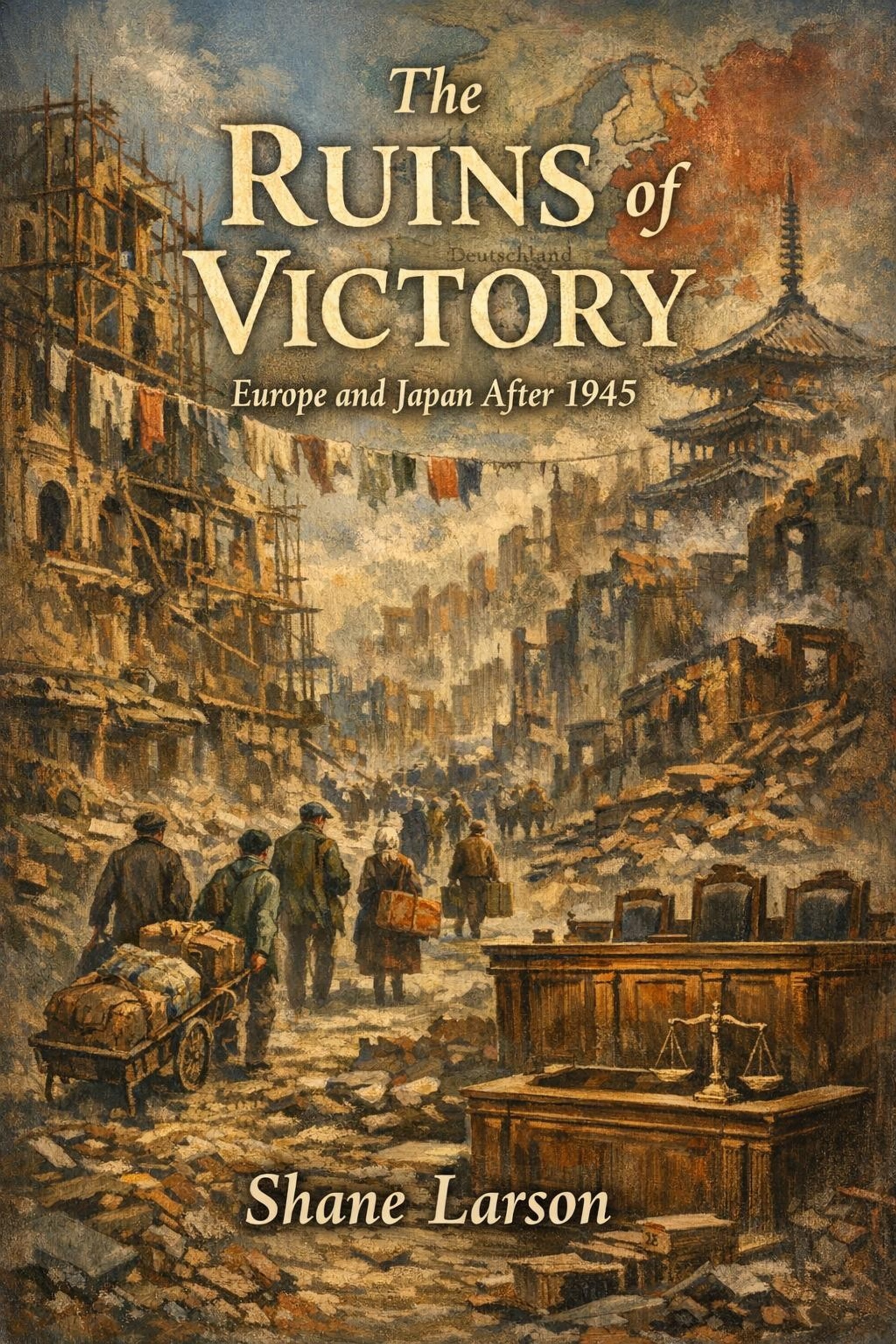
The Ruins of Victory
Europe and Japan After 1945
By Shane Larson
About This Book
In occupied Germany, in the late 1940s, there was a piece of paper worth more than money. It certified that its holder had been examined and found untainted by the regime he had spent twelve years serving, and Germans named it after a laundry detergent: the Persilschein — the Persil certificate, the paper that washed whiter. It was issued by the millions. A program built to remove a dictatorship's servants from public life had drowned in its own caseload, and what remained was a bureaucracy that laundered the past of the very people it had been designed to bar.
The detergent certificate belongs to the five least understood years of the twentieth century — the years between the surrender of Germany and Japan and the outbreak of war in Korea, when the largest questions of the modern world were answered by exhausted people working from hour to hour. Who would be punished, and by what law? Where would forty million uprooted people go? Who would govern two nations whose governments had been extinguished or subordinated? And what, in the end, had the whole catastrophe meant?
The Ruins of Victory is a history of how those questions were answered — in courtrooms, in occupation offices, in refugee columns, and in the founding documents of institutions the world still lives inside.
The postwar settlement is usually told as an achievement: the Marshall Plan, the airlift, the recovery, democracy restored. This book tells it as it happened, which is messier and more interesting. At Potsdam the victors approved the transfer of Central Europe's German populations with a clause promising it would be "orderly and humane"; what followed was among the largest forced migrations in European history, and its death toll remains a politically live number that this book refuses to settle silently. At Nuremberg, a court that established the modern law of atrocity also accepted — and then quietly buried — a Soviet indictment for a massacre the Soviets themselves had carried out. In Tokyo, the tribunal's own Indian justice wrote a dissent rejecting the entire proceeding, while behind the scenes American officers traded immunity to the men of Unit 731 for the records of their experiments. These are not footnotes to the settlement. They are the settlement, seen whole.
The book runs to 1950 across both defeated powers, giving Japan equal weight with Germany — a parallel treatment the aftermath literature rarely attempts, even though the two occupations were consciously run on opposite principles and produced instructively different results. And it ends where the period's real legacy lies: with the incompatible stories that France, Germany, the Soviet Union, Japan, and Britain each constructed about what the war had been — stories built in these same five years, under the same pressures, and still governing public argument today.
What's Inside
- A ledger of the ruin, in numbers: housing stock, coal output, calorie rations, and the black-market cigarette economy that functioned where currency did not — the arithmetic that governed every decision of the occupation years.
- The expulsions, handled with full rigor: the death toll of the German expulsions presented estimate by estimate, with each figure's provenance named — and with an honest account of who has needed the number to be large and who has needed it small.
- The people handed back: the Yalta repatriation clause and its execution, from the Cossacks at Lienz to the trains east, alongside the six and a half million Japanese brought home and the hundreds of thousands who went to Siberia instead.
- The trials with their critics on the page: ex post facto law, victor's justice, the dropped Katyn charge, Justice Pal's dissent, and the Emperor's exemption — presented at full strength rather than waved away.
- Denazification as arithmetic: eight million party members, a country that had to be staffed by somebody, and the certified compromise that resulted — measured in who sat on West German benches in 1955.
- Two occupations run on opposite theories: Germany governed directly by its conquerors, Japan governed through its own preserved state — and the week-long drafting of a Japanese constitution that has never once been amended.
- The division nobody ordered: currency reform, blockade, airlift, and two German states by 1949 — a partition that arrived as the by-product of a hundred smaller decisions.
- The ends of empires: partition in India, insurgencies in Indonesia and Indochina, and the Palestine question's direct line back to Europe's displaced-persons camps.
- The battle over memory: how five societies decided five incompatible things about the same war, what each version was for, and what each one cost in truth.
Why I Wrote This
I have spent ten books in this series watching institutions fail under time pressure — staffs, cabinets, alliances, whole economies making decisions too fast and breaking. I wanted to know what the opposite looked like: the same pressure, the same exhaustion, the same incomplete information, but institutions being built instead of collapsing. What I found was not reassuring in the way I expected. The builders of 1945 were not wiser than the men who had just wrecked the world; they were rushed, self-interested, and frequently wrong, and the things they improvised — a constitution in a week, a legal code in a summer — are still holding up the modern order anyway. That fact seemed worth a book. So did another one: the death toll of the German expulsions is still fought over, decades on, because various parties need it to be a particular size. A number that works that hard deserves to have its history written.
Frequently Asked Questions
Do I need to read the earlier volumes of The Second World War Chronicles first?
No. The Introduction includes a compact account of how the war ended on both fronts and where every major power stood in the summer of 1945, which is all the book assumes. It follows the series and stands entirely alone.
Is this a Cold War book?
Partly, but not principally. The Cold War arrives in these pages the way it arrived in fact — sideways, as the by-product of occupation decisions — and the book ends in 1950, before the confrontation hardens into its familiar shape. Its subject is the improvisation, not the standoff.
Does it cover Japan as thoroughly as Germany?
Yes, deliberately. The occupation of Japan, the Tokyo tribunal, the repatriations, and Japan's postwar memory get parallel treatment with their European counterparts throughout, because the two aftermaths were run on opposite principles and the comparison is where the insight lives.
How does the book handle contested death tolls and disputed figures?
Every contested number — the expulsions, the repatriations, prisoners in Soviet captivity, India's partition — is given as a range, with each estimate's source identified and the political interests behind the disagreements named. The book does not pick a figure silently, because doing so means joining a side without telling the reader.
Does it conclude that Nuremberg and Tokyo were victor's justice?
It declines to prosecute or defend. The objections — retroactive law, the Allies' own unexamined conduct, the buried Katyn indictment, Pal's dissent — are set out at their full strength and left standing, alongside an equally direct account of what the tribunals created and why the alternative on the table was summary execution.
If You Liked This, You Might Like
- The Institutional Collapse Pattern — the mirror image of this book: how institutions lose their legitimacy, read against a history of institutions acquiring it in a hurry.
- Collapse Proof — asks in the abstract the question this book asks of 1945: why do some hastily built systems endure while carefully built ones fall?
- The Empire Collapse Pattern — pairs with the decolonization chapters here, where the European empires' end arrived not by decline but by a war that broke their claim to permanence.
The peace of 1945 was assembled in five years by people who expected a different world than the one they got — and we live in what they built. The postwar volume of The Second World War Chronicles.
Included with Kindle Unlimited — read it free if you're a member.
New Military History releases and free chapters — no spam, unsubscribe anytime.