Blog Post
May 31, 2026
Post
There is a lost city in Illinois that was larger than medieval London.
That sentence is true. It is not a marketing exaggeration. It is not a half-truth that needs three asterisks of qualification. Around the year 1050, on the Mississippi floodplain eight miles east of where the Gateway Arch now stands, somebody built a real city. At its peak around 1100 it had between fifteen and twenty thousand permanent residents. London in 1100 had perhaps ten to fifteen thousand. Paris was in the same range. There was no city of comparable size anywhere else in what is now the United States or Canada, and there would not be another until Philadelphia surpassed Cahokia's peak population sometime around 1780.
The site is open to the public. It is a UNESCO World Heritage Site. You can drive there from downtown St. Louis in fifteen minutes. The central earthwork, called Monks Mound after the Trappist monks who briefly lived on it in the early nineteenth century, rises ten stories above the floodplain in four terraced platforms. You can climb it. It is the largest pre-Columbian structure north of Mexico by volume. There are one hundred and twenty other mounds in the same complex, organized around plazas and ceremonial precincts, and a reconstructed timber sun-calendar known as Woodhenge that tracks the solstices.
And most Americans have never heard of it.
A Real American City
Let me lay out what was actually there.
The center of Cahokia was Monks Mound. Construction began in stages around 1050 and continued for roughly two centuries. The final form is a stepped earthen platform about three hundred meters long, two hundred meters wide, and thirty meters high. It contains more than twenty million cubic feet of carried earth, all of it excavated, transported, and placed by hand using baskets. On top of the highest terrace stood a large timber building whose post-mold pattern has been excavated. It was probably the residence and ceremonial seat of the ruling lineage.
In front of Monks Mound, to the south, stretched the Grand Plaza. Fifty acres of flat, deliberately leveled and raised ground — an enormous public ceremonial space. The plaza was not a happy accident of geography. It was engineered. The original ground surface was uneven and had to be cut, filled, and resurfaced.
Surrounding the central precinct were more than one hundred and twenty other mounds of various forms. Platform mounds — flat-topped, used as bases for residential or ceremonial buildings. Conical mounds — often used as mortuary monuments. Ridge-top mounds — long and rectangular, of which the most famous is Mound 72. The mounds were organized around secondary plazas, in neighborhoods, with palisaded compounds for elite residences. The whole complex was at one point surrounded by a substantial wooden palisade wall with bastions, suggesting that toward the end of its history Cahokia faced — or expected — serious external threat.
To the west of Monks Mound stood Woodhenge: a circle of standing red cedar posts. There were several Woodhenges, built and replaced over time, each precisely positioned so that from a central observation point the sunrise on the equinoxes and solstices aligned with specific posts. These were calendrical instruments. They were also probably religious. The architecture of Cahokia was built along axes that meant something cosmologically. The city was an enacted theology.
Beyond the core, the floodplain held satellite centers at modern East St. Louis and St. Louis itself, both of which had their own mound groups before they were almost entirely destroyed by nineteenth-century urban development. Beyond those, a network of villages spread across the American Bottom. Greater Cahokia, including its satellites and immediate suburbs, may have held forty thousand people at its peak. Estimates vary; the debate is ongoing; the lower bounds are conservative and the upper bounds are not crazy.
A Continental System
Cahokia did not exist in isolation. It sat at the center of what archaeologists call the Mississippian world — a cultural, religious, and economic sphere that stretched from the Great Lakes to the Gulf of Mexico, from the Atlantic seaboard to the eastern Plains. Cahokian-style pottery, ritual paraphernalia, and architectural conventions spread outward in the eleventh and twelfth centuries. Whether by political conquest, religious mission, trade-driven emulation, or some combination, Cahokia's stylistic fingerprints turn up across the Eastern Woodlands.
The trade network was continental. Copper came from the Lake Superior deposits. Marine shell came from the Gulf coast and was worked into beads, gorgets, and ritual ornaments. Mica came from the southern Appalachians. Obsidian from the Rockies turns up in elite burials. High-quality chert for stone tools moved across hundreds of miles. The American Bottom was the hub of an exchange system that operated at scales generally not associated with pre-Columbian North America in the popular imagination.
The religious dimension is real and important. The Southeastern Ceremonial Complex — a shared body of iconography including the cross-in-circle motif, the long-nosed god maskettes, the Birdman figure, and a recognizable suite of ritual objects — spreads outward from Cahokia in the eleventh and twelfth centuries. Cahokia was probably a pilgrimage center. It had the institutional infrastructure of a religious capital. The successor centers that emerged later carried much of the same iconographic vocabulary forward.
Mound 72
In 1967, an archaeologist named Melvin Fowler began excavating a ridge-top mound near the southern end of the Cahokia complex. The mound was small and unremarkable from the outside. What was inside it changed how we understand pre-Columbian North America.
At the heart of Mound 72 was a layered burial complex centered on two high-status individuals. One of them was laid out on a platform constructed from roughly twenty thousand drilled marine shell beads, arranged in the shape of a falcon or hawk with its wings spread. Beneath and around the central figures were layered offerings: stacks of arrowheads from across the continent, sheets of mica, copper plates, ground-stone gaming pieces.
And around the central burial were the bodies of dozens of other people. Many of them appear to have been killed as part of the burial ritual. Several mass burials of young women, all of similar age, with no evident violence in the bones but interred together in a way that does not suggest natural causes. Mass burials of men, some with signs of having been killed.
Mound 72 is uncomfortable. It is uncomfortable for popular romanticized accounts of pre-Columbian indigenous societies, which often imagine a more pastoral, less hierarchical landscape than the evidence supports. It is also uncomfortable for older racist accounts of pre-contact North America, which tended to deny the possibility of complex statecraft at all. The evidence of Mound 72 splits the difference and makes a specific claim: Cahokia had a highly hierarchical, ritually elaborate, centrally organized political-religious system capable of mobilizing massive labor, commanding continental tribute, and conducting human sacrifice as part of elite burial ritual. That is the picture the evidence supports.
How It Ended
Cahokia's population peaked around 1100 and declined steadily for the next two and a half centuries. By 1350 the city was empty. The reasons are debated. Multiple causes likely intersected.
Climate played a role. The Medieval Warm Period — the favorable climatic window in which Cahokia rose — gave way to the cooler, more volatile conditions of the Little Ice Age. Severe floods in the American Bottom are recorded in the sedimentary record during the relevant centuries. Droughts disrupted agriculture. The intensified maize agriculture that supported the city's population pressed hard on local soils and forests.
Politics played a role. The defensive palisade built late in the city's history points to internal or external insecurity. The religious-ideological project that bound the city together — whatever it was — appears to have weakened. Factional fragmentation is consistent with the archaeological record. Disease may have played a role, though the evidence is harder to recover.
What did not happen is sudden catastrophe. There is no destruction layer. No conquest. No mass casualty event. Cahokia emptied slowly, generation by generation, as people moved out and successor centers elsewhere absorbed the population and the cultural tradition. Moundville in Alabama, Etowah in Georgia, Spiro in Oklahoma, Angel in Indiana — all flourished after Cahokia's decline. The Mississippian world contracted geographically and politically; it did not vanish.
What Came After
The descendants of the Cahokians are alive today. The Osage, the Quapaw, the Caddo, and other Eastern Woodlands and Plains peoples carry direct cultural inheritance from the Mississippian world. The Natchez, encountered by French colonists in the early eighteenth century, were still operating something recognizably Mississippian. The "lost civilization" frame is half wrong. The cities ended. The cultures did not.
When seventeenth- and eighteenth-century European observers first reached the Cahokia site, they noticed the mounds but did not recognize them as built structures. By the nineteenth century, an explicit "Moundbuilder Myth" had taken hold in white-American imagination — the insistence that the mounds had been built by some vanished non-indigenous people, anyone except the indigenous Americans who actually lived in the region. This was a racist denial, sustained for decades against accumulating contrary evidence, and finally laid to rest by Cyrus Thomas's 1894 Bureau of Ethnology report.
Even after 1894, professional attention to Cahokia was slow. The transformative push came with the highway salvage archaeology of the late 1950s and 1960s, when the construction of Interstates 55 and 70 cut through the site and forced large-scale rescue excavations. The modern era of Cahokia scholarship dates from that period.
Why It Matters
Cahokia changes the standard American history narrative. It establishes, with overwhelming archaeological evidence, that the territory of the present-day United States contained a real pre-Columbian city — urban-scale, monumentally constructed, centrally organized, with continental reach. It did not survive into the contact period. That is not a reason to leave it out of the story.
It also reframes what indigenous North American history actually looks like. Not a single trajectory but many. Not only mobile bands and small horticultural villages but, in specific places and times, dense urban populations with elite political institutions and engineered ceremonial landscapes. The full picture is more varied than the standard textbook account.
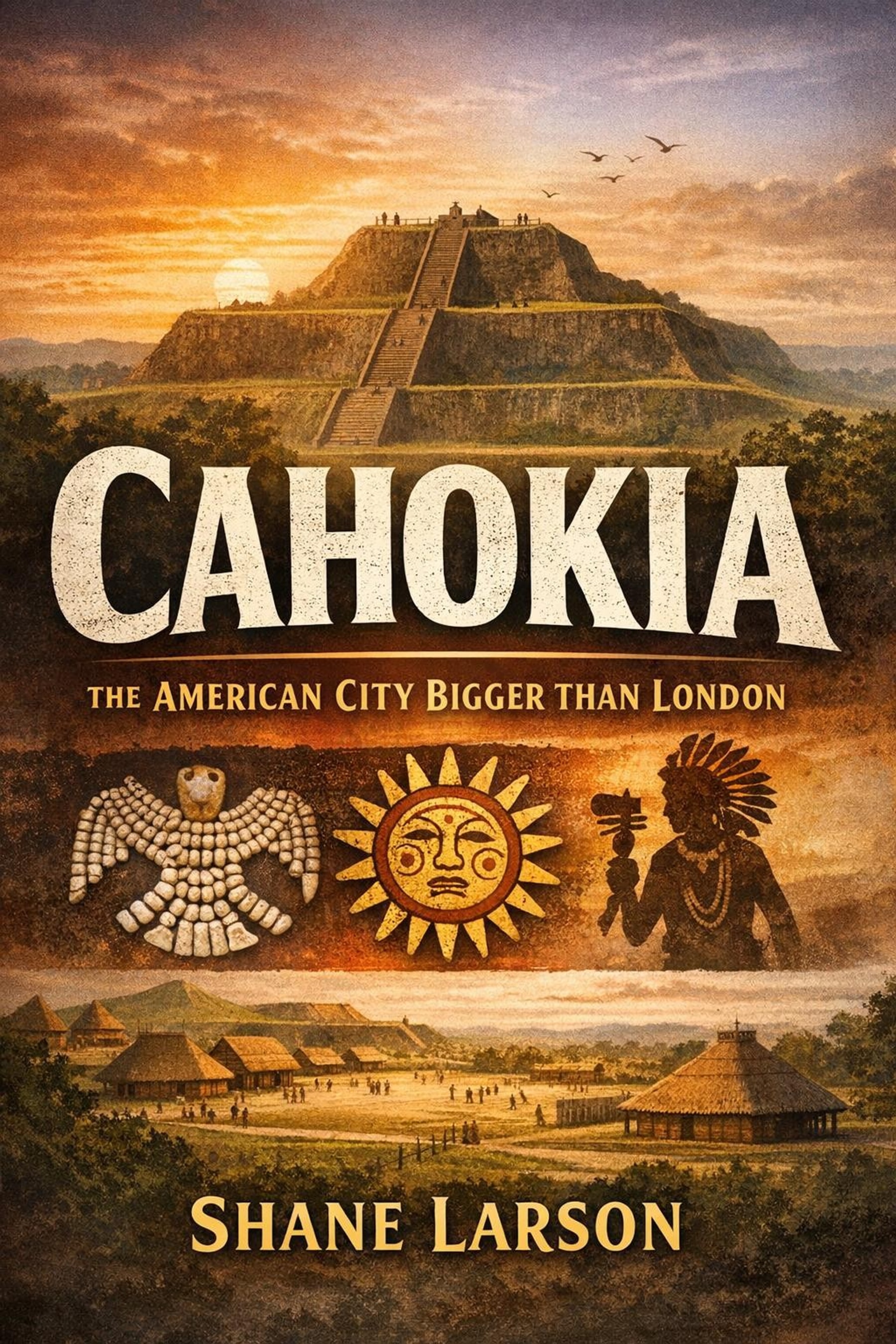
The new book gives Cahokia the full standalone narrative treatment it deserves. The hook is real. The evidence is overwhelming. Most Americans have never heard of it. The book is for the readers who want to.
Cahokia: The American City Bigger Than London is out now on Kindle. $3.99.