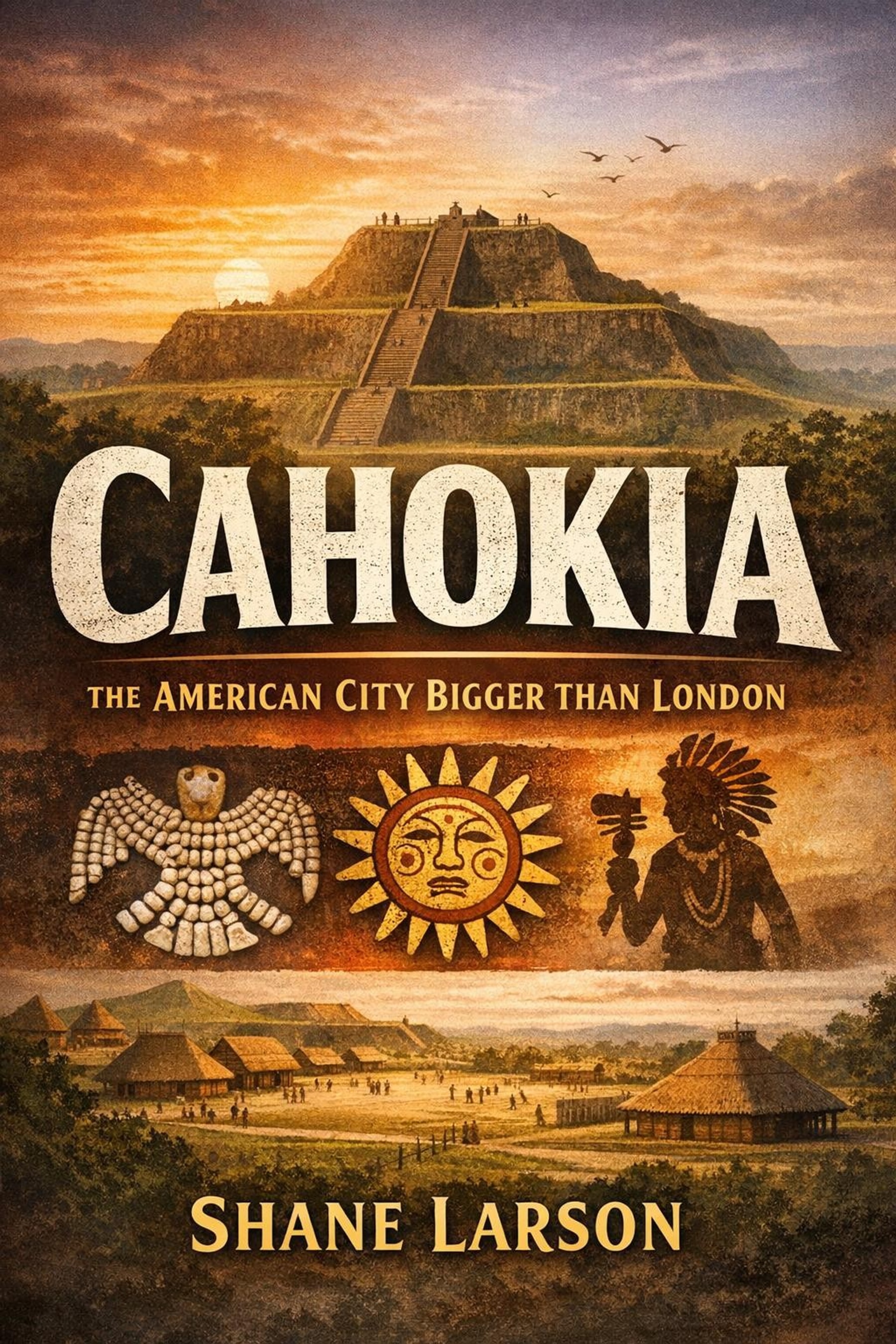
Cahokia
The American City Bigger Than London
By Shane Larson
About This Book
Eight miles east of where the Gateway Arch now stands, a flat-topped earthen pyramid rises ten stories out of the Illinois floodplain. It is the largest prehistoric earthwork in the Americas. The French explorers who passed it in the late seventeenth century took it for a natural hill. Generations of American settlers built farms across the base of it without ever asking what it was. As late as the 1960s, an interstate highway was bulldozed straight through the surrounding mound field.
It is not a hill. It is the central structure of a city that, around the year 1050, housed twenty thousand people — more than London at the same date, more than Paris.
The city's real name is lost. Cahokia is a borrowed label, the name of a much later and unrelated tribe that the French met in the area in the 1690s. Everything the original builders called themselves, their kings, their gods, and their city went silent sometime in the fourteenth century, and the survivors who carried fragments of the culture forward — the Osage, the Quapaw, the Caddo, and others — did so without writing it down.
The Story of a City America Forgot
What archaeologists have been able to reconstruct is staggering. The site covers six square miles. Monks Mound alone contains more than twenty million cubic feet of carried earth, every basket of it hauled by hand from borrow pits scattered across the floodplain. The Grand Plaza, fifty acres of artificially leveled ground in front of the mound, required engineering on a scale that would not be matched in North America for another seven hundred years. A timber circle west of the central precinct — the so-called Woodhenge — tracked the equinoxes and solstices with sightlines accurate to within a degree.
And at the city's core, in a mound now catalogued as Mound 72, archaeologists in the 1960s unearthed a burial that has reshaped every theory of pre-Columbian North America. A high-status man, probably a ruler or paramount priest, had been laid out on a bird-shaped platform built from twenty thousand polished marine shell beads. Around him: sacrificed retainers, executed prisoners buried in mass graves, and grave goods sourced from a thousand miles in every direction.
The city's rise, peak, and collapse all fit inside three hundred years. By 1350, the population had dispersed. By the time French missionaries arrived, the descendants were living in scattered tribal villages and the mounds had become topography.
Cahokia: The Lost City of North America traces what happened — the construction boom, the trade empire, the religious revolution, the political consolidation, and the long unraveling that followed. It also traces what happened to the memory of the place after Europeans arrived: the deliberate erasure, the racist "Moundbuilder Myth" that attributed the earthworks to a vanished white race rather than to the ancestors of living Native Americans, and the slow archaeological work — still ongoing — of restoring Cahokia to its place in the continent's history.
What You'll Discover
- The single-generation building boom, sometime around 1050, that converted a small farming village into a city of fifteen to twenty thousand people
- Monks Mound: the engineering, the construction sequence, and the platform structures that stood on top of it
- The Grand Plaza as a designed civic space — its dimensions, its leveling, and what the open ground was used for
- The Woodhenge complex and the astronomical alignments that organized the Cahokian calendar
- Mound 72 in detail: the bird platform, the shell-bead burial, the sacrificed retainers, and what the assemblage suggests about ritual hierarchy and political violence
- The continental trade network — copper from the Great Lakes, marine shell from the Gulf, mica from the southern Appalachians, obsidian and chert from across the West — that ran through the city's economy
- The Cahokian religious complex and how its iconography spread south and east into the Mississippian world
- The long, two-century decline: environmental pressure, political fracture, regional out-migration, and final abandonment
- The Moundbuilder Myth: how nineteenth-century American writers invented a fictional vanished race to avoid crediting Native ancestors with the earthworks they were standing on
- A visitor's guide to Cahokia Mounds State Historic Site as it stands today — what survived, what was lost to highway construction, and how to read the landscape
Why I Wrote This
I grew up being taught — explicitly, in school — that the Americas before 1492 were thinly populated, technologically simple, and politically unorganized. None of that is true, and Cahokia is the loudest single piece of evidence against it. A city of twenty thousand people, with monumental architecture and a continental trade network, sat on the Mississippi five hundred years before Columbus, and most Americans have never heard of it.
That gap is not accidental. The racist nineteenth-century theories about who built the mounds — the "Moundbuilders" supposedly being a lost white civilization wiped out by ancestral Native Americans — were a deliberate ideological move designed to justify continued land seizures. The real history was buried, sometimes literally, by everything that came after.
This is the third book I've written in a thread that runs across Peak Grizzly's ancient history catalog: civilizations that were large, sophisticated, and consequential, and that the standard story still refuses to take seriously. Cahokia deserves that seriousness. So does the work of the archaeologists, particularly Timothy Pauketat and Thomas Emerson, who have spent careers reconstructing the place against decades of academic indifference.
Frequently Asked Questions
Do I need a background in archaeology to follow this book?
No. The book assumes no prior knowledge of Mississippian culture, North American archaeology, or pre-Columbian history. Technical terms are defined where they appear, and the chronology is laid out in plain prose.
Is this a textbook or a narrative history?
Narrative history. The structure follows the rise, peak, and decline of the city as a story, with archaeological evidence woven into the chapters rather than separated out into reference material. There are no footnotes interrupting the text, though a sources section appears at the end.
How does this compare to Charles Mann's 1491?
1491 is the broader survey and devotes one excellent chapter to Cahokia. This book is what that chapter looks like expanded into a full treatment — more detail on Monks Mound, Mound 72, the trade network, the Moundbuilder Myth, and the post-abandonment cultural lineage.
Does it cover the Mound 72 burial in depth?
Yes. The Mound 72 excavation has its own chapter, including the bird-shaped shell-bead platform, the surrounding burials, the sacrificed retainers, the trade goods, and the ongoing scholarly debate about whether the central figure was a ruler, a priest, or a mythological reenactment.
Is this part of a series?
Cahokia stands on its own, but it sits inside Peak Grizzly's broader ancient-history catalog alongside titles on the Phoenicians, the Hittites, the Sea Peoples, and other civilizations whose stories the standard curriculum still skips.
Is the book available on Kindle Unlimited?
Yes. Available through Kindle Unlimited and for direct purchase on Kindle and in paperback.
If You Liked This, You Might Like
- The Sea Peoples — A different lost civilization at a different end of the world: the raiders who collapsed the Bronze Age Mediterranean and then vanished from the record.
- Ancient Apocalypse — The Bronze Age collapse as a structural event: how an interconnected world came apart in a single generation, with patterns that echo Cahokia's own decline.
- The Phoenicians — Another civilization whose contributions were systematically minimized in the history most of us were taught.
- Twilight of the Ziggurats — Mesopotamia's long unraveling, told as the slow exhaustion of a once-dominant urban culture.
Cahokia rose, ruled, and fell on American ground. Its story is part of American history, whether the textbooks include it or not.
Included with Kindle Unlimited — read it free if you're a member.
New Ancient History releases and free chapters — no spam, unsubscribe anytime.