Blog Post
April 23, 2026
Almost everything the modern world knows about Spartacus starts with a shot of Kirk Douglas standing on a wooden platform with a chain around his neck, and the shot is not wrong. Spartacus really was a gladiator. He really was enslaved. The 1960 Kubrick film got the emotional core of the story right, and so did the Starz series half a century later. What they both leave out, because it does not fit the clean arc of slave-becomes-rebel, is the detail that makes the actual history make sense.
Before Spartacus was a gladiator, he was a Roman soldier.
Plutarch mentions it almost in passing, in the Life of Crassus, the main surviving narrative of the war. Appian says it more directly. And once you see it, you cannot unsee it. The Third Servile War, which Rome spent a century trying to forget, becomes legible as a military campaign conducted by a man who had been trained by the enemy he was about to humiliate.
The Auxiliary Pipeline
Rome's army in the late Republic was not just the legions. Alongside every legion marched an equivalent force of auxilia, non-citizen troops recruited from the provinces and client kingdoms Rome had absorbed or defeated. Thracians, Gauls, Numidians, Illyrians, Syrians, Iberians. They served under Roman officers. They drew Roman pay. They carried Roman-issue gear, mostly. They were not legionaries, but they fought alongside legionaries in every major campaign of the period, and the best of them were very, very good.
Spartacus was Thracian. The Thracians were a mountain people from the region that is now roughly Bulgaria and parts of northern Greece and European Turkey. They were known in the ancient world for two things: horses and infantry discipline. Rome had been pushing into the Balkans for a century, and Thracian contingents in Roman service were a standard feature of the late Republican army. Some volunteered. Some were conscripted under treaty obligations. Some were simply the price a defeated tribe paid to keep its villages intact.
We do not know exactly when or where Spartacus served, but we know he did. Appian says he had fought for the Romans. Plutarch calls him a man of "great spirit and bodily strength" and, more pointedly, "more Greek than his fortune would suggest," which in the mouth of a Roman-era Greek biographer is the highest compliment available to a non-Greek and non-Roman: he was smarter than his barbarian background implied. That intelligence did not come from nowhere. It came from training, probably from literacy, and certainly from years spent inside the Roman military system learning how it worked.
Desertion and the Legal Trap
At some point, for reasons the sources do not preserve, Spartacus deserted. Desertion from auxiliary service was common enough that Roman military law had detailed categories for it. A deserter who was recaptured and had not yet taken arms against Rome faced beating, reduction in rank, sometimes execution if the circumstances were bad. A deserter who had taken arms against Rome, or who had gone over to an enemy, faced a different legal status entirely.
Under Roman law, a free man captured in arms against Rome could be legally enslaved. The legal fiction was that he had forfeited his personhood by making war on the Roman people. In practice, it meant the slave markets at Delos and Aquileia had a steady supply of former soldiers who had picked the wrong side, or deserted, or ended up on the losing edge of a provincial uprising. Spartacus was one of them.
He ended up at a ludus, a gladiator school, at Capua, about a hundred and twenty miles south of Rome, owned by a man named Lentulus Batiatus. Capua was the center of the Italian gladiator trade. A ludus was not a prison. It was a closed training facility, run like a cross between a stable and a boarding school, with a coach, a cook, a doctor, armed guards, and a careful hierarchy among the men inside. The gladiators were valuable property. They were fed well. They were trained hard. And they were watched constantly, because everyone in the Roman world understood that a building full of men trained to kill was, at some level, always one bad night away from being a problem.
The Tactical Fingerprint
The breakout at Capua in the summer of 73 BCE was spectacular but not, by itself, unprecedented. Slaves had escaped before. Small bands of runaways had terrorized the Italian countryside for decades. What was unprecedented was what happened next.
Within weeks, the fugitives had taken up a defensive position on the slopes of Mount Vesuvius. The Roman response was exactly what you would expect from a state that did not yet understand it was in a real war: a scratch force under a praetor named Claudius Glaber, thrown together from levies and volunteers, sent down to break up what the Senate still thought was a bandit problem. Glaber arrived at Vesuvius, saw the rebels on a plateau near the summit, and set up a siege on the only known path down. He was, in a purely tactical sense, doing the right thing.
Spartacus had his men cut ropes from the wild grape vines that grew on the mountain and descend the cliff face at night on the blind side of the Roman camp. They came around behind Glaber in the dark and annihilated him.
This is not a bandit's trick. It is a textbook flanking maneuver, the kind of thing a Roman officer would have drilled into him during basic campaign training. Secure the enemy's blind side. Attack at night when discipline is weakest. Use terrain the enemy assumes is impassable. Every element of the Vesuvius ambush reads like a field exercise from a Roman training manual, because it essentially was. Spartacus had been trained by the people he was now fighting.
The pattern holds across the two years that followed. The defeat of the next praetor, Publius Varinius, was a sequence of engagements in which Spartacus repeatedly forced Varinius to fight on ground of Spartacus's choosing. The defeats of the consuls in 72 BCE, Gellius and Lentulus Clodianus, involved Spartacus dividing a Roman force and defeating its halves in sequence, the classic defensive-interior-lines maneuver. The destruction of Cassius's army at Mutina used Roman-style deployment and Roman-style discipline against a Roman army that had, in that moment, neither.
These are not the wins of an inspired amateur. They are the wins of a professional.
Why This Detail Disappears
The ancient sources have the information. Plutarch has it. Appian has it. The problem is that both writers were interested in different stories than the one the detail implies.
Plutarch was writing a biography of Crassus. Spartacus is the antagonist, and Plutarch's narrative interest lies in how Crassus recovered from the Senate's humiliation, restored Roman discipline through decimation, and finally caught the rebel army in Lucania. The auxiliary service is a line in the first paragraph of the Spartacus material, a piece of background, not a thesis.
Appian was writing a survey of the Roman civil wars, and the Servile War was a detour from his main argument about the disintegration of the Republic. He gives Spartacus more operational detail than Plutarch, but he compresses the military campaigning into a few pages. The auxiliary service appears, but as a fact, not a framework.
Later popularizers inherited the Plutarchan framework. Roman historians of the imperial period, to the extent that they discussed the Servile War at all, preferred to treat the rebel victories as either the consequence of Roman overconfidence or the inexplicable luck of a desperate man. The possibility that Spartacus was a competent commander who had learned his trade in Roman service implied that any ex-soldier, under the right conditions, could do the same thing. This was not a thought the senatorial class wanted their grandchildren reading at leisure.
The silence got inherited. Howard Fast's novel treats Spartacus as a symbol of resistance. Kubrick and Trumbo treat him as a secular saint. The Starz series treats him as a revenge protagonist. None of these portrayals are wrong, exactly, but none of them quite have room for the man who in 73 BCE sat down and planned a two-year insurgency with the calm competence of someone who had seen the enemy's order of battle from the inside.
What the Detail Does to the Story
If you put the auxiliary service back at the center of the narrative, everything downstream reads differently. The breakout at Capua is not a spasm of violence. It is the first phase of a plan. The march up Vesuvius is not a flight into the hills. It is the selection of defensible ground. The descent on the vine ropes is not a miracle. It is a trained officer solving a tactical problem in the way he had been taught.
The two years of victories are not a divine accident. They are the work of a military mind. The refusal to cross the Alps in 72 BCE, the decision to turn south instead, the failed pivot toward Sicily, the final battle in Lucania, all of it becomes the decision-making of a commander who has run out of good options and is choosing, between bad ones, the bad one that keeps his people together longest.
And the ending becomes more terrible for being more human. Plutarch has Spartacus killing his own horse before the final battle, a deliberate, theatrical refusal to keep the option of flight for himself. It is the kind of gesture an officer makes in front of his men when he has decided that this is the fight. Appian says two centurions died in front of him before he went down, and that when the fighting ended, his body could not be identified in the pile. It is the death of a professional who chose to die at the head of his people rather than live as the one who ran.
That is a different story than the one the Kubrick film tells. It is also, I think, the one the ancient sources were actually trying to tell, if you read them closely enough to hear what they did not quite dare to say out loud.
Why This Matters Now
I did not write a book about Spartacus to argue that he was a better general than Plutarch gives him credit for, although he was. I wrote it because the story of the Third Servile War is one of the rare ancient episodes where the sources let us see a man the official historians tried to erase, and because the detail that unlocks the war, the auxiliary service, is exactly the kind of thing popular treatments keep smoothing over.
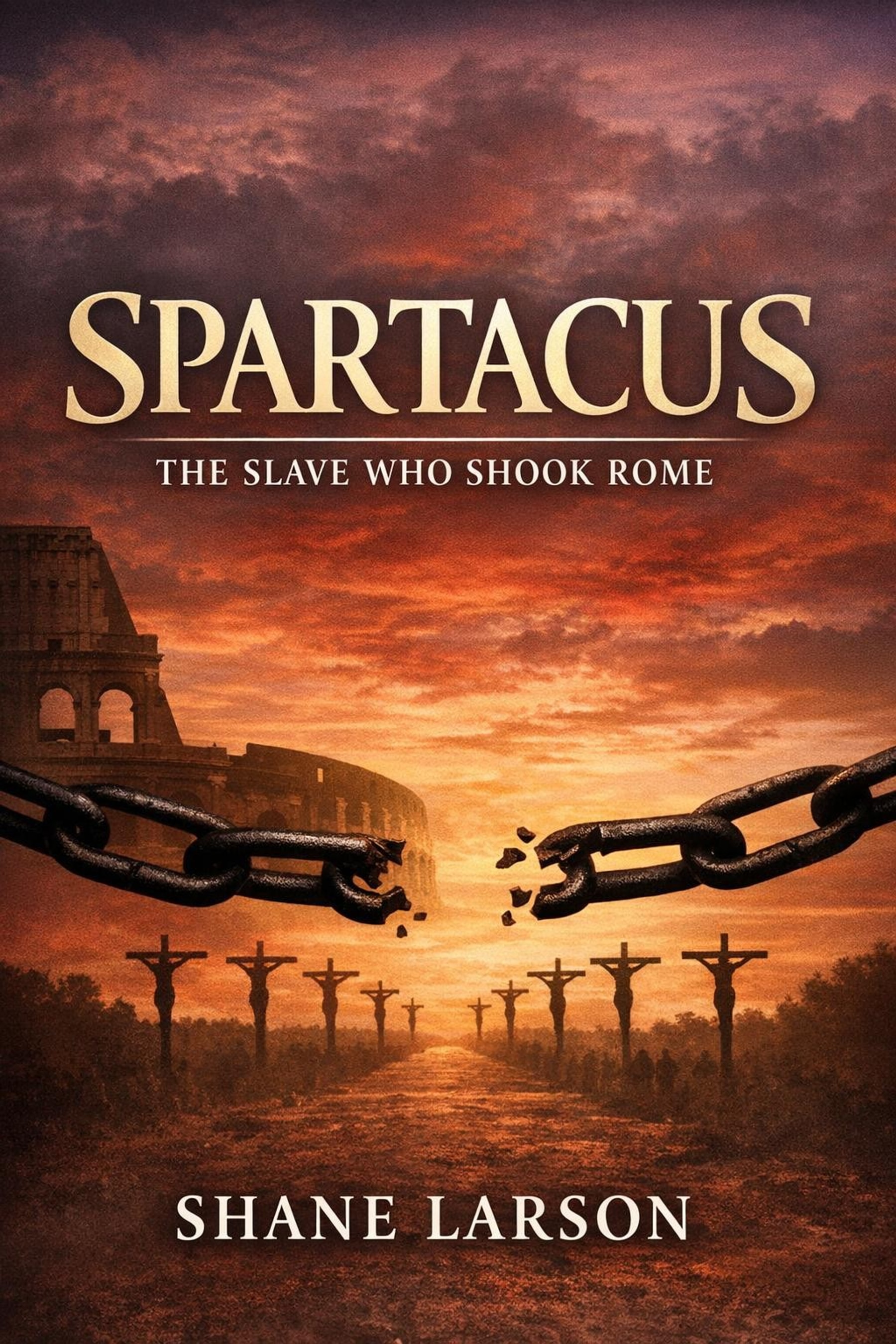
The full book, Spartacus: The Slave Who Shook Rome, tells the whole story. The Thracian world he came from. The auxiliary unit and the desertion. The school at Capua. The breakout. The two years of victories. The mystery at the heart of the war, the reason the rebels turned south when the Alps were in sight. The rivalry between Crassus and Pompey that the war ignited, and that twenty years later would help bring down the Republic. The final battle. The six thousand crucifixions. And the two-thousand-year afterlife of a man who became whatever each age that remembered him needed him to be.
It is out now on Kindle for $3.99, and free in Kindle Unlimited. If you have read my books on Hannibal, on the fall of Rome, on Nero or Boudica or Carthage, this one is the next in the line. Same voice, same approach, same commitment to taking the ancient sources seriously enough to argue with them when they need arguing with.
The man Rome tried to forget deserves better than to be remembered as a footnote to Kirk Douglas. This is the book that tries to give him his due.