Blog Post
April 10, 2026
The golden age wasn't what you learned in school.
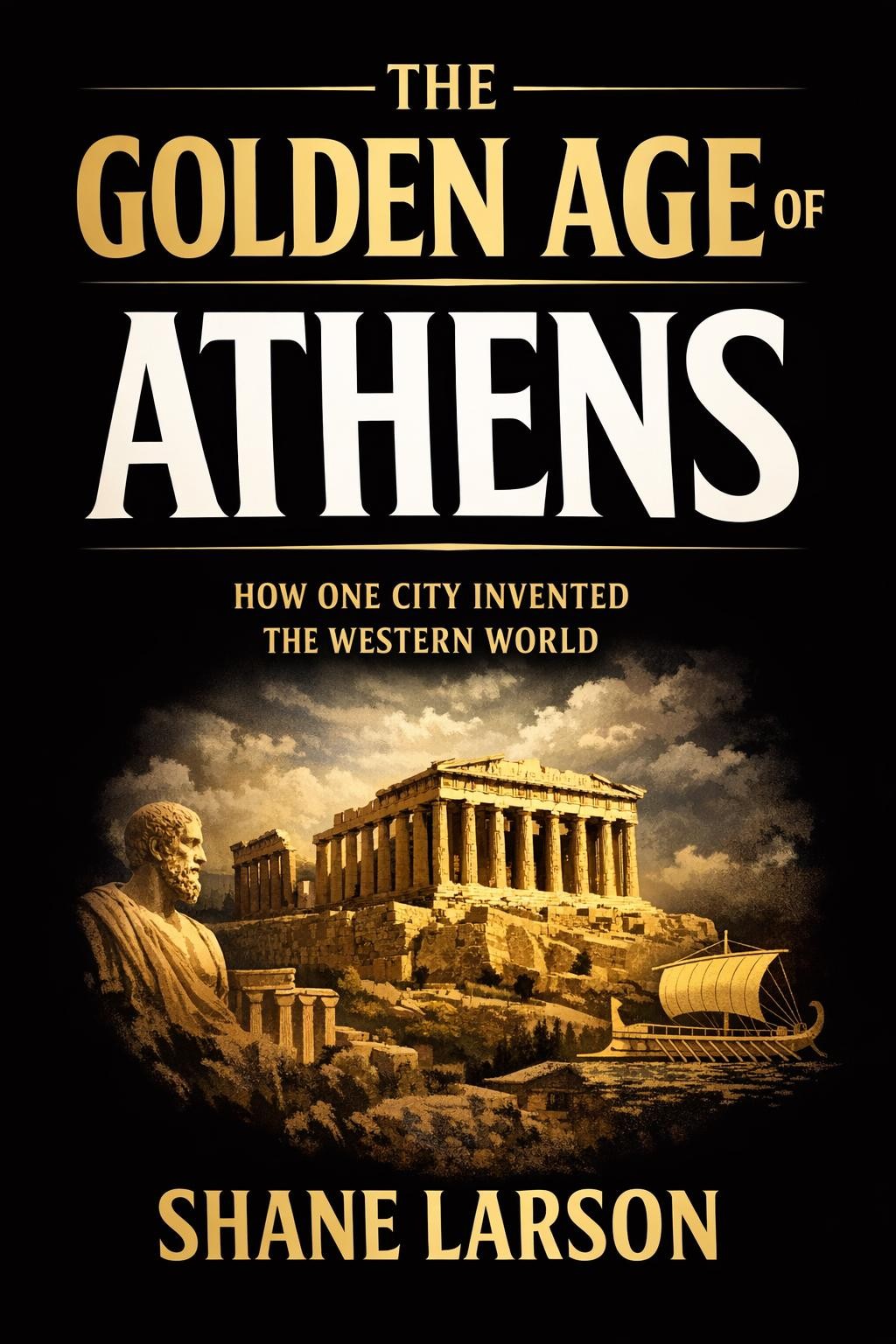
We love the story of Athens. A small city on a rocky peninsula invents democracy, produces Socrates and Sophocles, builds the Parthenon, and gives the Western world its foundational ideas about freedom, reason, and self-governance.
It's a great story. It's also deeply incomplete.
The Athens that invented democracy was simultaneously an imperial power that extracted tribute from over 200 subject states. The Athens that celebrated individual freedom enslaved roughly 80,000 to 100,000 people — perhaps a third of its total population. The Athens that created the philosophical tradition of questioning assumptions refused to let women participate in public life at all.
This isn't a reason to dismiss Athens. It's a reason to take Athens seriously — because the paradox at the heart of the golden age is the same paradox that haunts every democracy that has followed.
The Democracy That Wasn't Universal
When Pericles delivered his famous funeral oration in 431 BCE — the speech that defined Athenian democracy for posterity — he painted a picture of a city where "advancement in public life falls to reputation for capacity, class considerations not being allowed to interfere with merit."
It's a magnificent vision. It also applied to roughly 30,000 adult male citizens out of a population of 250,000.
Women couldn't vote, couldn't own property in most cases, couldn't appear in court. Metics — resident foreigners, many of whom had lived in Athens for generations — could work, pay taxes, and serve in the military, but couldn't participate in the Assembly or the courts. And slaves, who powered the silver mines at Laurium, rowed the triremes, worked the fields, and maintained the households, had no legal personhood at all.
The radical democracy that we celebrate — the Assembly where any citizen could stand and address thousands of his peers, the courts where juries of 501 decided cases without judges — was a system of extraordinary freedom built on a foundation of extraordinary exclusion.
This matters because it's not ancient history. It's a pattern.
The Empire Problem
Athens didn't set out to build an empire. After the Persian Wars, it formed the Delian League — a voluntary defensive alliance of Greek city-states pooling resources to prevent another Persian invasion. Athens contributed the largest fleet. The treasury was kept on the island of Delos. Everything was collaborative.
Within twenty years, Athens had moved the treasury to the Acropolis, was spending allied tribute on its own building program, and was crushing any city-state that tried to leave the alliance. When Naxos attempted to secede around 470 BCE, Athens besieged the island and forced it back into the League. When Thasos tried the same thing a few years later, Athens did it again.
By the time Pericles was building the Parthenon, the "alliance" was an empire in everything but name. The Parthenon itself — the building we point to as the supreme achievement of classical civilization — was funded with money that had been collected to fight Persia.
Pericles' political opponents called him out on this. Thucydides (the politician, not the historian) accused him of dressing Athens up "like a wanton woman" with stolen money. Pericles responded that as long as Athens fulfilled its obligation to defend the allies from Persia, what it did with the surplus was its own business.
It was a brazen argument. It was also, in the context of Athenian power politics, an effective one. The Assembly backed Pericles, and the building continued.
The Thucydides Trap
The historian Thucydides — writing about the Peloponnesian War that eventually destroyed Athens — identified something that political scientists still debate today. He argued that the war between Athens and Sparta was fundamentally caused not by any specific dispute but by the growth of Athenian power and the fear this inspired in Sparta.
"It was the rise of Athens and the fear that this instilled in Sparta that made war inevitable."
This analysis — now called the "Thucydides Trap" — suggests that when a rising power threatens to displace an established one, war is the likely result. Political scientist Graham Allison applied this framework to US-China relations in his 2017 book Destined for War, arguing that of sixteen cases in the last 500 years where a rising power confronted a ruling one, twelve ended in conflict.
Whether or not you buy the theory in its modern application, the original case study is compelling. Athens and Sparta had fundamentally incompatible visions of how Greek civilization should work. Athens was democratic, commercial, naval, and expansionist. Sparta was oligarchic, militaristic, land-based, and conservative. The Greek world wasn't big enough for both models to coexist indefinitely.
The war that resulted lasted twenty-seven years (431-404 BCE), killed tens of thousands, destroyed Athens' empire, and ended the golden age.
The Sicilian Disaster: When Democracy Goes Wrong
If you want to understand how democracy can produce catastrophic decisions, study the Athenian invasion of Sicily.
In 415 BCE, Athens was in a temporary lull in the war with Sparta. The demagogue Alcibiades — brilliant, charismatic, reckless — convinced the Assembly to launch a massive expedition against Syracuse, the largest Greek city in Sicily. The strategic logic was thin. The potential rewards were enormous. The Assembly voted for it with enthusiasm.
The expedition was the largest military force Athens had ever assembled. Two years later, it was destroyed completely — the army killed or enslaved, the fleet captured. Approximately 40,000 men were lost.
The decision had been made democratically. The Assembly had debated, voted, and approved. The older general Nicias had argued against it — and the Assembly responded by making him co-commander of the expedition he opposed.
This is the dark side of direct democracy. When the entire citizen body votes on military strategy, the result can be brilliant (as at Salamis in 480 BCE) or catastrophic (as in Sicily in 415 BCE). There's no institutional check, no committee review, no requirement for expertise. The crowd decides, and the crowd can be spectacularly wrong.
The Trial That Defines the Paradox
In 399 BCE, four years after the war ended, Athens put Socrates on trial. The charges were impiety and corrupting the youth. The real issue was political: several of Socrates' former students had been among the Thirty Tyrants, the Spartan-backed oligarchy that had briefly ruled Athens after its defeat. The democracy had been restored, and the city was looking for someone to blame.
Socrates didn't help his own case. His defense speech (as recorded by Plato) was defiant, ironic, and deliberately provocative. He compared himself to a gadfly stinging a lazy horse — the horse being Athens. He told the jury they should be thanking him, not prosecuting him.
The jury voted to convict, 280 to 221. When asked to propose his own punishment (standard Athenian practice), Socrates suggested free meals at public expense for the rest of his life. The jury voted for death.
This is the event that defines the paradox of Athens. The world's first democracy — the city that celebrated free speech, open debate, and the questioning of authority — executed its most famous questioner. The same system that produced the freedom for Socrates to philosophize also produced the power to kill him for it.
Why the Paradox Matters Now
We inherit Athens' contradictions. Every modern democracy struggles with the same tensions: freedom versus security, inclusion versus exclusion, popular sovereignty versus expertise, the right to question versus the desire for stability.
The golden age of Athens wasn't a golden age for everyone. It was a period of extraordinary achievement made possible by imperial wealth and slave labor, governed by a system that excluded the majority of its population, and ended by the very qualities — ambition, confidence, democratic boldness — that had created it.
That's not a reason to dismiss Athens. It's a reason to study it honestly. The sanitized version — wise philosophers in white robes debating truth on marble steps — is a fantasy. The real Athens was messy, violent, contradictory, and fascinating. It produced genuine genius and genuine atrocity, often in the same decade.
Understanding how both things were true at once is the only way to learn anything useful from the golden age. And in a world where democracies are once again struggling with demagogues, imperial overreach, and the question of who really gets to participate, the Athenian example has never been more relevant.