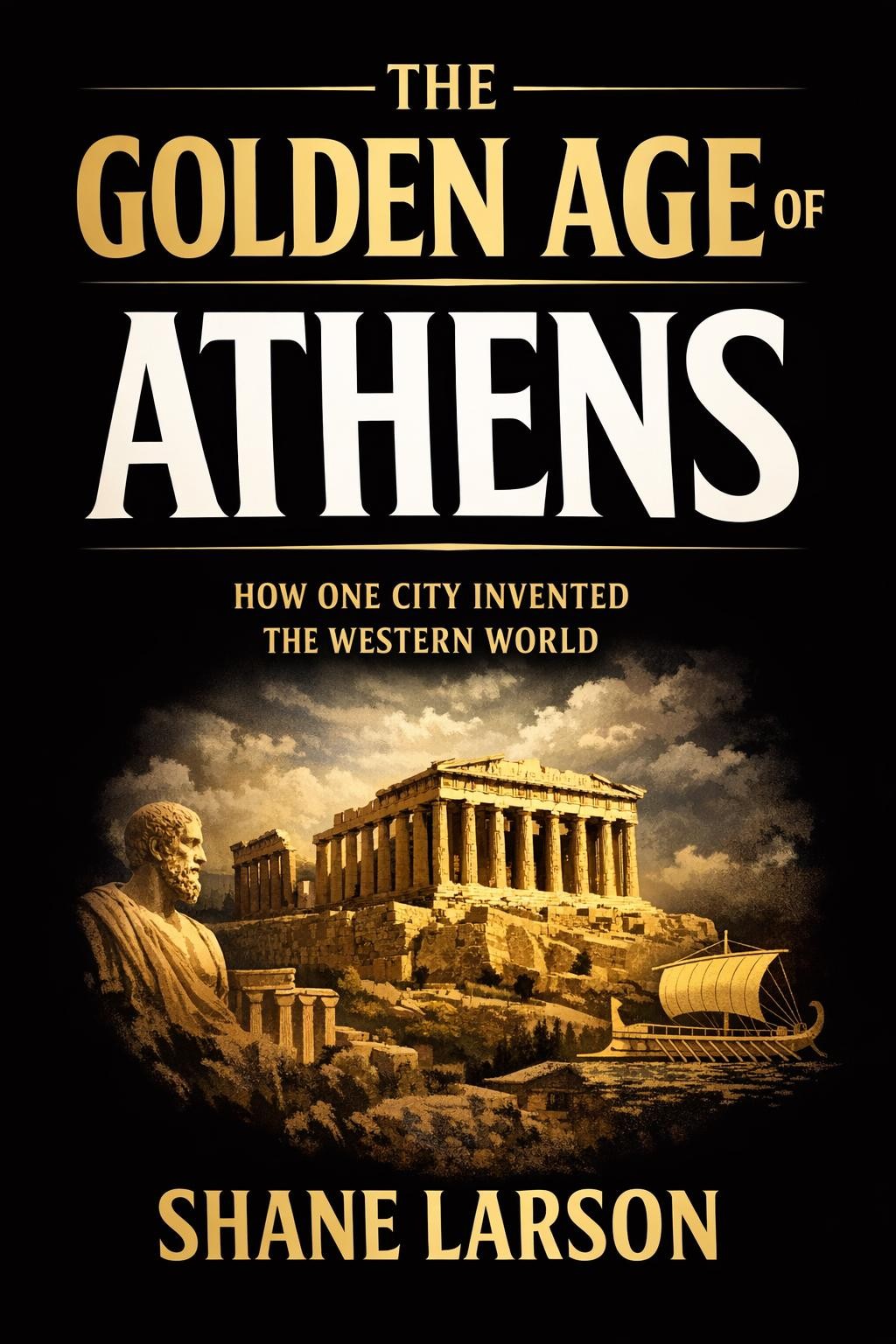
The Golden Age of Athens
How One City Invented the Western World
By Shane Larson
About This Book
A city of 250,000 people — smaller than modern Boise — produced the philosophical, political, and artistic foundations that still shape the Western world. Then they destroyed themselves in a war everyone could see coming.
The Golden Age of Athens lasted roughly eighty years. In that span, one city-state gave the world democracy, tragedy, philosophy, historical writing, and the Parthenon. Pericles transformed tribute money from allied states into monuments. Socrates turned street-corner argument into a method for examining human existence. Thucydides looked at war and decided to write it down accurately — a genuinely new idea. None of this was inevitable. Most of it was contested, fragile, and dependent on decisions that could easily have gone the other way.
What Athens built was inseparable from what Athens was willing to do to build it: an empire, a slave economy, and a political culture that excluded women and foreigners from the rights it claimed to champion. The golden age and the dark foundations were the same thing.
The Golden Age of Athens tells the full story — the military genius of Themistocles at Salamis, the deliberate beauty of the Acropolis, the intellectual explosion that produced Sophocles and Euripides and Aristophanes in the same generation, and the Peloponnesian War that Thucydides documented as it unraveled the city that had hired him to command part of it.
What's inside:
- Marathon, Thermopylae, and Salamis — how the Persian Wars transformed Athens from a second-tier city-state into the dominant power of the Greek world
- The mechanics of Athenian democracy — who actually voted, how the assembly worked, and why the system was both more radical and more limited than the mythology suggests
- Pericles and the Parthenon — the politics behind the building program and what it reveals about how Athens understood its own importance
- The intellectual explosion — why one city produced Socrates, Sophocles, Euripides, Herodotus, Thucydides, and Aristophanes in a single lifetime
- The Peloponnesian War — twenty-seven years of conflict between Athens and Sparta that neither side could afford and both sides chose anyway
- The Sicilian Expedition — the catastrophic overreach that broke Athenian military power and the democratic vote that made it happen
- The trial of Socrates — why the world's first democracy executed its greatest philosopher and what that tells us about the limits of democratic tolerance
- The slave economy, the excluded women, the exploited allies — the structures that made the golden age possible
No classics degree required. No mythology left intact.
Part of the Ancient History series by Shane Larson. Related titles: Sparta: The Warrior State, The Persian Empire, The Bronze Age World, The Library of Alexandria, The Minoans, and Hatshepsut: The Pharaoh Who Disappeared.
Included with Kindle Unlimited — read it free if you're a member.
New Ancient History releases and free chapters — no spam, unsubscribe anytime.
More in This Genre
View all →