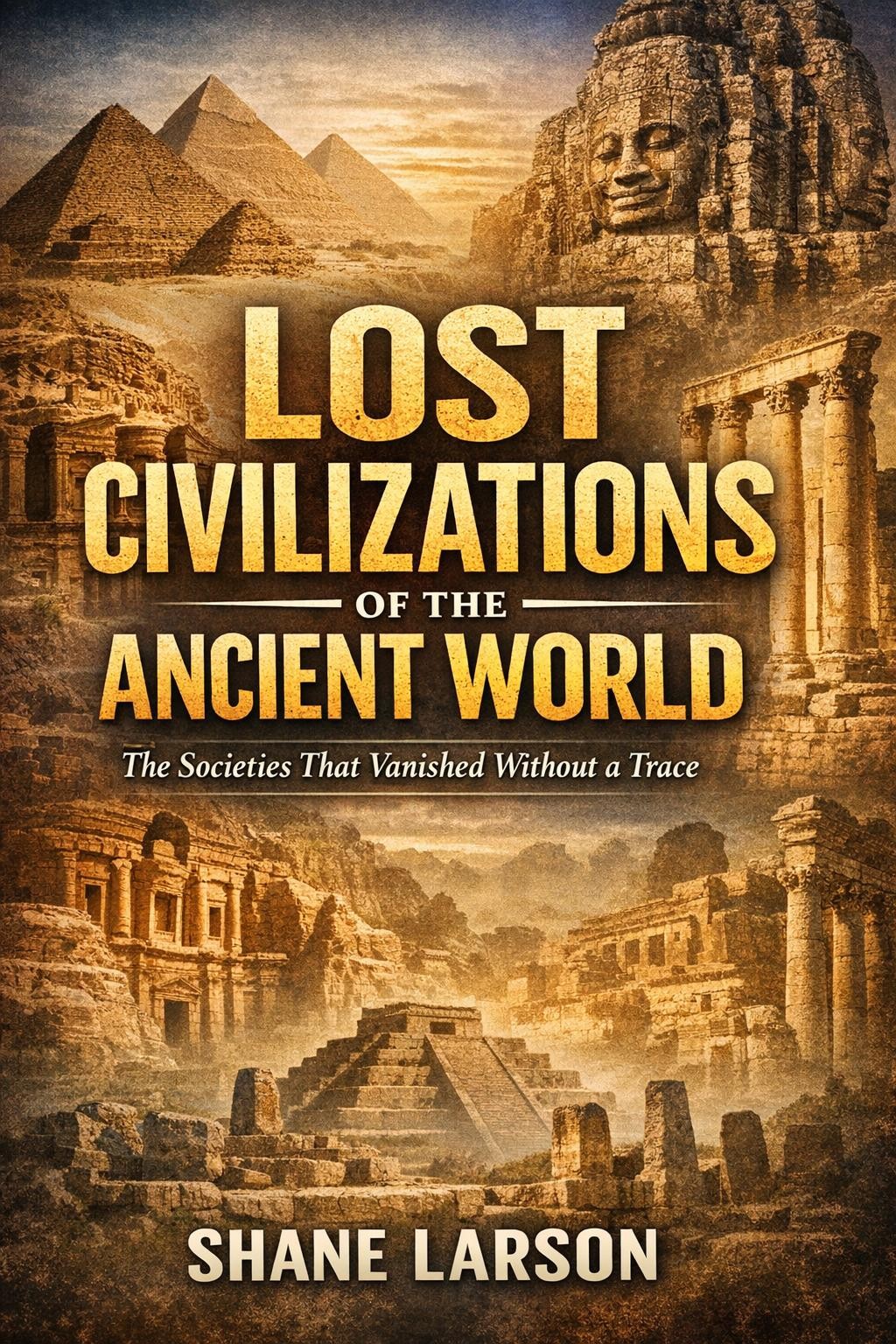
Blog Post — Lost Civilizations of the Ancient World
April 8, 2026
History has a bias problem.
The civilizations we study most are the ones that left written records in scripts we can read. Egypt had hieroglyphics. Mesopotamia had cuneiform. Greece and Rome wrote in alphabets that evolved into the ones we use today. Their stories survived because we can read their words.
But for every civilization with a readable archive, there are others that achieved extraordinary things and then disappeared -- leaving behind ruins, artifacts, and in some cases writing systems that no one alive can decipher. These societies didn't fail because they were primitive. Many of them were more sophisticated than the cultures that replaced them. They vanished because of environmental catastrophe, absorption by successor states, or the simple passage of enough time to erase everything but stone.
Here are ten of them. Each one changes how you think about the ancient world.
1. The Indus Valley Civilization -- The Biggest Civilization Nobody Knows
Around 2500 BCE, while Egypt was building the Great Pyramids, a civilization in what is now Pakistan and northwestern India had built something arguably more impressive: a network of planned cities with grid-pattern streets, standardized brick sizes, sophisticated drainage systems, and indoor plumbing.
The Indus Valley Civilization (also called the Harappan Civilization) was the largest of the Bronze Age civilizations. At its peak, it covered more territory than either Egypt or Mesopotamia. Its two great cities, Mohenjo-daro and Harappa, each housed tens of thousands of people in what appear to be remarkably well-organized urban environments.
And we can barely tell you anything about it.
The Indus Valley people had a writing system. They left thousands of inscribed seals, each typically showing an animal figure and a short line of script. But the inscriptions are too short, and we have no bilingual text -- no Rosetta Stone -- to crack the code. Without readable texts, we don't know what they called themselves, what language they spoke, how they governed their cities, or what gods they worshipped.
What we know comes entirely from archaeology: the physical remains of their cities, their trade goods, their art. And what that archaeology reveals is a society that was remarkably egalitarian by ancient standards. No palaces. No royal tombs. No obvious military infrastructure. Standardized weights and measures across the entire civilization, suggesting centralized coordination without the usual trappings of authoritarian rule.
By about 1900 BCE, the cities were abandoned. The population dispersed into smaller settlements. The reasons are still debated -- climate change, the shifting of river courses, the breakdown of trade networks -- but the result is clear. The largest civilization of the Bronze Age simply dissolved.
2. The Kingdom of Aksum -- Africa's Forgotten Superpower
Ask most people to name the great powers of the ancient world and you'll hear Rome, Persia, China. Maybe Greece or Egypt. Almost nobody says Aksum.
They should. The Persian prophet Mani, writing in the third century CE, listed the four great powers of the world as Rome, Persia, China, and Aksum. This wasn't flattery. It was an accurate description of a trading empire that controlled the Red Sea corridor between the Mediterranean and the Indian Ocean.
Based in what is now northern Ethiopia and Eritrea, Aksum was a commercial powerhouse. Its port at Adulis was one of the busiest in the ancient world. Aksumite merchants traded gold, ivory, and exotic animals to Rome and imported silk, spices, and manufactured goods from India. The kingdom minted its own gold coins -- one of only four states in the world to do so at the time.
The Aksumites erected enormous stone stelae -- carved obelisks that are among the largest monolithic structures ever created. They developed their own script (Ge'ez, which is still used in Ethiopian liturgy). They were among the earliest adopters of Christianity, converting in the fourth century CE under King Ezana.
And then Aksum declined. The expansion of Islam shifted trade routes away from the Red Sea. The kingdom contracted, isolated itself, and eventually faded from the awareness of the wider world. When European explorers encountered Ethiopia centuries later, they had no idea they were walking through the remnants of one of the ancient world's four great empires.
3. Norte Chico -- The Civilization That Shouldn't Exist
In 1994, archaeologist Ruth Shady began excavating a site called Caral in the Supe Valley of coastal Peru. What she found didn't match any existing model of early civilization.
Caral was old. Radiocarbon dating placed its construction around 3000 BCE -- contemporary with the Egyptian pyramids. This made Norte Chico (the broader civilization of which Caral was a part) the oldest known civilization in the Americas by roughly two thousand years.
But the age wasn't the strangest part. Norte Chico had monumental architecture -- large platform mounds, sunken circular plazas, and complex urban planning. It had what appears to be social stratification and organized labor. But it had no pottery. No writing (though they may have used quipu, the knotted-string recording system better known from the Inca). And no evidence of warfare. No defensive walls, no weapons caches, no depictions of battle.
This is a problem for archaeological theory. Most models of early civilization assume that complex societies arise through one of two drivers: agricultural surplus (which creates wealth inequality and the need for administration) or warfare (which creates the need for centralized command). Norte Chico seems to have run on neither.
Instead, the economy appears to have been built on a trade relationship between coastal fishing communities and inland agricultural settlements. The coastal towns produced anchovies and other marine resources. The inland towns grew cotton, which the coastal towns needed for fishing nets. This mutual dependency, Shady argues, created the economic complexity that drove urbanization.
No armies. No war. Just anchovies and cotton. It's one of the most fascinating puzzles in archaeology.
4. Great Zimbabwe -- The City Colonialism Tried to Erase
Between the eleventh and fifteenth centuries CE, a Shona-speaking civilization in southeastern Africa built a stone city that, at its peak, housed 10,000 to 20,000 people. The Great Enclosure -- the most famous structure -- features walls thirty-six feet high and sixteen feet thick, built from cut granite blocks fitted together without mortar. It is the largest ancient structure in sub-Saharan Africa south of the Sahara.
Great Zimbabwe was a trading civilization. Archaeological evidence shows connections to the Indian Ocean trade network: Chinese porcelain, Persian Gulf glass beads, and coins from Kilwa (a Swahili trading city on the coast of modern Tanzania) have all been found at the site. The civilization exported gold and ivory through coastal intermediaries, linking the interior of Africa to the broader medieval trading world.
The archaeological truth about Great Zimbabwe has been clear for decades. But for more than a century, European colonists and the Rhodesian government actively suppressed it.
When Europeans first encountered the ruins in the late nineteenth century, they could not accept that Africans had built them. Theories proliferated: the ruins were Phoenician, built by the Queen of Sheba, constructed by Arab traders, or left by some vanished white civilization. In 1905, archaeologist David Randall-MacIver published evidence that the site was African in origin. He was ignored. In the 1960s and 1970s, the Rhodesian government fired archaeologists who confirmed the African origin of the site and censored their publications.
The story of Great Zimbabwe is not just about a vanished civilization. It's about the politics of who gets to have a history.
5. The Minoans -- Europe's First Civilization
Before Greece, before Rome, before anything else in Europe, there were the Minoans.
Based on the island of Crete, the Minoan civilization flourished from roughly 2700 to 1450 BCE. At Knossos, they built a palace complex of over a thousand rooms, with indoor plumbing, light wells, drainage systems, and multi-story architecture. Their art depicts bull-leaping, marine life, and women in positions of apparent authority. Their trade networks reached Egypt, the Levant, and across the Aegean.
The Minoans had writing. Two systems, in fact: Linear A and Linear B. Linear B was deciphered in 1952 and turned out to be an early form of Greek -- used by the Mycenaeans who eventually took over Crete. Linear A remains undeciphered. Whatever language the Minoans spoke, whatever their literature contained, whatever administrative records might tell us about their society -- it's locked behind a script no one can read.
The eruption of Thera (modern Santorini) around 1628 BCE devastated the Minoans, though it didn't destroy them immediately. The civilization lingered for another two centuries before being absorbed by the Mycenaeans. By the time of Classical Greece, the Minoans survived only as myth -- the labyrinth, the Minotaur, King Minos. The reality was far more interesting than the legend.
Why Civilizations Disappear
These ten civilizations disappeared for different reasons. Climate change (the Khmer, the Indus Valley). Volcanic eruption (the Minoans). Absorption by more powerful neighbors (the Etruscans, the Nabataeans). The shifting of trade routes (Aksum). Simple dispersal (Norte Chico).
But a few patterns recur.
The writing problem is real. Civilizations with readable written records get remembered. Civilizations without them become archaeology -- studied by specialists, unknown to the general public. The Minoans, the Indus Valley, and the Etruscans all had writing. But because we can't fully read it, they exist in a category between history and mystery.
Successor civilizations erase predecessors. Rome absorbed the Etruscans so completely that their language, religion, and culture vanished -- even though Rome itself was built on Etruscan foundations. The Mycenaeans replaced the Minoans. The Thai kingdoms displaced the Khmer. History is written by the civilizations that survive, and they rarely credit the ones they replaced.
Environmental change is the silent killer. The Indus Valley cities were abandoned when river systems shifted. The Khmer hydraulic system collapsed under prolonged drought. These weren't sudden catastrophes. They were slow-motion crises that undermined the infrastructure civilizations depended on.
The lesson is not that civilizations are fragile. Most of the societies in this book lasted centuries. The lesson is that survival requires adaptation, and that the historical record is biased toward the civilizations that happened to leave the right kind of evidence in the right places.
The History That History Forgot
Every one of these civilizations was somebody's home. They had art, religion, trade, governance, and daily life. They raised children, built houses, buried their dead. They were not footnotes in somebody else's story. They were the story.
The fact that we forgot them says more about us than about them.
"Lost Civilizations of the Ancient World: The Societies That Vanished Without a Trace" is available now on Amazon Kindle and Kindle Unlimited.
Shane Larson is the author of multiple ancient history titles including The Bronze Age World, Assyria, The Hittite Empire, Sparta, and The Sea Peoples. Connect at shanelarson.com.