The Bronze Age Was the First Global Civilization - Here's What We Lost
April 4, 2026 · 6 min read
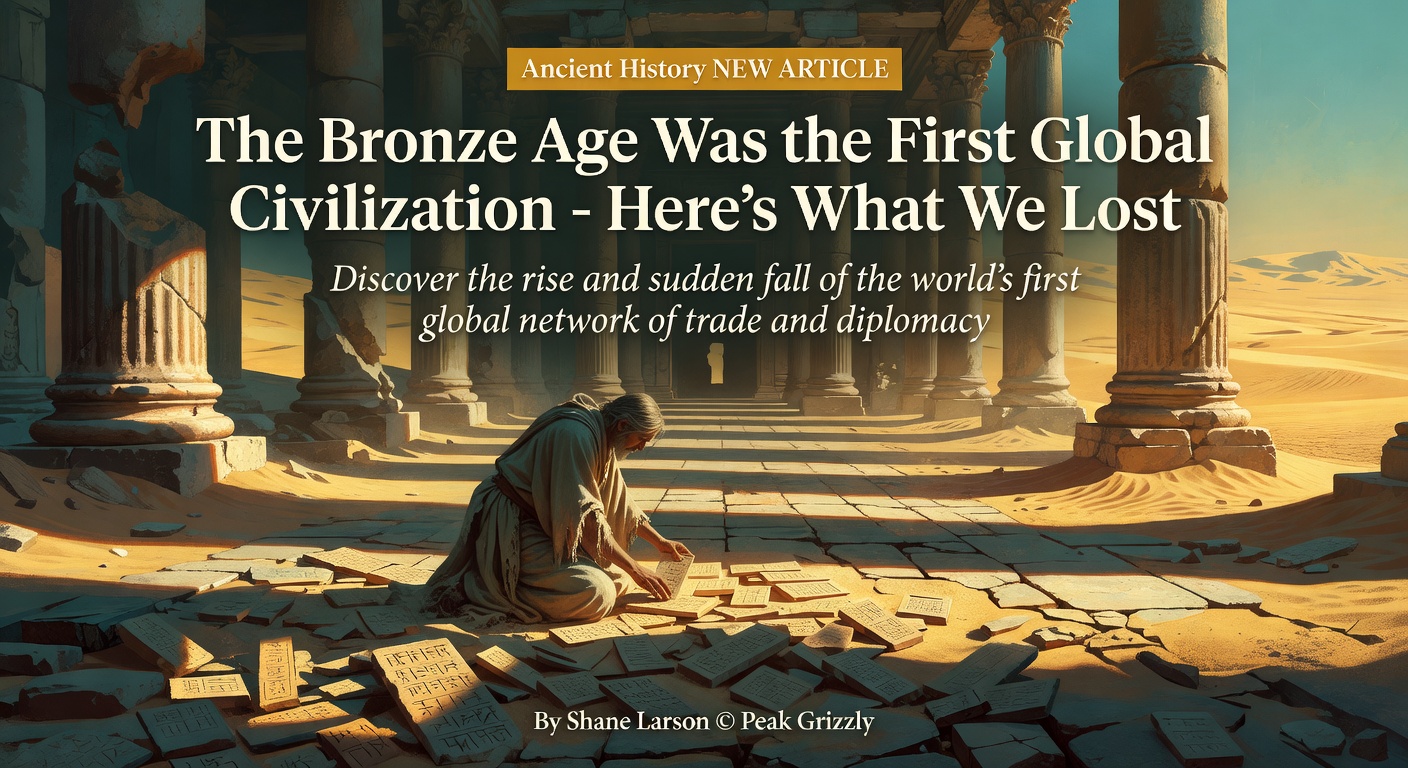
In 1887, a woman digging in the ruins of Tell el-Amarna in Egypt found a cache of clay tablets. She thought they might be worth something, so she sold them. Dealers broke some of them apart to increase their inventory. Scholars initially dismissed them as fakes.
They were not fakes. They were the diplomatic correspondence of the ancient world.
The Amarna Letters -- 382 surviving tablets written in Akkadian cuneiform -- are the closest thing we have to reading the email inbox of a Bronze Age pharaoh. They contain letters from the kings of the Hittites, Babylonia, Assyria, and Mitanni, as well as from dozens of vassal rulers across the Levant. The letters are blunt, transactional, and surprisingly human.
The king of Babylonia writes to the pharaoh complaining that the gold sent to him was underweight. The king of Assyria writes to announce that he is now a great power and expects to be treated as an equal. A vassal ruler in Canaan writes desperate letter after desperate letter begging for military reinforcements that never arrive.
These letters reveal something that most people don't realize about the ancient world: the Late Bronze Age, roughly 1500 to 1200 BCE, was not an era of isolated civilizations developing in parallel. It was a genuinely interconnected international system -- the first one in human history.
The Club of Great Kings
The Bronze Age world had a hierarchy, and the rulers at the top knew exactly where they stood.
The great powers -- Egypt, the Hittite Empire (Hatti), Babylonia, Assyria, and for a time Mitanni -- formed what scholars sometimes call the "Club of Great Kings." These rulers addressed each other as "brother" in their correspondence. They exchanged lavish gifts. They negotiated treaties. They sent their daughters to marry each other's sons.
Everyone else was a vassal. The smaller kingdoms -- Ugarit, Amurru, the Canaanite city-states, Cyprus -- owed loyalty to one great power or another. They paid tribute, provided military contingents when called upon, and navigated carefully between the competing interests of their overlords.
This was not a loose collection of trading partners. It was a structured international system with recognized rules, diplomatic protocols, and consequences for breaking them.
The Ship That Proved Everything
In 1982, a sponge diver named Mehmet Cakir spotted something on the seafloor off Uluburun, near the southern coast of Turkey. What he found turned out to be one of the most important archaeological discoveries of the twentieth century.
The Uluburun shipwreck, dating to approximately 1300 BCE, was a merchant vessel carrying cargo from across the known world. The inventory reads like a manifest of Bronze Age globalization:
- Ten tons of copper in the form of ox-hide ingots, almost certainly from Cyprus
- One ton of tin, likely originating in Central Asia or possibly Cornwall
- Gold and silver jewelry from multiple traditions
- Baltic amber -- which means goods from northern Europe reached the eastern Mediterranean
- African ebony and elephant ivory
- Canaanite amphorae filled with resin
- Glass ingots from Mesopotamia or Egypt
- Cypriot pottery, Mycenaean pottery, Syrian weapons
One ship. Goods from at least eleven different cultures. Crossing the Mediterranean thirty-three centuries ago.
The Uluburun wreck didn't just suggest that Bronze Age trade existed. It proved that trade operated at a scale and complexity that challenges our assumptions about the ancient world.
Why Bronze Made Globalization Inevitable
Here is the thing about bronze that most people don't think about: you cannot make it alone.
Bronze is an alloy of copper and tin. Copper is relatively common -- Cyprus had enormous deposits, and there were sources in Anatolia and the Sinai. But tin is rare. The major tin sources were in Central Asia (modern Afghanistan), possibly Cornwall in Britain, and a few other distant locations.
If you wanted bronze -- and you did, because bronze weapons and tools were the foundation of military and economic power -- you needed both metals. No single civilization controlled both. This meant that long-distance trade was not optional. It was a strategic necessity.
The Bronze Age World
The entire Bronze Age international system was, in a very real sense, built on the tin trade. The networks that moved tin from Central Asia to the Mediterranean carried everything else with them: gold, lapis lazuli, textiles, grain, timber, manufactured goods. The infrastructure of the tin supply chain became the infrastructure of civilization.
This created enormous wealth and cultural exchange. It also created enormous vulnerability. When the trade networks failed, civilizations that depended on imported tin could no longer make the alloy that underpinned their military and economic power.
Diplomacy by Marriage
One of the most striking features of the Bronze Age international system was the use of royal marriages as instruments of foreign policy.
When two great powers wanted to cement an alliance, they exchanged princesses. The process was formalized: negotiations over dowry, exchanges of gifts, elaborate wedding processions across hundreds of miles. A Babylonian princess might travel to Egypt. A Hittite princess might marry the pharaoh. These were not love matches. They were strategic transactions.
The system worked remarkably well -- until it didn't. The most dramatic failure was the Zananza affair. After the death of the young pharaoh Tutankhamun, his widow Ankhesenamun wrote to the Hittite king Suppiluliuma I requesting one of his sons as a husband. Suppiluliuma was stunned -- an Egyptian queen had never made such a request. After verifying the offer, he sent his son Zananza to Egypt.
Zananza was murdered en route. The resulting fury nearly triggered a full-scale war between Egypt and Hatti, and it poisoned relations between the two superpowers for decades.
The System's Fragility
The Bronze Age international system looked stable. For roughly three centuries, the great powers maintained their networks, their alliances, and their trade routes. But the system had vulnerabilities that its participants either didn't recognize or couldn't address.
Supply chain dependency. When trade carried luxuries, disruption was inconvenient. But by the late thirteenth century BCE, trade carried essentials -- tin for bronze, grain for populations that had outgrown local food production, timber for shipbuilding and construction. Disruption of essential trade meant civilizational crisis.
Climate instability. There is growing evidence of severe drought across the eastern Mediterranean in the late thirteenth century BCE. Tree ring data, pollen records, and ancient texts all point to a period of reduced rainfall that stressed agricultural production across the region.
Cascading failure. The great powers were interdependent. When one partner weakened, it could not fulfill its obligations to the others. When trade routes contracted, every economy that depended on them suffered. The system was built for mutual prosperity, but it was also wired for mutual destruction.
Around 1200 BCE, it all came apart. The Hittite Empire collapsed so completely that it was forgotten for three thousand years. Mycenaean Greece fell into a dark age. Ugarit was burned and never rebuilt. Egypt survived but lost its empire and never recovered its former power. The international system that had connected these civilizations vanished, and nothing comparable would emerge for centuries.
The Story Before the Catastrophe
I've spent several books writing about the Bronze Age Collapse -- the catastrophe itself, the Sea Peoples, the Hittite Empire's fall, the Iron Age that followed. But I realized that to understand what was lost, you need to understand what existed.
The Bronze Age World: The First Global Civilization and How It All Fell Apart tells that story. It covers the great powers at their peak, the trade networks that connected them, the diplomatic system that maintained their relationships, and the slow accumulation of vulnerabilities that made the whole structure fragile.
It is the prequel to the collapse -- the story of the world that was destroyed.
If you are interested in ancient history, in how civilizations build and maintain complex international systems, or in the uncomfortable parallels between Bronze Age supply chain dependency and our own, this book is where to start.
Available now on Amazon Kindle and Kindle Unlimited.
The Bronze Age World
New posts and releases, straight to your inbox. No spam, unsubscribe anytime.