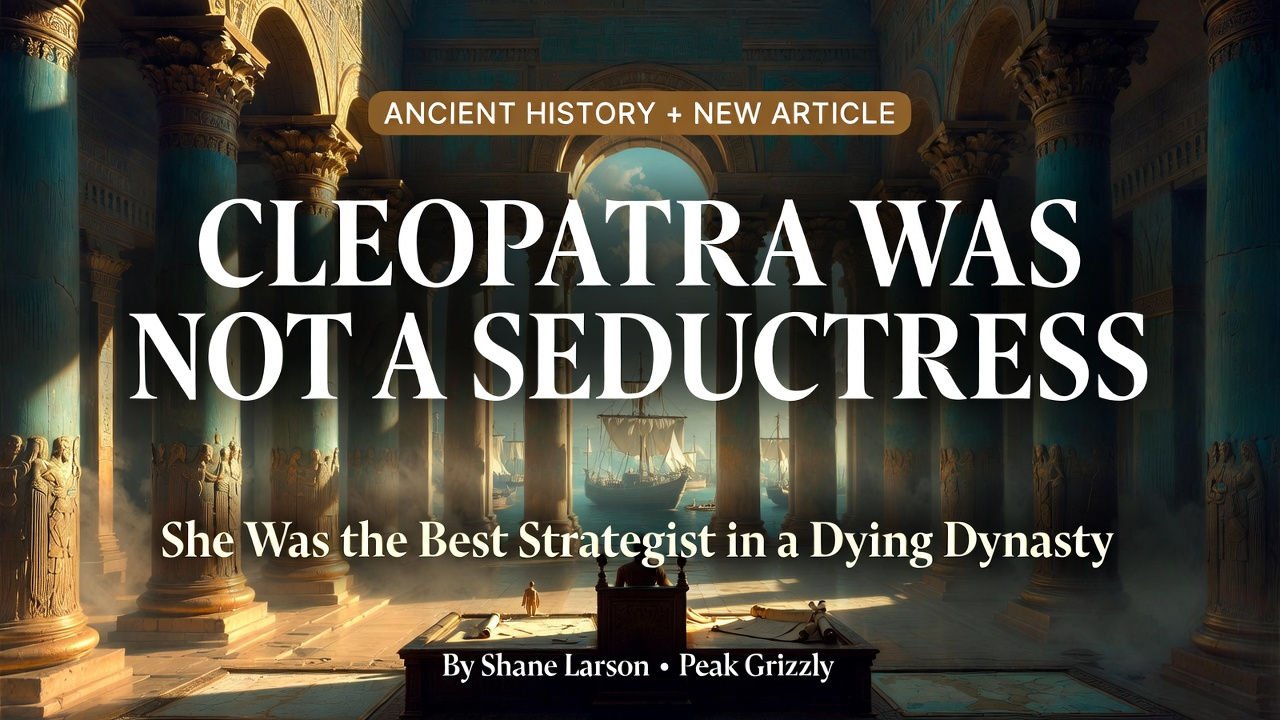
Cleopatra Was Not a Seductress. She Was the Best Strategist in a Dying Dynasty.
March 31, 2026 · 5 min read
Everything you think you know about Cleopatra is probably shaped by propaganda written by the man who killed her.
She wasn't Egyptian -- she was Macedonian Greek, the last ruler of a dynasty planted in Egypt by one of Alexander the Great's generals nearly three centuries before her birth. She wasn't defined by her love affairs -- she spoke nine languages, managed one of the ancient world's most complex economies, and was the most capable ruler her dynasty had produced in generations. And she wasn't swept along by fate. She was a calculating strategist who played the most dangerous political game in the ancient world and came closer to winning than anyone had a right to expect.
The real Cleopatra is more interesting than the myth. But to understand her, you have to understand what she was actually trying to do.
The Problem She Inherited
Cleopatra didn't inherit a strong kingdom. She inherited a slow-motion disaster.
The Ptolemaic dynasty had been in decline for over a century before she was born. The early Ptolemies were formidable -- they controlled not just Egypt but Cyprus, parts of Libya, and territories along the eastern Mediterranean coast. Ptolemaic wealth, generated by the Nile's agricultural surplus and monopolistic control of key commodities, was legendary. The Library of Alexandria made their capital the intellectual center of the ancient world.
But by the second century BC, the dynasty was rotting from within. Ptolemaic succession had become a bloodsport. Brothers killed brothers. Mothers killed sons. Queens orchestrated the assassination of rival wives. The small, paranoid ruling family -- they practiced sibling marriage in imitation of pharaonic tradition -- staggered from one succession crisis to the next.
Meanwhile, the economic infrastructure crumbled. Canals fell into disrepair. Tax revenues declined. The currency was debased. And above everything loomed the shadow of Rome.
By Cleopatra's time, the question wasn't whether Egypt would lose its independence. It was when, and under what circumstances. Her father had been a supplicant -- a client king who held his throne at Rome's pleasure and paid for the privilege with borrowed money. The famous incident of 168 BC, when a Roman ambassador drew a circle in the sand around a foreign king and told him to decide before stepping out, was a reminder to everyone in the eastern Mediterranean of who actually ran things.
This was the inheritance that awaited Cleopatra VII: a kingdom that was rich but declining, prestigious but dependent, powerful in memory but fragile in reality. She would spend her entire life trying to save it.
The Meeting That Changed Everything
When Julius Caesar arrived in Alexandria in October 48 BC, he was the most powerful man in the Roman world but also one of the most financially stretched. The civil war against Pompey had been enormously expensive. He needed money to pay his legions and stability in Egypt to keep Rome's grain supply flowing.
Cleopatra was twenty-one, queen of a kingdom that existed only because Rome allowed it, facing a civil war against her brother's faction that she could not win without outside help. She had one meeting to make her case -- not as a supplicant begging for Roman intervention (as her father would have done) but as a partner offering a strategic alliance.
Consider the political calculus. Caesar needed money immediately and Egyptian stability long-term. Cleopatra needed military force immediately and a fundamental repositioning of Egypt's relationship with Rome long-term. Her father had been a client. She intended to be an ally -- someone whose kingdom was valuable enough to Rome that its independence would be protected as a strategic interest, not a favor.
Cleopatra's Egypt
Whatever happened in that meeting, it worked. Within days, Caesar had committed to her cause. What followed -- the siege of Alexandria, the urban combat through one of the ancient world's largest cities, the Battle of the Nile where her fifteen-year-old brother drowned weighted down by golden armor -- was the military execution of a political decision that Cleopatra had engineered.
The Nile cruise that followed wasn't the romantic interlude of Hollywood legend. Four hundred ships accompanied the procession, carrying Roman soldiers and Egyptian courtiers in a display of combined power. For Cleopatra, it was an opportunity to be seen governing -- appearing before her subjects as pharaoh, performing the rituals that legitimized her rule, endorsed by the most powerful military commander in the world. For Caesar, it was a chance to survey the kingdom he'd just invested in.
The birth of Caesarion -- "Little Caesar" -- was the culmination of the strategy. A child who embodied the union of Rome's greatest general and Egypt's wealthiest kingdom was a political asset of almost incalculable value. Cleopatra named him Ptolemy XV Caesarion, explicitly linking the dynasty to Roman power. The name was itself statecraft.
What the Propaganda Buried
Octavian -- the man who would become Augustus and found the Roman Empire -- understood something important about Cleopatra. She was dangerous not because she was seductive but because she was competent. A capable, independent Egyptian kingdom allied with a Roman strongman (first Caesar, then Antony) threatened the entire structure of Roman power in the east.
So Octavian did what effective political operators do: he attacked the perception, not the reality. His propaganda campaign recast a political and military threat as a sexual one. Cleopatra became the foreign temptress who had enslaved good Roman men with her exotic wiles. The strategic alliance became a scandal. The political partnership became a love affair.
It worked so well that two thousand years later, most people still think of Cleopatra primarily as a romantic figure. Shakespeare wrote it that way. Hollywood filmed it that way. The political operator who spoke nine languages, managed an ancient economy, and nearly preserved a three-thousand-year civilization has been reduced to a woman defined by her relationships with men.
The real story is more interesting and more instructive. Cleopatra was playing a game with terrible odds -- trying to preserve Egyptian independence in a Mediterranean that Rome was swallowing whole. She played it with extraordinary skill, using every tool available: diplomacy, economics, military alliance, cultural performance, and yes, personal relationships that also served strategic purposes.
She lost. Actium and the fall of Alexandria ended pharaonic Egypt forever. But she came closer to winning than the odds suggested was possible, and her failure was less about personal shortcomings than about the structural reality that no single kingdom could indefinitely resist Roman expansion.
The propaganda, though -- that was Octavian's real masterpiece. He didn't just defeat Cleopatra. He replaced her with a fiction so compelling that it has outlasted his own empire.
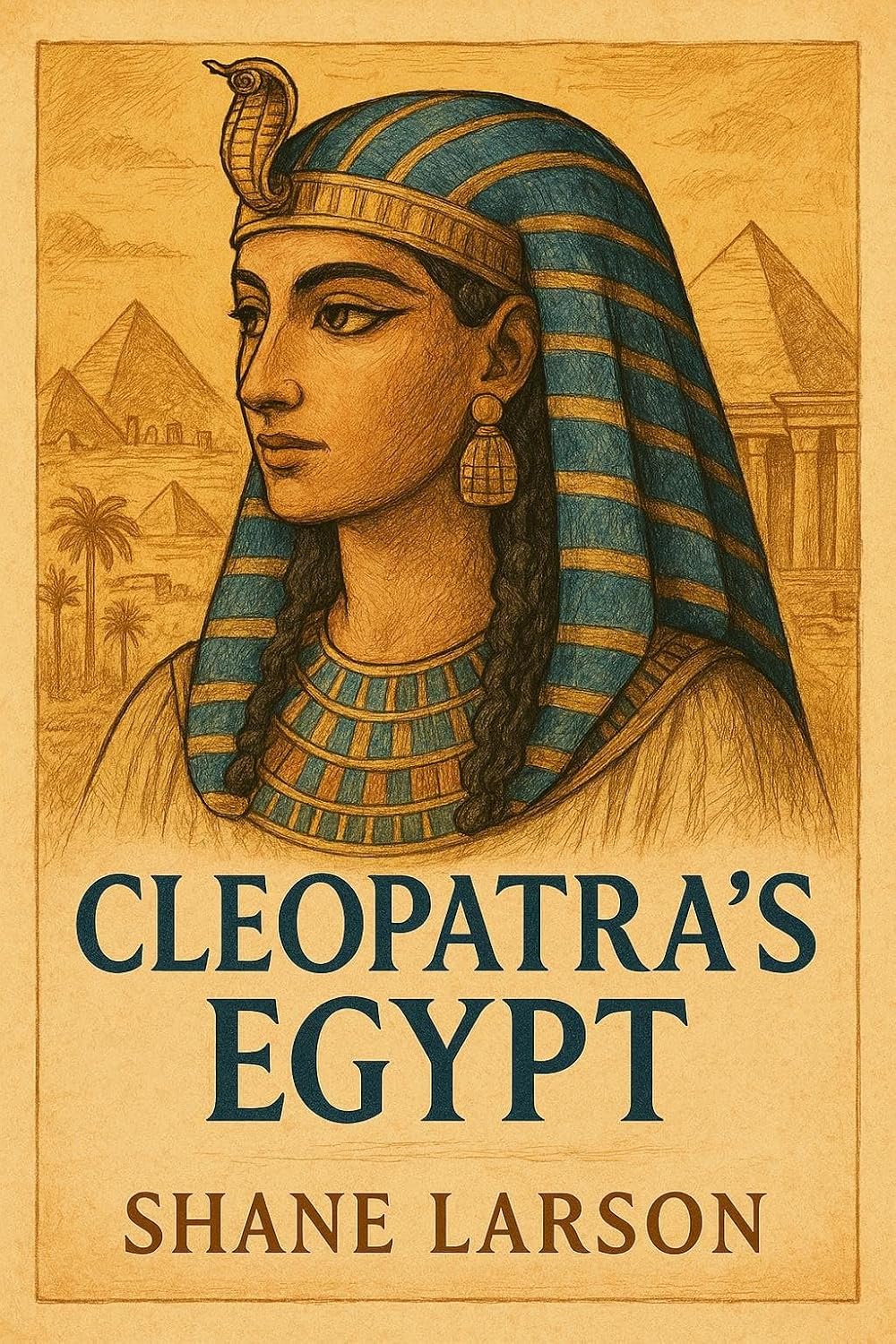
Cleopatra's Egypt: The Last Pharaoh and the End of an Ancient World is available now on Amazon Kindle. [Link placeholder]
Cleopatra's Egypt
New posts and releases, straight to your inbox. No spam, unsubscribe anytime.