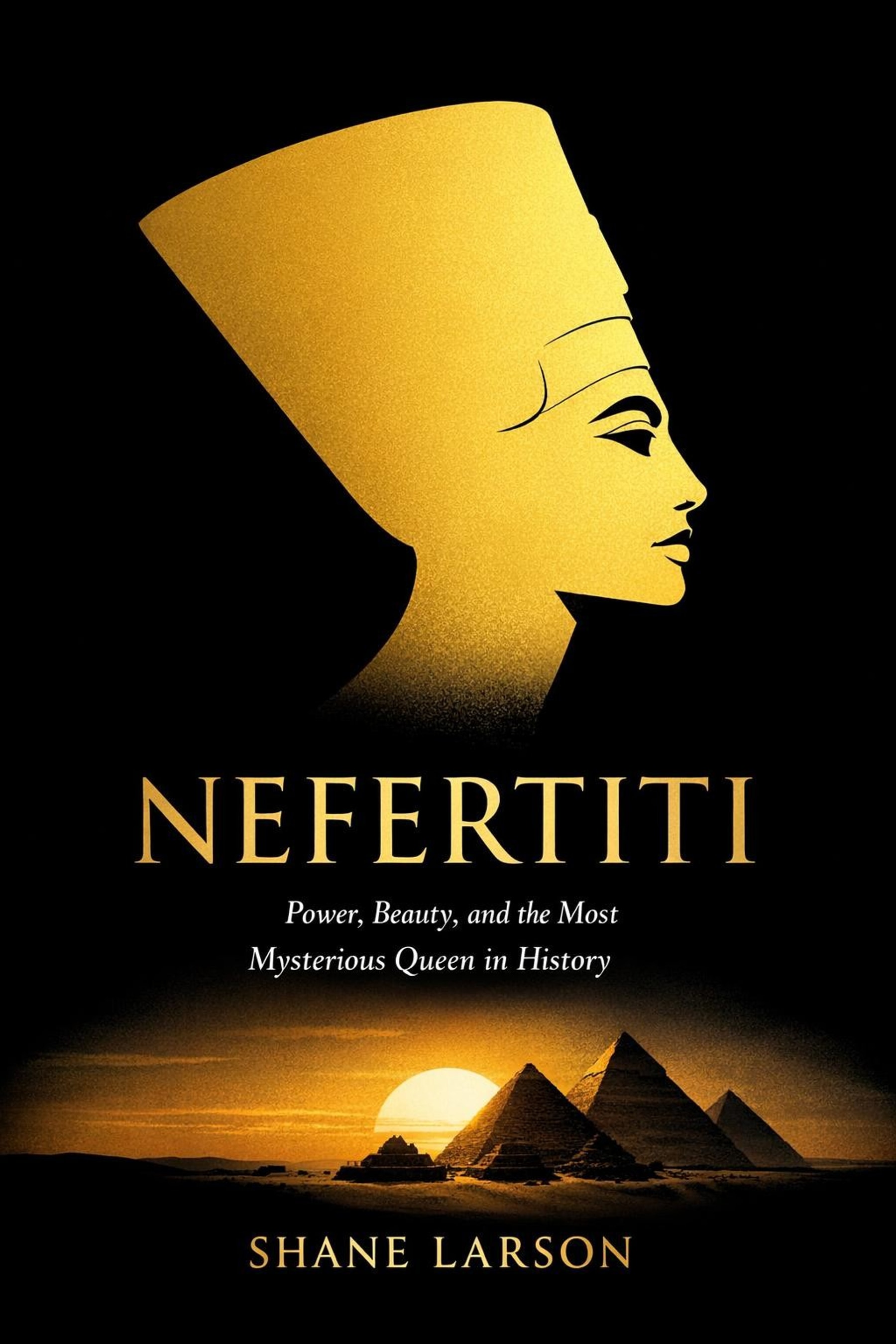
Nefertiti
Power, Beauty, and the Most Mysterious Queen in History
By Shane Larson
About This Book
Sometime around 1345 BCE, in a workshop on the east bank of the Nile, a sculptor named Thutmose finished carving a head out of limestone, coated it in plaster, and painted it. He left it on a shelf. Three thousand years later, German archaeologists hauled it out of the sand. A century after that, it is one of the most photographed objects on earth.
Almost nothing about the woman it depicts has survived in the public imagination intact. Ancient Egypt did its best to erase her. Modern publishing has done its best to flatten her into a face on a coffee mug. The truth — what we can actually piece together from inscriptions, reliefs, talatat blocks, royal tomb fragments, and a hundred and twenty years of archaeology — is that Nefertiti was one of the most politically powerful women in the ancient world, the co-architect of a religious revolution that nearly broke Egypt, and possibly the pharaoh who reigned after her husband died trying to hold his new god together.
This book is about all of that, and about the long, strange afterlife of her image.
The Story
Nefertiti steps into the historical record as the wife of Amenhotep IV, a young pharaoh who, within a few years of taking the throne, renamed himself Akhenaten, shut down the old temple priesthoods, declared the sun disk Aten the only god worth worshipping, and abandoned the traditional capital to build a new city from scratch in the middle of the desert. This was not a gentle reform. It was an attempt to delete fifteen hundred years of Egyptian religion in a single reign.
Nefertiti was not standing behind him. She was beside him, and the iconography is explicit about it. She appears at the same scale as Akhenaten in the temple art at Amarna — something queens are not supposed to do. She is shown in the smiting pose, war club raised over a captive, which previously belonged exclusively to the king. She makes offerings directly to the Aten without her husband in the scene, which violates the entire theological logic of a religion where the royal couple is supposed to be the sole interface between humanity and god. Her royal name was changed to Neferneferuaten-Nefertiti, embedding the name of the god into her own. She had six daughters with Akhenaten and we have their names, their portraits, and reliefs of the family at intimate moments — meals, mourning, play — that have no parallel in earlier dynastic art.
Then she vanishes. Around year 12 of Akhenaten's reign she disappears from the inscriptions. Around year 17, Akhenaten dies. Someone called Neferneferuaten then reigns as pharaoh, possibly as co-regent, possibly alone. The leading candidate for who that pharaoh actually is — and the case has gotten stronger with each round of scholarship over the last twenty years — is Nefertiti herself, ruling under a throne name that openly invoked the god she had helped install.
After her, the wreckage. Tutankhamun, almost certainly her stepson, took the throne as a child and was steered by his advisors back toward the old gods. The capital at Amarna was abandoned within a generation. Horemheb, a military man with no royal blood, became pharaoh and ran an explicit erasure campaign — Akhenaten's name was hacked out of the inscriptions, the Aten temples were torn down for their building stone, and the official king lists pretended the entire Amarna interlude had never happened. Horemheb dated his own reign as beginning before Akhenaten's, mathematically erasing two pharaohs and a queen.
The book reconstructs the whole arc: the world she was born into, the revolution she helped engineer, the art that captured her, the political collapse that followed, and the slow archaeological recovery — Petrie's surveys, Borchardt's discovery of the bust in 1912, the radar scans behind KV62, the contested DNA work on the Amarna mummies, and the still-unresolved question of where her body is.
What You'll Discover
- The Egypt of the early 18th Dynasty — wealthy, expansionist, and quietly straining under the political weight of the Amun priesthood at Karnak
- The strong but circumstantial case that Nefertiti was the daughter of Ay, a court official who would himself eventually take the throne
- Akhetaten, the planned city built from raw desert in five years, with its temples, palaces, workers' villages, and the boundary stelae that defined it
- The Aten religion in detail — what it taught, what it eliminated, and the live scholarly debate over whether it qualifies as the first true monotheism
- The full evidence for Nefertiti as co-ruler, including the smiting reliefs, the solo offering scenes, the royal titulary, and the unique crown that became her visual signature
- The Amarna art revolution — naturalism, sunken relief, family intimacy, the radical new body proportions — and the workshop of Thutmose where the bust was made
- The Neferneferuaten problem and what an actual female pharaoh in 1336 BCE would have looked like
- The Dahamunzu Affair, in which a widowed Egyptian queen wrote to the Hittite king asking for a son to marry — almost certainly the most extraordinary diplomatic letter to survive from the late Bronze Age
- Horemheb's erasure project and how the entire Amarna interlude was scrubbed from official memory until the 19th century rediscovered it
- The 1912 excavation, the way the bust left Egypt, and the century-long repatriation argument that still hasn't ended
- The ongoing search for her tomb — Reeves's hidden-chamber theory at KV62, the radar results, and what the DNA from the Younger Lady mummy may or may not be telling us
Why I Wrote This
I came to Nefertiti the way most people do — through the bust. I had seen the image on book covers and museum posters for years before I ever read a serious word about who she actually was, and when I finally did, I was annoyed at how badly the popular version had failed her.
The thing that ultimately pulled me in wasn't her beauty. It was the iconography. The first time I read a real description of the smiting reliefs — a queen, in the formal art of a culture that did not casually rewrite its visual conventions, depicted in a pose that was a pharaonic exclusive — I realized the story I'd been told my whole life had buried the actual headline. This was a woman exercising kingly power in plain sight, with her husband's full cooperation, in the most theologically charged moment in Egyptian history. And then the inscriptions stop, and she's gone, and the people who came after spent decades trying to make sure no one would remember any of it.
This book is the one I wanted to read when I started. It takes the visual evidence seriously, takes the disappearance seriously, and tries to be honest about where the evidence runs out and the speculation begins.
— Shane Larson
Frequently Asked Questions
Do I need to have read the book on Akhenaten first?
No. Nefertiti is written to stand alone — the Amarna period, the Aten religion, and Akhenaten's role are all explained from scratch. That said, if you're planning to read both, the Akhenaten book goes deeper on the theology and the politics of the religious revolution, while this one keeps her in the foreground. Most readers find the two complement each other well in either order.
Is this a narrative history or an academic study?
Narrative history, written for general readers. The argument moves chronologically, the prose is meant to be readable in long sittings, and technical terms are explained the first time they appear. The sources are real and serious — the recent scholarship on the Amarna mummies, the iconographic analysis, the Reeves theory — but the book is not formatted as an academic monograph.
Does the book come down on whether Nefertiti ruled as pharaoh?
It lays out the evidence on both sides, but yes, it takes a position. The case for Nefertiti as the pharaoh Neferneferuaten has been strengthening for the last two decades, and I think the weight of the iconographic and inscriptional evidence now favors it. The book explains why, and is equally explicit about what remains genuinely uncertain.
What about the bust itself — does the book cover the repatriation argument?
Yes. There's a full chapter on the 1912 excavation by the Borchardt expedition, the disputed circumstances under which the bust left Egypt, and the ongoing Egyptian campaign to have it returned. The politics of the object are part of its story.
Is this on Kindle Unlimited?
Yes — it's available through KU at no additional charge for Kindle Unlimited subscribers. It's also available as a standalone Kindle purchase.
Is there an audiobook?
An audiobook edition is in production. You can check the book's page on Audible or the Peak Grizzly site for current availability.
If You Liked This, You Might Like
- Hatshepsut: The Pharaoh Who Disappeared — the other great Egyptian queen whose successors tried to erase her, and the closest direct parallel to Nefertiti's story
- Akhenaten: The Heretic Pharaoh Who Invented Monotheism — the same period from her husband's side, with deeper coverage of the Aten theology
- The Bronze Age World — the broader Mediterranean and Near Eastern context the Amarna period sits inside, including the diplomatic world the Dahamunzu Affair was part of
- Cleopatra's Egypt — a different Egypt, more than a thousand years later, ruled by a woman who also ended up flattened into a cliché in popular memory
Closing
A queen who exercised pharaonic power in plain sight. A religious revolution that nearly broke the oldest civilization on earth. A face the world remembers and a name the world almost forgot. Nefertiti: Power, Beauty, and the Most Mysterious Queen in History is the woman behind the bust — and the long, strange story of how she came back.
From the Egyptian thread of the Peak Grizzly catalog, and a keystone of the powerful-women-of-the-ancient-world sub-series.
Included with Kindle Unlimited — read it free if you're a member.
New Ancient History releases and free chapters — no spam, unsubscribe anytime.