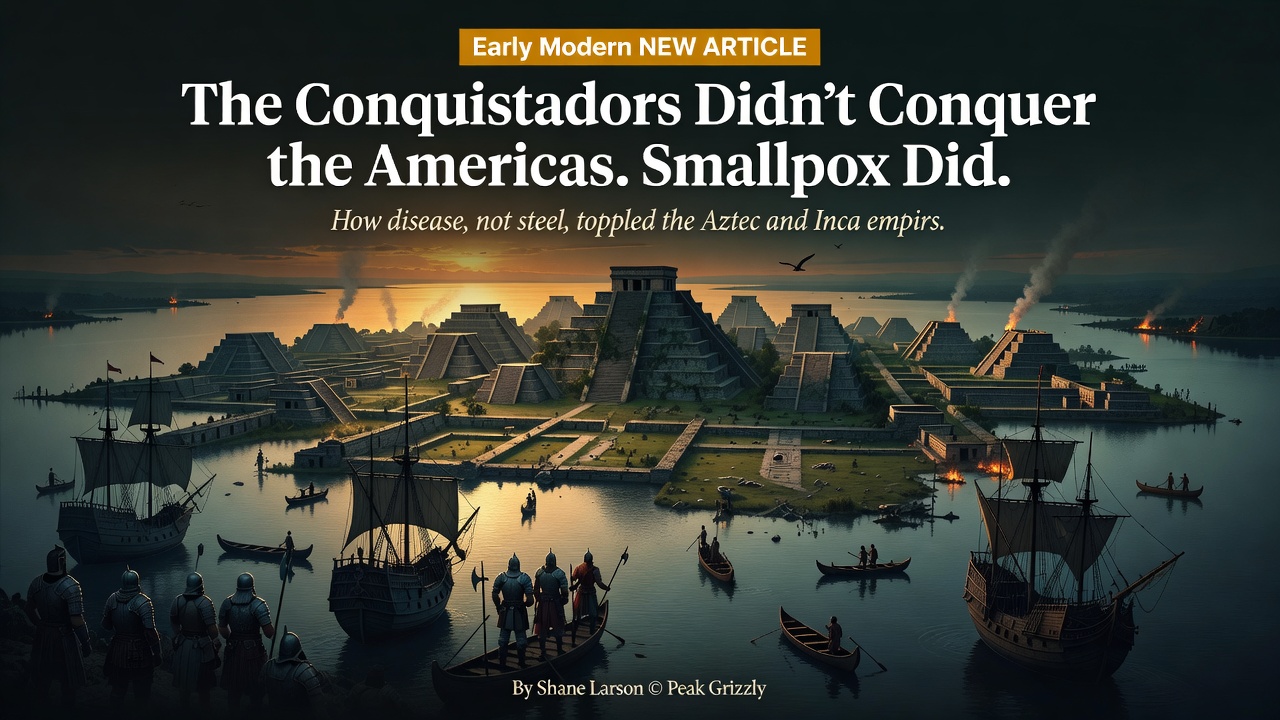
The Conquistadors Didn't Conquer the Americas. Smallpox Did.
July 6, 2026 · 6 min read
When Cortés returned to lay siege to Tenochtitlan in 1521, the most powerful city in the Americas was already a city of the dead — and he had nothing to do with it.
That sentence runs against everything the legend tells us. The story we inherited is clean and flattering to a certain idea of European genius: a few hundred Spaniards, armored and audacious, sailed into two of the largest empires on Earth and brought them down through steel, horses, and sheer nerve. Cortés outmaneuvered the Aztecs. Pizarro out-marched the Inca. A handful of men against millions.
Here is the uncomfortable thing about that story. Almost every fact in it is true. Cortés really did have only a few hundred soldiers. Pizarro really did capture the Inca with fewer than 200. They really did win. The problem is not the facts. The problem is the weight we put on them. We have built a monument to the conquerors and quietly written the actual conqueror out of the account.
The actual conqueror was a virus.
The plague that took Tenochtitlan
Start with the city everyone remembers. In June 1520, the Spanish were not winning. They were fleeing. Moctezuma was dead, the Aztec capital had risen against the invaders, and on the night the Spanish later called the Noche Triste — the Night of Sorrows — Cortés and his men were driven out across the causeways in a rout, losing men, horses, and most of the gold they had stolen. By any military reckoning, the conquest of Tenochtitlan had just failed.
What happened next was not decided by Cortés. It was decided by smallpox.
The disease had arrived on the mainland with the Spanish and their auxiliaries, and over the autumn of 1520 it tore through the Valley of Mexico. The Aztecs had never encountered it. They had no acquired immunity, no folk knowledge of how to nurse it, no concept of quarantine for a pathogen that had simply never existed in their world. It killed indiscriminately and at staggering speed. Among the dead was Cuitláhuac — the new emperor, the very leader who had just inflicted a humiliating defeat on the Spanish and might have organized the resistance that finished them.
By the time Cortés regrouped, gathered tens of thousands of Indigenous allies who had their own reasons to hate the Aztecs, and came back to besiege Tenochtitlan, he was not attacking an empire at the height of its power. He was attacking a population that had been hollowed out by an epidemic in the months he was away. The siege was brutal and it mattered. But the decisive blow had already landed, and the Spanish neither aimed it nor understood it.
In the Andes, the disease arrived first
If Mexico shows disease working alongside conquest, Peru shows it working ahead of conquest entirely.
Smallpox did not wait for Pizarro. It moved through trade routes and human contact faster than any column of soldiers could march, leaping from the Caribbean and Mesoamerica down through the continent. It reached the Inca empire — the largest, most administratively sophisticated state in the Americas — before a single Spaniard set foot in the highlands.
And it killed the emperor. Huayna Capac, the ruler who had expanded the Inca realm to its greatest extent, died in an epidemic that also killed his designated heir. The empire had no settled mechanism for a sudden double vacancy at the top. What followed was a vicious civil war between two of his surviving sons, Atahualpa and Huáscar — a war that consumed the empire's energy, split its loyalties, and left its provinces exhausted and divided.
This is the situation Pizarro walked into in 1532. He did not topple a unified empire at its peak. He arrived in the smoldering aftermath of a succession crisis that disease had triggered, and he was shrewd enough to exploit it. The famous capture of Atahualpa at Cajamarca, the ransom room filled with gold, the rapid collapse of resistance — all of it happened against the backdrop of a state that had already been broken from the inside by a pathogen nobody could see.
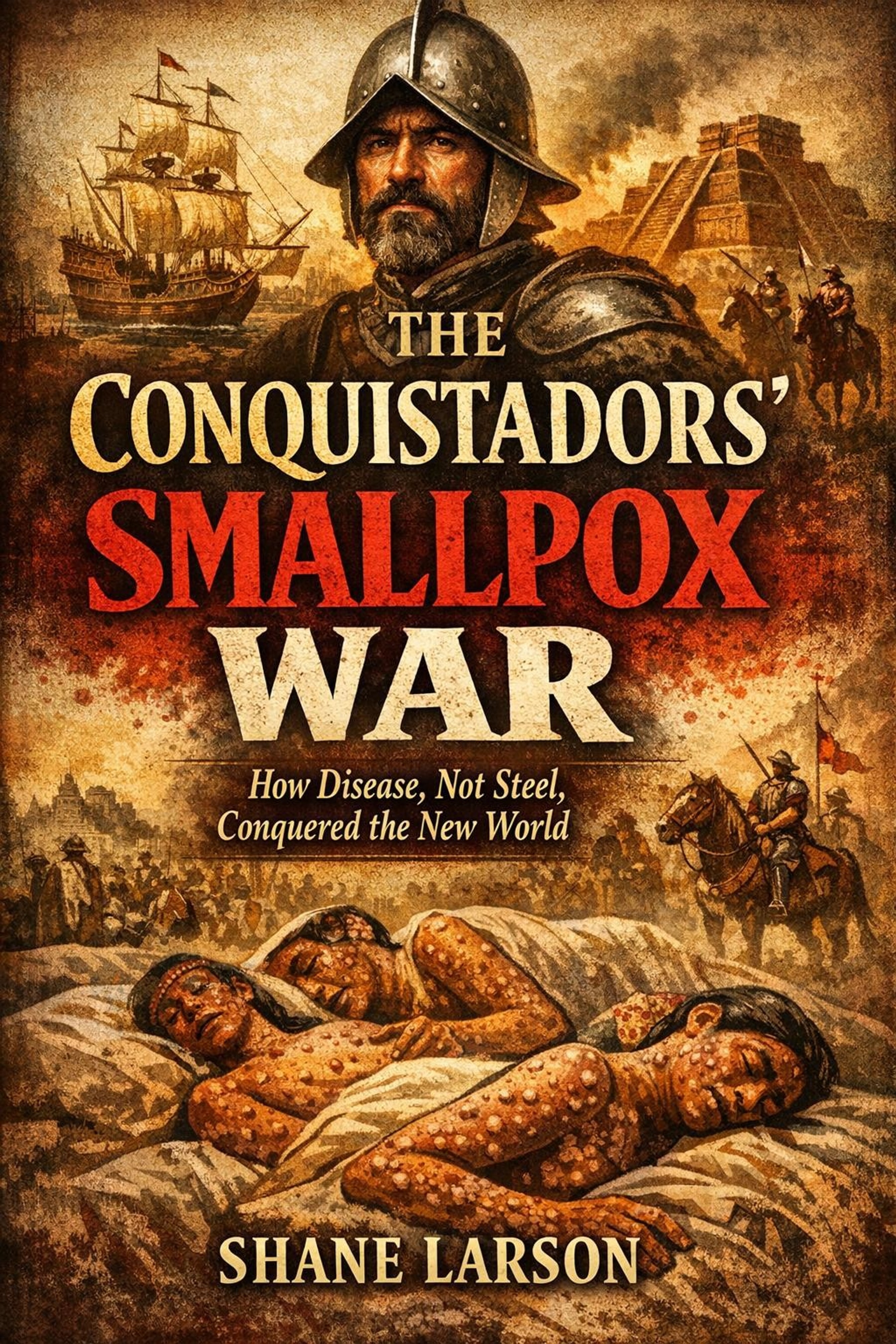
The Conquistadors' Smallpox War
Remove the smallpox and the story does not work. A few hundred men do not defeat the Inca army at full strength, united under a single uncontested ruler, in its own mountains. The disease made the conquest possible. The conquistadors finished a job that biology had started.
The largest catastrophe in human history
Zoom out from the two famous empires and the scale becomes almost impossible to hold in the mind.
Over the long sixteenth century — and the waves of disease kept coming for generations, not years — roughly nine out of every ten Indigenous people in the Americas died. Smallpox was the most dramatic killer, but it was not alone: measles, influenza, typhus, and a procession of other Old World infections rolled across populations with no prior exposure, often in successive waves that killed the survivors of the last one. Demographers still argue about the exact pre-contact population, and the book walks through how those estimates are actually built and why they vary. But across the credible range, the conclusion holds. This was the largest demographic collapse in human history.
It is worth being careful about what that means and what it doesn't. To say disease did most of the killing is not to absolve the Spanish of the brutality that is amply documented — the forced labor, the slaving, the violence. Those were real and they made the dying worse. But they cannot account for a 90% collapse across two continents, much of it in regions Europeans had barely entered. Only biology operating at continental scale can do that. The honest historical account is multi-causal, and it puts the pathogen at the center.
Why it only went one way
There is one more question the legend never asks, and it may be the most revealing of all: why did the diseases travel only in one direction?
The Spanish carried smallpox and a dozen other killers to the Americas. The Americas sent back almost nothing comparable. This was not luck or providence; it was the deep history of the two hemispheres. The dense cities, the long domestication of herd animals, the crowded trade networks of Eurasia and Africa had been incubating and circulating epidemic diseases for thousands of years, and the survivors carried hard-won immunities. The Americas, for reasons rooted in their own ecological and agricultural history, had not assembled the same arsenal. When the two disease pools finally met in 1492, the exchange was catastrophically lopsided.
This is what Alfred Crosby named the Columbian Exchange, and it is the real engine of the conquest. Not steel. Not horses. Not the supposed genius of two ambitious men. An invisible, accidental, biological asymmetry that no one in 1521 could have explained or even seen.
Reading the conquest honestly
None of this is new to historians. It runs through Crosby's The Columbian Exchange, Charles Mann's 1491 and 1493, Jared Diamond's Guns, Germs, and Steel, and Matthew Restall's careful dismantling of the conquest myths. What I've tried to do in The Conquistadors' Smallpox War is gather that scholarship into a single, propulsive narrative — to tell the story of the conquest the way it actually happened, with the disease restored to its rightful place at the center and the conquerors restored to theirs at the edge.
It is, I think, a better story than the legend. It is stranger, sadder, and far more honest about how history actually turns — not on the will of great men, but on forces they neither controlled nor understood.
The Conquistadors' Smallpox War: How Disease, Not Steel, Conquered the New World is available now on Kindle for $3.99, free on Kindle Unlimited.*
Internal-link opportunities for shanelarson.com: link "Tenochtitlan" and the Aztec siege discussion to the companion title on the Aztec capital in the Americas cluster; link the Inca succession crisis to the post/book on the Inca Highway. A third link from the "largest collapse in human history" line could point to the Collapse Pattern series landing page.
The Conquistadors' Smallpox War
New posts and releases, straight to your inbox. No spam, unsubscribe anytime.