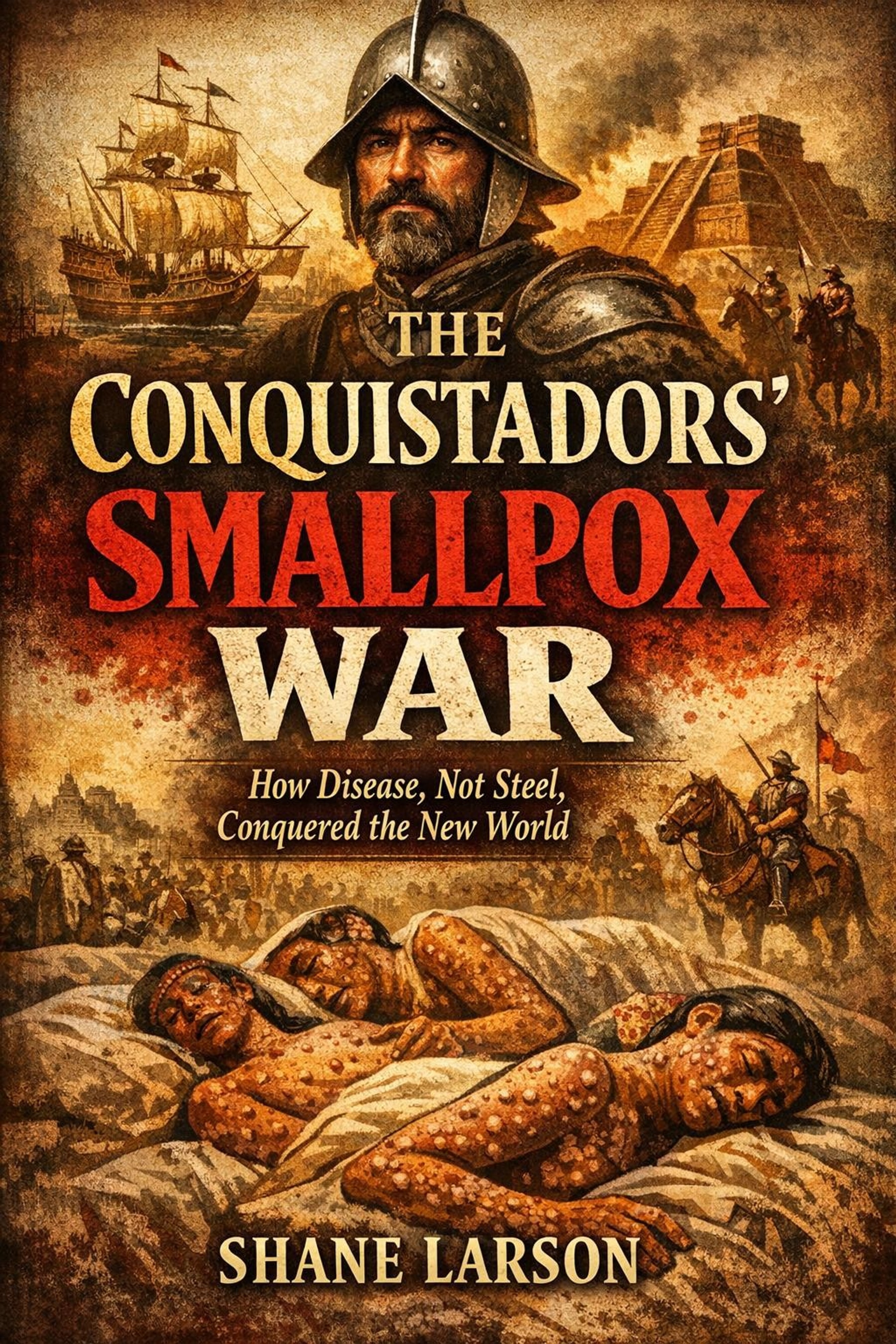
The Conquistadors' Smallpox War
How Disease, Not Steel, Conquered the New World
By Shane Larson
About This Book
In the winter of 1520, the people of Tenochtitlan watched a new kind of death move through their city. It began with fever and a rash, then pustules that covered the skin so completely that the sick could not lie down, could not eat, could not draw water. Whole households died within days of one another. The Spanish had been driven out of the capital months earlier, bloodied and retreating. And yet the city was dying anyway — not from Castilian steel, but from something no one in the Americas had a name for.
That something was smallpox. By the time Hernán Cortés returned to lay siege, the largest city in the Western Hemisphere had already lost a staggering share of its population, including the emperor who had beaten him in battle. The conquest we remember as a triumph of arms was, in its decisive moments, a triumph of contagion.
The Argument
The familiar version of the Spanish conquest is a story about men: Cortés the cunning, Pizarro the ruthless, a few hundred adventurers with horses and gunpowder overturning empires of millions. It is a satisfying story, and it survives because it flatters everyone who tells it. It is also, in its essentials, false.
The real conqueror was invisible. When Europeans crossed the Atlantic, they carried a biological arsenal that no Indigenous immune system had ever encountered — smallpox above all, but also measles, typhus, influenza, and more. In populations with no inherited resistance, these diseases did not merely spread. They detonated. Smallpox reached Tenochtitlan and killed the emperor Cuitláhuac within eighty days of taking the throne. In the Andes, it moved faster than any Spaniard could ride, killing the Inca ruler Huayna Capac before Pizarro's men ever laid eyes on Cusco — and touching off a succession war that tore the empire in half exactly when it could least afford to fight one.
This book reconstructs that catastrophe on the terms the evidence actually supports. Across the long sixteenth century, the Indigenous population of the Americas fell by something on the order of ninety percent — the steepest demographic collapse in the human record. It happened because of an accident of biology and geography, not because of the courage or genius of the men whose names we remember. Written in the multi-causal, evidence-first tradition of Charles Mann, Alfred Crosby, and Jared Diamond, it separates what the sources can prove from the legend that grew up around them.
What You'll Discover
- Why the fall of Tenochtitlan and Cusco was decided by an epidemic, not by the battles the chronicles dwell on
- How smallpox crossed the Andes ahead of the Spanish advance, killing an emperor and igniting a civil war before the conquest formally began
- The mechanics of the Columbian Exchange — and the accident of history that made it run overwhelmingly in one direction
- How the "great man" narrative of Cortés and Pizarro took hold, and whose interests it served
- What a ninety-percent mortality figure actually describes, and the methods historians use to reconstruct populations that left no census
- Why the Americas had no equivalent plague to send back across the Atlantic, and what that asymmetry reveals about the deep history of both hemispheres
- How the survivors remembered the dying, in the Indigenous accounts that rarely make it into the standard telling
Why I Wrote This
I got tired of the version where a handful of Spaniards simply out-fought two of the largest empires on Earth. It never held up. You do not topple a state of several million people with a few hundred soldiers unless something else has already done most of the work — and once you start reading the sources instead of the summaries, that something is obvious. The emperors were dead before the sieges. The cities were half-empty before the flags went up.
What interests me is not just correcting the record but understanding why the wrong version was so durable. A conquest by disease is a story with no hero and no villain worth the name — just an accident of immunity that happened to run one direction. That is harder to celebrate and harder to condemn, which is probably why the tidier legend won. I wanted to write the honest one instead, and to give the people who died of it something closer to the weight they deserve.
Frequently Asked Questions
Did smallpox really kill ninety percent of Native Americans?
Over the full course of the sixteenth century, yes — that figure reflects the cumulative toll of repeated epidemics, not a single outbreak. The book explains where the estimate comes from, why demographers debate the exact number, and how population reconstruction works when the societies in question left no written census.
Is this a narrative history or an academic study?
It's narrative history grounded in the evidence. The story is told for a general reader — no jargon, no assumed coursework — but every major claim is anchored to what the sources actually support rather than to legend.
Do I need to have read 1491 or Guns, Germs, and Steel first?
No. If you loved those books you'll recognize the tradition, but this one stands entirely on its own and assumes no prior reading.
Does the book cover North America, or only the Aztec and Inca empires?
The Aztec and Inca collapses are the narrative spine because the evidence there is richest, but the book situates them inside the wider Columbian Exchange that reshaped both continents.
What is the Columbian Exchange?
It's the vast transfer of diseases, plants, animals, and people between the Old and New Worlds that began in 1492. The book focuses on its most consequential and least discussed component: the one-directional flow of epidemic disease.
If You Liked This, You Might Like
- Tenochtitlan — the full story of the Aztec capital that smallpox emptied before the siege ever began.
- The Inca Highway — the road network that bound the Andean empire together, and along which the plague may have traveled ahead of Pizarro.
- Cahokia — the great pre-Columbian city north of the Rio Grande, and a reminder of how much of the Americas we've forgotten.
- The Collapse Pattern — how the largest, most confident civilizations undo themselves, from a wider analytical angle.
The empires of the Americas were not beaten by better men. They were hollowed out by a pathogen that arrived before the armies did — and this is the story the legend was built to hide.
New Early Modern History releases and free chapters — no spam, unsubscribe anytime.
More in This Genre
View all →