
The Eighteen-Month AI Roadmap Is a Socially Acceptable Way of Not Starting
August 5, 2026 · 5 min read
You have seen the deck. Eighteen months, four phases, a Gantt chart with colour-coded workstreams and dependencies nobody will ever track. Phase 1: Assessment and Planning. Phase 2: Pilot and Proof of Concept. Phase 3: Scale and Optimise. Phase 4: Enterprise-Wide Transformation.
It looks professional. It looks responsible. It is the kind of thing a board approves without argument.
It is also, in most cases, a way of not starting that nobody can criticise.
Not because the people who built it are cynical — they aren't. They are competent professionals trained to believe that careful planning precedes successful execution, and for building a bridge or migrating a mainframe, that belief is correct.
It is not correct here, and the reason is specific.
The Planning Assumption Doesn't Hold
Detailed upfront planning works when three conditions are true: the technology is stable, the requirements are knowable in advance, and the cost of a wrong decision is high enough to justify the analysis.
For AI work in an enterprise, none of the three hold.
The capability set changes materially over the life of an eighteen-month plan, which means your Phase 3 assumptions describe tools that no longer resemble what will exist when Phase 3 arrives. The requirements are not knowable in advance, because what people actually do with a capability is reliably different from what they say they will do. And the cost of being wrong is now low — a failed deployment costs weeks, not a capital budget.
When those conditions fail, planning stops being risk reduction and becomes delay with a document attached.
The most valuable information about whether something works in your organization comes from putting it in front of your people. Nothing in a planning phase produces that information, and no amount of additional analysis substitutes for it.
What Paralysis Actually Looks Like
It is rarely a decision to stall. It is a sequence of individually reasonable requests, each of which adds weeks.
A vendor evaluation, because choosing carelessly would be irresponsible. A security review, because the risks are real. A steering committee, because this affects several functions. A pilot scope, then a revised pilot scope after a stakeholder raises a concern. A business case with an ROI model, for a technology whose returns nobody can yet estimate honestly. A wait for the next budget cycle.
Nine months later there is a great deal of documentation and no deployed capability, and the organization has learned nothing that could not have been learned in week three.
Meanwhile the people who were going to use the thing did not wait. They are already using consumer tools on their own accounts, ungoverned, because the sanctioned path had no delivery date.
Ninety Days, Because the Constraint Is Attention
The case for a ninety-day cycle is not that ninety days is magic. It is that ninety days is roughly the longest interval an organization can sustain focus on something before priorities move.
It is long enough to deploy something real, gather genuine usage data, adjust, and deploy again. It is short enough that the sponsor who authorised it is still in the role, still cares, and has not yet been pulled onto the next thing.
The structure that works has a shape.
The 90-Day AI Transformation
Week one is subtraction. Stop the things that are not going anywhere — the pilots running without owners, the evaluations with no decision date, the committee that has met four times. Declare what you are actually doing and what you are explicitly not doing. Most organizations have more AI activity than they realise and less of it is going anywhere than anyone admits.
Weeks two and three ship something. One deployment, narrow, to real users doing real work. Not a proof of concept in a sandbox — that answers a question nobody is asking. The point is to reach the state where you have usage data, because everything after this depends on evidence rather than opinion.
Week four is honest assessment. What did people actually do with it, versus what you expected? Where did it break? What did they ask for that you did not anticipate? This is the highest-value week in the cycle and the one most likely to be skipped, because the answers are frequently unflattering.
Weeks five and six go parallel. Now that you know what one deployment looks like, run several at once. Parallelism is what turns a pilot into a programme, and it is only safe after the first cycle has taught you where the failure modes are.
Weeks seven and eight measure. Not adoption — outcomes. Cycle time on real processes, output quality, hours returned to the people doing the work. If you cannot state what changed in terms someone outside the project would recognise, you do not yet have a result.
Weeks nine through twelve make it durable. Capture what the organization learned, put the operating practices in place, and get the successful deployments out of project status and into ownership by the teams who use them. Most of what fails at this stage fails because nobody owned it after the sprint ended.
The Objection
The reasonable pushback is that this sounds like an argument against governance, and it isn't.
Security review, data handling, access control, and compliance are not optional and do not get skipped. What changes is that they run concurrently with a narrow deployment rather than sequentially in front of a broad one. Reviewing a scoped tool used by twenty people is fast. Reviewing a hypothetical enterprise rollout is slow, and it is slow because there is nothing concrete to review.
The scope is the risk control. A deployment that touches one team and one data source can be assessed in days and reversed in hours. That is a stronger safety property than eighteen months of planning followed by a large launch.
What You Actually Get
The compounding advantage is not the tooling. Everyone has access to the same tooling.
It is the organizational capability to deploy, evaluate honestly, and adjust — which is a muscle that only develops through repetition. An organization that has run four ninety-day cycles is not four cycles ahead on features. It is ahead on knowing how its own people respond, which failure modes are real for its data, and how long things actually take.
That knowledge cannot be acquired by planning, and it is the thing the eighteen-month roadmap defers indefinitely.
The roadmap is not the problem. The ratio is. Almost every organization stuck on this has its planning-to-execution ratio inverted, and the fix is not a better plan.
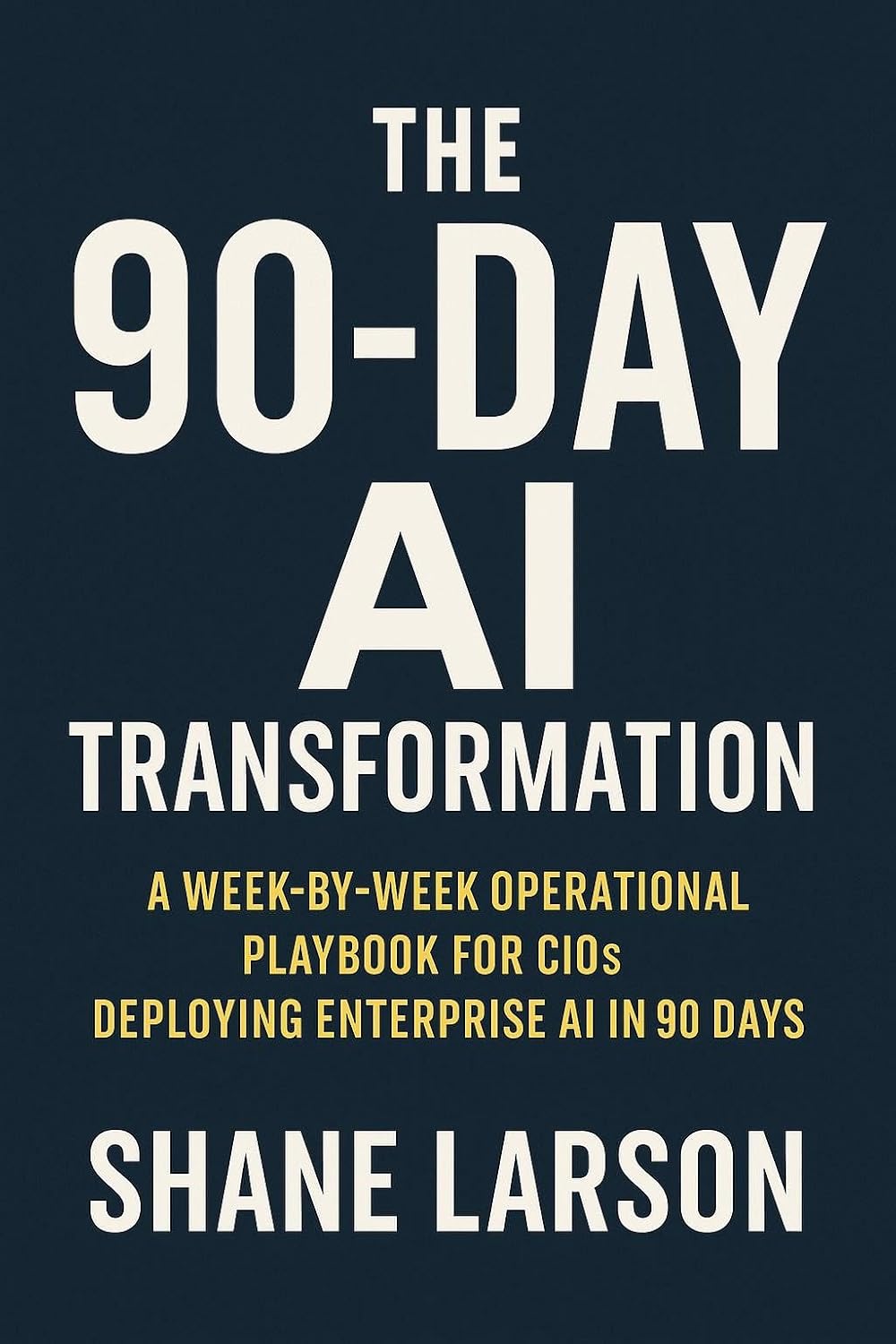
The 90-Day AI Transformation: A Week-by-Week Playbook for CIOs Who Need Results Now is the full cycle — setting up the sprint, the first deployment, parallel deployments, integration and measurement, organizational learning, making it stick, and moving from sprint to operating model.
The 90-Day AI Transformation
New posts and releases, straight to your inbox. No spam, unsubscribe anytime.