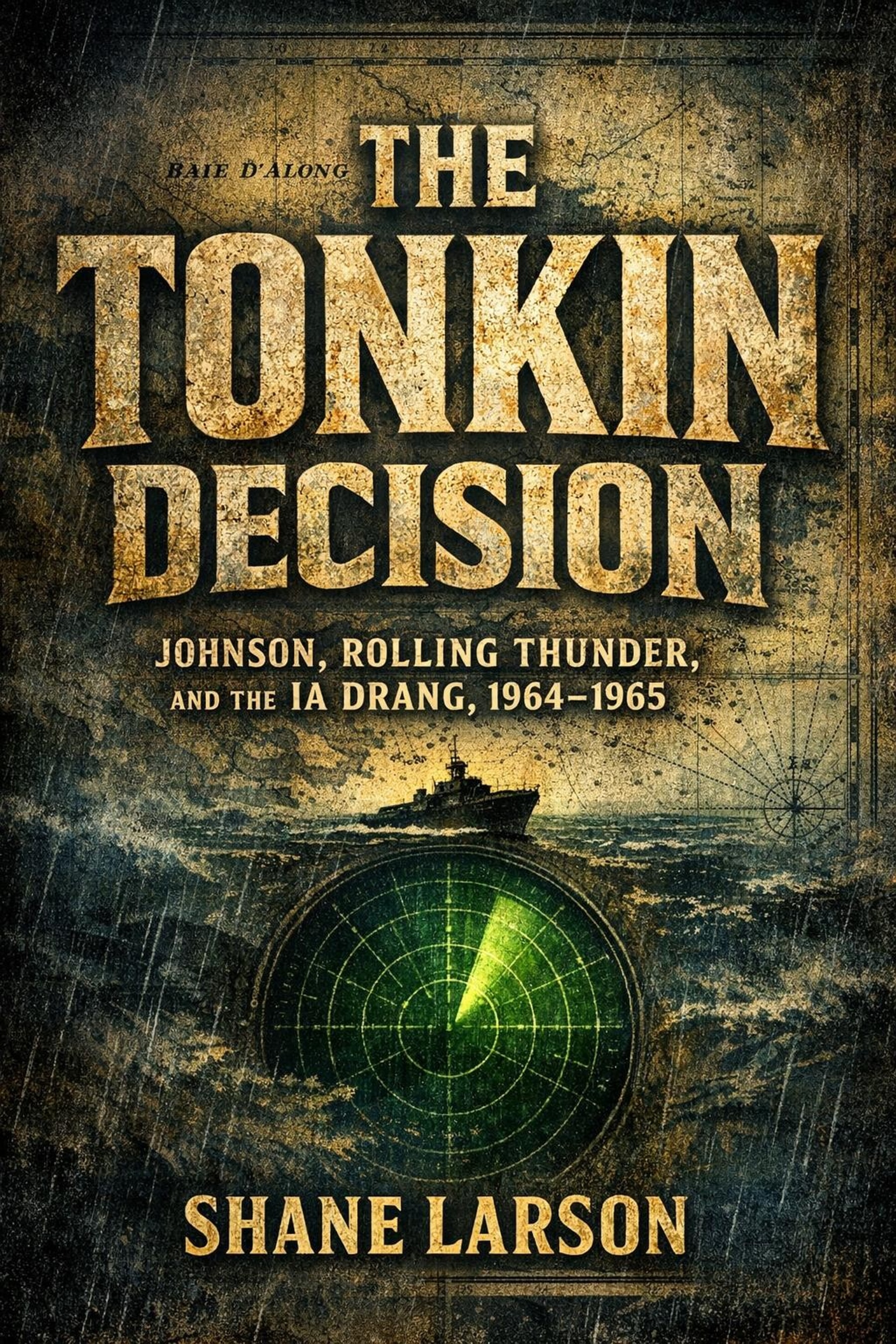
The Tonkin Decision
Johnson, Rolling Thunder, and the Ia Drang, 1964-1965
By Shane Larson · The Vietnam War Chronicles (Book 3)
About This Book
Two destroyers steamed through the Gulf of Tonkin in the black early hours of 4 August 1964, and everything about the night conspired against clear perception. Thunderstorms scattered false returns across the radar screens. The sonar operator aboard the USS Maddox was inexperienced and had been at general quarters for hours, listening for torpedoes in the noise of his own ship's rudder as she manoeuvred hard. The task group had been told to expect an attack after the genuine engagement two days earlier — and men told to expect an attack tend to find one. For more than two hours the ships reported torpedo wakes, fired at radar contacts, and counted incoming boats that the aircraft circling overhead could never see.
Before sunrise, the officer commanding the task group cabled Washington to say the reports deserved complete evaluation before anyone acted on them. The caution did not survive the trip up the chain. Retaliatory airstrikes were ordered that day, and within a week Congress had passed, with two dissenting votes, a resolution that would serve as the legal foundation for the American war in Vietnam for the next seven years.
This is not a story about a lie, and that is what makes it worth a book. Doubt existed at every level of the system that night — recorded, transmitted, documented. It simply grew weaker at each relay, while certainty grew stronger, until what reached the president was an attack that the weight of the evidence now indicates never took place.
The Tonkin Decision covers the eighteen months, from November 1963 to December 1965, in which the Vietnam War acquired its real dimensions. When the period began, sixteen thousand American advisors were in South Vietnam. When it ended, nearly two hundred thousand American troops were in combat, a bombing campaign against the North was in its tenth month, and the first battle between American and North Vietnamese regulars had been fought in a valley called the Ia Drang. At no point between those two dates did the administration describe to the public what it was choosing. The clearest case is the Marines: two battalions waded ashore at Da Nang in March 1965 to guard an airfield, and the book traces, decision by decision, how base security became enclave defence and then offensive operations — each step small, each step approved, the sum never stated.
The book also insists on a symmetry the purely American telling misses. In December 1963, at the Ninth Plenum of the Vietnam Workers' Party — before Tonkin, before any American bomb fell on the North — Hanoi resolved to seek a quick decisive victory in the South and to commit its regular army to win it. Read together, the two national records show both capitals choosing at the same time, each convinced it was merely reacting. An entire chapter tells Hanoi's side from the translated Vietnamese sources, and it sits early in the book because that is where it belongs in time.
Why I Wrote This
The Tonkin story I absorbed for most of my life was a lie story: the government faked an attack to get its war. Sitting with the declassified record — the cables, the NSA's internal history, the Johnson tapes — I found something worse and more ordinary. Nobody had to fake anything. The reporting system did exactly what it was built to do, quickly and efficiently, on information that was wrong. The doubts were real, they were written down, they were sent up the chain — and they died in the aggregation, the way qualifiers always die when a summary gets shorter at each level. That felt like a story about institutions, not villains, and it needed a book.
The other thing that changed the book's shape was the Vietnamese record. Hanoi decided to escalate in December 1963, before the events it is usually described as answering. Both capitals spent 1964 believing they were reacting. You can't see that from either archive alone.
Frequently Asked Questions
Does this book say the Gulf of Tonkin incident was faked?
No, and the distinction matters. The attack of 2 August 1964 happened — the North Vietnamese official history claims it. The reported second attack of 4 August almost certainly did not happen, but the evidence supports honest error compounded by a reporting chain under pressure, not fabrication. The book keeps three questions separate throughout: what occurred on the water, what was reported upward, and what the decision-makers believed when they acted.
Do I need to read Volumes 1 and 2 first?
No. The Introduction includes a compact account of the war so far — the French defeat, the Geneva partition, the Diem years, the advisory build-up — so the book stands alone. Readers of the earlier volumes pick up the thread three weeks after Volume 2 closed.
Is this a combat history?
Mostly not. The book's subject is how the decisions of 1964–65 were made, and most of its pages are set in Washington, Hanoi, and Saigon rather than in the field. Sustained combat narrative arrives in the final quarter, with the Ia Drang campaign of November 1965.
What sources does the book rely on?
Documents over historians. Quotation is reserved for the public record: the Pentagon Papers, the Foreign Relations of the United States series, the Johnson White House tapes cited by conversation and date, and the declassified NSA histories, alongside the translated Vietnamese official record. Contested figures — troop strengths, casualties, bombing tonnage — are given as ranges with a named source at each end.
Does the book cover the North Vietnamese side, or just Washington?
Both, on principle. Hanoi's decision-making gets a dedicated chapter built from Vietnamese sources in translation, and the closing chapter gives each capital's own reading of what the first battle between their regular armies had proved.
If You Liked This, You Might Like
- The Institutional Collapse Pattern — a systems-level look at how trusted institutions fail, which is exactly the machinery this book watches producing a war authorisation from a phantom battle.
- The Empire Collapse Pattern — great powers undone by their own internal logic rather than their enemies, the pattern the July 1965 meetings enact in miniature.
- The Trung Sisters — Vietnam's war against a vastly larger power, fought nineteen centuries earlier, and a reminder of how long that country's resistance tradition runs.
The scale of America's war in Vietnam was set in these eighteen months, in rooms whose records are now open — and the record of what was decided can finally be read beside the record of what was said. The Tonkin Decision is Volume 3 of The Vietnam War Chronicles, an eight-volume history of the Vietnam War from 1945 to 1975.
What You'll Learn
- **OPLAN 34A and the Desoto patrols** — the covert raids against the North Vietnamese coast and the signals-intelligence missions running near them, and why their proximity made the events of August 1964 possible in the first place.
- **A full chapter on the Ninth Plenum**, written from the translated Vietnamese record rather than from American intelligence estimates of it, carrying the book's central symmetry.
- **The resolution that was waiting.** The Tonkin Gulf Resolution had been drafted months before the incident it answered; the book covers its three-day passage, the dissents of Senators Morse and Gruening, and how the text was later stretched.
- **George Ball's dissent at full strength** — the best-documented internal case against escalation, given the space it earned by being substantially right.
- **Rolling Thunder from both directions**: the theory of coercive signalling behind it, the target restrictions stated fairly, North Vietnamese dispersal and repair, and the two scholarly readings — a campaign mis-designed, or a mission impossible.
- **The July 1965 meetings from the published transcripts**, including the two negative decisions — no reserve call-up, no declaration — that quietly determined how the war would be manned and paid for.
- **The Ia Drang with X-Ray and Albany treated as one action**, casualty figures on both sides given as ranges with named sources, and the sobering conclusion each command drew from the same battle.
- **An appendix laying out the Tonkin evidence piece by piece** — the ships' reports, the weather, the intercepts and what they actually said, the National Security Agency's declassified reassessment — so readers can weigh the record themselves.
New Military History releases and free chapters — no spam, unsubscribe anytime.
More in The Vietnam War Chronicles
View series →
More in This Genre
View all →