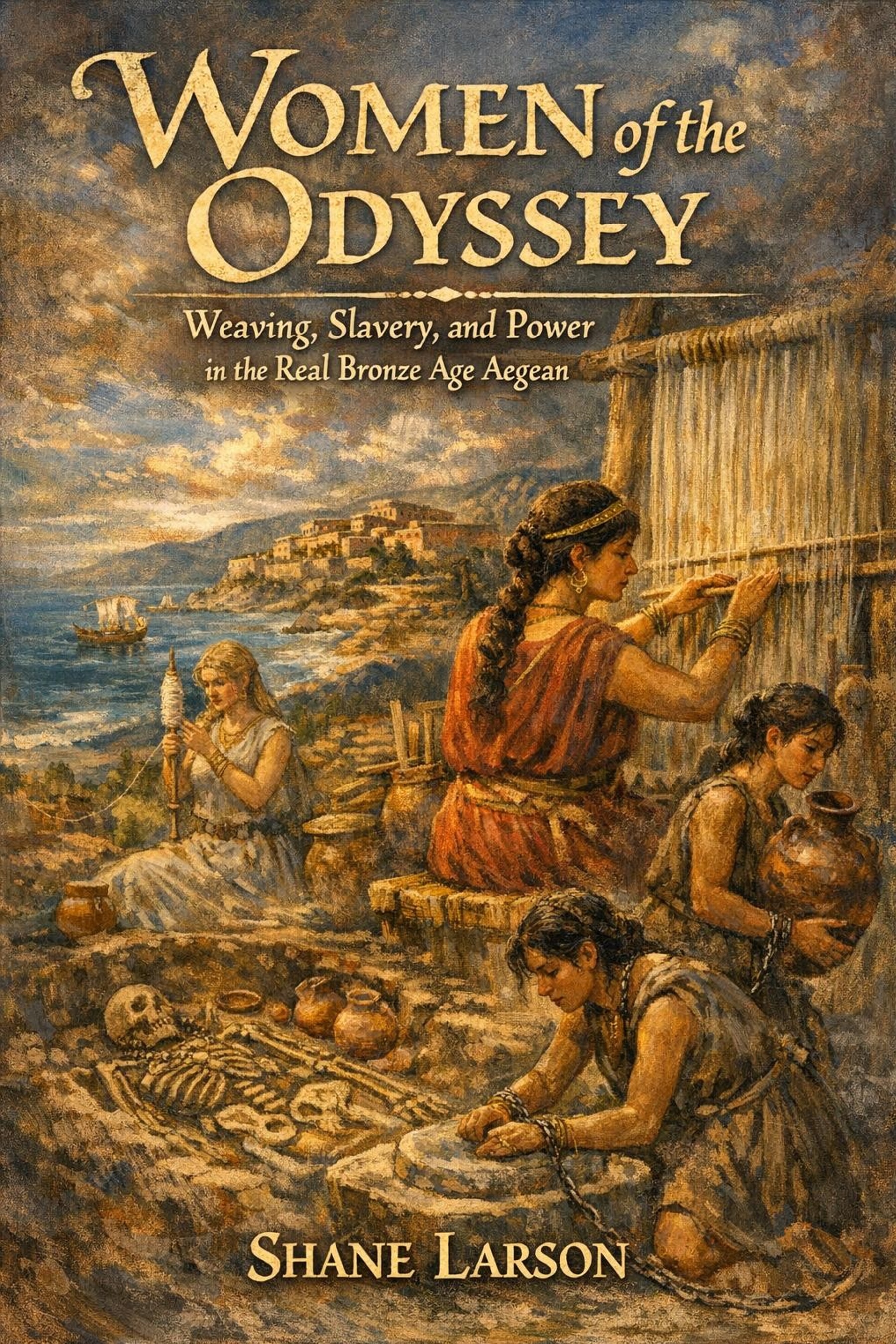
Women of the Odyssey
Weaving, Slavery, and Power in the Real Bronze Age Aegean
By Shane Larson
About This Book
Around 1180 BC, the palace at Pylos burned. The fire that ended the kingdom also preserved it: the flames baked its clay records hard, and among them survived something no other corner of the ancient world left behind — an account of roughly 750 working women, listed group by group with their trades, their monthly wheat and figs, and their children counted beside them. Spinners. Carders. Finishers. Grain-grinders. Whole crews whose only label is the foreign coastline they came from.
Four centuries later, a poem took shape about a king trying to get home. Everyone remembers the men in it. But the Odyssey is full of women doing the actual work of that world — a queen running an estate under siege for twenty years, island rulers who answer to nobody, an old nurse who holds every secret in the house, and the enslaved women whose labor keeps the great hall fed, clothed, and lit.
This book puts the poem and the clay side by side and asks what the retellings never quite get to: what was the real world of these women like — not as Homer imagined it, but as the Bronze Age documented it?
The Argument
Women of the Odyssey is history, not fiction, and it runs on a simple method. Every chapter opens on a woman from the poem — Penelope, Eurycleia, Circe, Nausicaa, Helen, Arete, the twelve executed in Book 22 — and then turns from the poetry to the evidence: the Linear B tablets from Pylos and Knossos, the archaeology of houses, graves, and workshops, and the records of the Aegean's Bronze Age neighbors, from Hittite marriage law to the inventoried royal brides of the Amarna letters.
What the evidence shows is a world organized around women's labor to a degree the poem only half-remembers. Cloth was the treasure of the Mycenaean palaces — stored like bullion, gifted to seal alliances, shipped abroad for copper and tin — and cloth was made, at every stage, by women. The Knossos archive tracks sheep in the tens of thousands and assigns wool quotas to work-groups; the Pylos rolls ration those groups down to the half-share a daughter drew beside her mother. When the poem puts a loom in the great hall and a queen at it, it is placing at the center of the house exactly what the accounts place at the center of the economy.
The book is equally direct about the darker half of that system. Many of the women in the tablets were not free: they hold no land in an archive obsessed with land, they are provisioned at the subsistence floor for life, and blocks of them are identified only by where they were taken from. That pattern, read against the poem's matter-of-fact traffic in captured women, is examined soberly, without flinching or sensationalizing. Where the record supports a conclusion, the book states it; where it supports only an inference, it says so; where the evidence goes dark, it refuses to fill the silence with invention.
Why I Wrote This
Two facts got their hooks into me and would not let go. The first was arithmetic. Researchers in Copenhagen put reconstructed Bronze Age tools into experienced weavers' hands and timed the work: roughly a hundred hours of spinning behind every ten at the loom. The moment I saw that ratio, Penelope's trick stopped being a fairy tale and became engineering — a delay built on labor costs every man in her hall knew in his bones. The second was a filing convention. The scribes at Pylos recorded whole groups of women not by name or trade, but by the foreign coastline they had been taken from — a bureaucracy confessing, in bland shorthand, to a traffic the poem also remembers. A poem I thought I knew turned out to be standing on an economy, and the economy was made of women's hours. I wanted to write the book that counted them.
Frequently Asked Questions
Is this a retelling, like Circe or The Penelopiad?
No — and that is the point. The retellings give Homer's women invented interior lives; this book gives them a documented world. It is narrative history built from the Linear B tablets, excavation reports, and comparative Bronze Age records, explicit about the line between what the evidence proves, what scholars infer, and what only the poem imagines. If you enjoyed the novels, this is the factual ground they stand on.
Do I need to know the Odyssey to follow it?
No. Every chapter opens by retelling, briefly and in plain language, the scenes it needs. If you have never read the poem, the book works as an introduction to it; if you know it well, you will meet familiar scenes carrying unfamiliar evidence.
Does the book deal with the slavery in the poem?
Yes, directly — an entire section covers the enslaved women of the tablets and the household, including the twelve executed in Book 22. It treats the subject as history rather than spectacle: how women entered palace labor, how dependency was graded, and where the evidence for coercion is strong and where it is inference. It neither softens the material nor dramatizes it.
Do I need to read the other Homer's World books first?
No. Each volume stands alone. The Search for Ithaca hunts for Odysseus's island, The Real World Behind the Odyssey surveys the poem's whole material world, and Cult of the Hero traces what later Greeks made of Homer's dead; this book goes deep on one subject the others could only touch. Further companions on the poem's composition and geography are in the works.
How long is the book, and how technical is it?
About 56,000 words — thirteen chapters plus appendices, including a plain-language walkthrough of the key women's-labor tablets and a guide to how Bronze Age cloth was actually made. No Greek is required; every tablet term is explained the first time it appears.
If You Liked This, You Might Like
- The Real World Behind the Odyssey — the panoramic companion: ships, palaces, trade, and daily life across the poem's whole world, where this book drills into one seam of it.
- The Mycenaeans — the full portrait of the palace civilization whose archives, citadels, and collapse frame every chapter here.
- Gilgamesh — the same method applied to an older epic: a legendary poem read against the clay-tablet record of the world that produced it.
- Hatshepsut — what documented female power looked like in the Bronze Age, from the one civilization that let a woman hold the throne and then tried to erase her.
Homer's women have been retold for three thousand years. This is what happens when, instead, you check the records.
Part of the Homer's World series from Peak Grizzly Publishing.
What You'll Learn
- Eighty thousand sheep. The Knossos flock records, and how one palace ran wool-to-cloth production as a targeted, audited industry — the engine women powered.
- The spinning bottleneck. Experimental archaeology has timed Bronze Age textile work with reconstructed tools, and a king's shroud comes out at plausibly a year of labor — which is why a hall full of suitors believed Penelope's timetable.
- The shroud as engineering. Why unweaving by night was an economically optimized delay — spending the cheap half of the labor twice while banking the expensive half once.
- A census of the unfree. How the Pylos work-group tablets carry the documentary fingerprint of a slave trade running along the same Anatolian coastline the epic tradition treats as raiding water.
- Eritha's lawsuit. A priestess who took her community to court over land — the best-documented act by a named woman in the Aegean Bronze Age, and the key to the one real avenue of female standing.
- Marriage as statecraft. Bride-gifts, dowries, and the machinery of alliance behind Nausicaa's riverbank meeting — and why the poem contradicts itself about how the payments ran.
- The remarriage crisis. Why a presumed widow choosing a husband was a property emergency, and how Penelope ruled from the gaps of a system whose every rule ran against her.
- What Athens narrowed. A comparison with the far more constrained women of the classical sources — and why "the Bronze Age was better for women" is a claim the evidence will not fully carry.
New Ancient History releases and free chapters — no spam, unsubscribe anytime.
More in This Genre
View all →