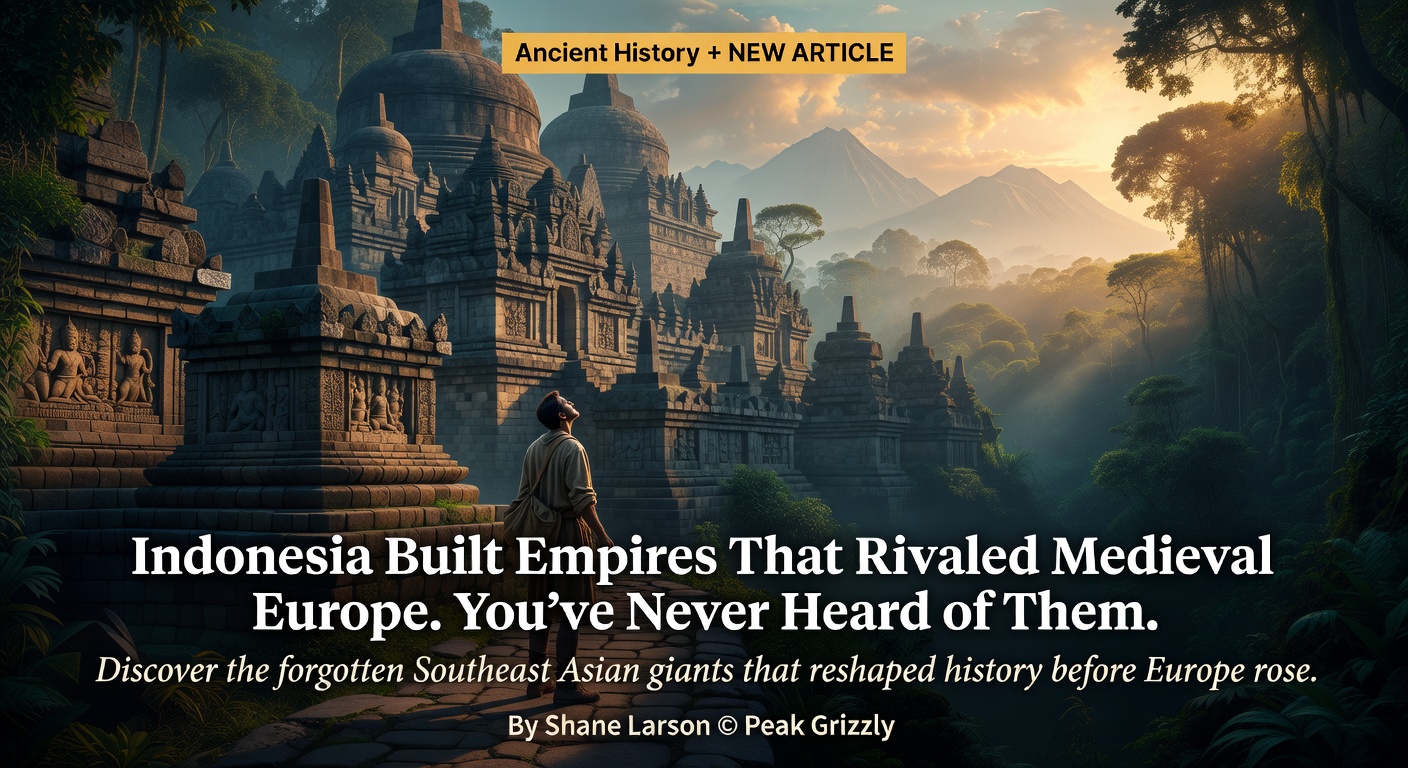
Indonesia Built Empires That Rivaled Medieval Europe. You've Never Heard of Them.
April 16, 2026 · 10 min read
Title: "Indonesia Built Empires That Rivaled Medieval Europe. You've Never Heard of Them."
If I asked you to name the great empires of the medieval world, you'd probably start with the usual list. The Byzantine Empire. The Carolingian Empire. The Abbasid Caliphate. Maybe the Song Dynasty if you're feeling expansive.
You almost certainly wouldn't mention Srivijaya or Majapahit.
And that's a problem. Because these Indonesian empires weren't backwaters on the edge of civilization. They were central players in a global trading network that connected China to India to the Arab world to East Africa, facilitating the exchange of silk, porcelain, spices, and even ideas that shaped societies across continents. They built monuments that rival anything in the Western canon, drawing on advanced engineering and artistic traditions that blended local ingenuity with influences from India and beyond. They controlled some of the most strategically important waterways on Earth, where naval prowess and diplomatic savvy allowed them to thrive amid the complexities of international commerce.
But most world history courses give them a paragraph, if that, often overshadowed by a Eurocentric lens that prioritizes land-based powers over maritime ones, as if the seas weren't the true highways of medieval globalization.
Here's what they're missing.
The Maritime Superpower You've Never Heard Of
In the 7th century, while Western Europe was still sorting itself out after the fall of Rome — dealing with fragmented kingdoms and the slow rebuilding of infrastructure — a Buddhist maritime empire was rising on the island of Sumatra, capitalizing on the region's fertile river deltas and abundant natural resources to forge a formidable state.
Srivijaya — based near modern-day Palembang — controlled the Strait of Malacca, the narrow waterway between Sumatra and the Malay Peninsula. If you wanted to move goods between China and India by sea, you went through the Strait of Malacca, where ships laden with teas, textiles, and precious metals had to navigate treacherous currents and monsoon winds. And if you went through the Strait of Malacca, you paid Srivijaya, either through tolls that funded their expansive bureaucracy or alliances that ensured safe passage amid pirate threats.
This was the chokepoint of Asian maritime trade, a vital artery for the movement of wealth that made Srivijaya wealthier than many contemporary European realms, and they held it for roughly 600 years, adapting to shifts in regional politics like the rise and fall of neighboring kingdoms. At its peak, Srivijaya was a major center of Buddhist learning, where monasteries served not just as places of worship but as hubs for translating texts and fostering intellectual exchange, drawing scholars from afar. The Chinese monk Yijing spent years there in the late 7th century, studying Sanskrit texts and noting that the kingdom hosted over a thousand Buddhist monks, impressed by the depth of their libraries and the quality of their education. He recommended that Chinese monks stop in Srivijaya to study before continuing to India — that's how important its monasteries were, offering a curriculum that included philosophy, medicine, and astronomy, which in turn influenced East Asian thought for generations.
Srivijaya maintained diplomatic relations with the Tang Dynasty in China, exchanging envoys and gifts that included exotic animals and advanced technologies; the Chola Empire in India, where they shared naval strategies to combat common threats; and the Abbasid Caliphate in Baghdad, linking them to the Islamic world's scholarly networks. It wasn't a regional footnote; it was a major node in a global network, where cultural and economic interactions helped spread innovations like shipbuilding techniques that enabled longer voyages.
Yet most people in the West have never encountered the name, perhaps because their power was projected through fleets rather than armies, a subtlety lost in histories that favor conquest over commerce.
A Monument Larger Than Notre-Dame
In central Java, roughly contemporary with Srivijaya's dominance over maritime trade, something extraordinary was happening on land, as volcanic landscapes provided the raw materials for architectural feats that symbolized spiritual and societal harmony.
Around 800 CE, the Sailendra Dynasty began construction of Borobudur — a stepped pyramid of volcanic stone that would become the largest Buddhist monument in the world, requiring thousands of laborers and decades of planning to carve and assemble its massive blocks without modern tools. It contains 2,672 narrative relief panels carved into its walls, telling stories from Buddhist scripture and depicting daily life in 9th-century Java, from bustling markets to intricate rituals, offering a vivid snapshot of a society where art and religion intertwined. It has 504 Buddha statues arranged across its terraces, each one uniquely styled to represent different aspects of enlightenment, and 72 perforated stupas crown its upper levels, each containing a seated Buddha that pilgrims could view through the stone latticework, symbolizing the path to nirvana.
The entire structure is arranged as a three-dimensional mandala — a physical representation of the Buddhist cosmological journey from the world of desire at the base, with its earthly carvings of human struggles, to the realm of formlessness at the summit, encouraging visitors to meditate on their own spiritual progress as they ascended. Walking the galleries from bottom to top is, literally, a walk through the stages of Buddhist enlightenment, a practice that drew pilgrims from across Asia and fostered a sense of shared identity.
Borobudur was completed roughly a century before construction began on Notre-Dame de Paris, standing as a testament to earlier advancements in stone masonry and design that European builders would later emulate in their own cathedrals. It predates Angkor Wat by three hundred years, outshining many contemporaries in scale and detail, and its survival through earthquakes and volcanic eruptions underscores the durability of Javanese engineering.
Nearby, the Hindu temple complex of Prambanan was built around the same period — 240 temples dedicated to Shiva, Vishnu, and Brahma, with relief panels depicting the Ramayana that rival the finest stone carving anywhere in the ancient world, featuring dynamic scenes of battles and courtly life that required artists to master perspectives and proportions ahead of their time. These weren't the achievements of a primitive society; Java in the 9th century was one of the most sophisticated civilizations on Earth, blending agricultural innovation with artistic excellence to support such grand projects.
Majapahit: The Empire at Its Peak
Fast forward to the 13th century. A new power was rising in eastern Java, emerging from the fertile plains and rivers that supported a growing population and complex agricultural systems.
Indonesia: Empires of the Archipelago
Majapahit, founded in 1293 after a characteristically dramatic episode involving a Mongol invasion force that was tricked into helping overthrow a rival kingdom — a maneuver that highlighted the empire's early diplomatic cunning — would become the largest and most powerful empire in Indonesian history, extending its influence through a network of vassal states and trade alliances. At its peak under Prime Minister Gajah Mada in the mid-14th century, who swore an oath to unite the archipelago and enforced it through strategic marriages and military campaigns, Majapahit claimed sovereignty over most of the Indonesian archipelago, the Malay Peninsula, and parts of the Philippines, controlling key resources like rice fields and spice routes that fueled its economy.
The empire's court poet, Mpu Prapanca, documented its reach and sophistication in the Nagarakertagama, one of the most important historical texts in Southeast Asian history, which not only lists the empire's territories but also describes the opulence of royal courts and the integration of diverse cultures. Majapahit's capital was a planned city with sophisticated water management systems that included canals and reservoirs to prevent flooding and ensure food security, grand public ceremonies that blended religious festivals with state events to reinforce loyalty, and a cosmopolitan culture that blended Hindu, Buddhist, and indigenous Javanese traditions, resulting in unique art forms like shadow puppet theater that told stories of gods and heroes.
Foreign traders from China, India, and the Arab world visited its ports, drawn by markets where gold, pepper, and textiles changed hands, and its artistic traditions — in metalwork that produced intricate jewelry, textiles woven with dyes from local plants, dance performances that combined martial arts with mythology, and literature that preserved oral histories — influenced the entire region for centuries, laying the groundwork for modern Indonesian arts.
When Majapahit eventually declined in the 15th and 16th centuries, displaced by the rising power of Islamic sultanates along the coast that introduced new trade dynamics and religious shifts, its cultural legacy didn't disappear; it became the foundation for much of what we now think of as Indonesian civilization, with elements like its governance structures influencing later kingdoms. Modern Indonesia's national motto — Bhinneka Tunggal Ika ("Unity in Diversity") — comes from a 14th-century Majapahit poem, embodying the empire's success in forging cohesion amid ethnic and religious variety.
Then Came the Europeans
The arrival of the Portuguese in the early 16th century, followed by the Dutch, introduced a new dynamic that would dominate Indonesian history for the next four centuries, shifting the balance from indigenous powers to foreign exploiters.
But the Europeans didn't come to Indonesia because it was a backwater; they came precisely because it was the center of something the entire world wanted, a hub of production for commodities that had transformed global cuisine and medicine. The Maluku Islands — the fabled Spice Islands of eastern Indonesia — were the only place on Earth where cloves, nutmeg, and mace grew, crops that thrived in the volcanic soil and equatorial climate, and these spices were worth more than gold in European markets, used for preserving food, flavoring wines, and even treating plagues, driving demand that inflated prices tenfold.
The entire Age of Exploration, the voyages of Columbus and Magellan who sought alternative routes to avoid Muslim-controlled trade paths, the rise of the Portuguese and Dutch maritime empires built on naval innovations like the caravel ship, all of it was driven, at least in part, by the desire to reach these tiny volcanic islands in the middle of the Indonesian archipelago, where a single shipload could make merchants fabulously wealthy.
What followed was one of history's great tragedies, as colonial powers enforced monopolies through force. The Dutch East India Company — the VOC, the world's first megacorporation, with its own army and global trade network — built an empire of extraction and violence that ruled Indonesia for three and a half centuries, imposing taxes and labor systems that disrupted local economies. The Banda Islands massacre of 1621, where the Dutch killed or enslaved nearly the entire native population to monopolize the nutmeg trade, stands as one of the most brutal episodes of colonial history, a stark counterpoint to the empire's earlier prosperity and a reminder of how external greed could unravel thriving societies.
But Indonesia's story didn't end with colonialism; the independence movement, led by figures like Sukarno who drew on Majapahit's legacy of unity, the revolution that mobilized diverse ethnic groups against Dutch rule, and the building of a modern nation from 17,000 islands and hundreds of ethnic groups is one of the most remarkable political achievements of the 20th century, forging a constitution that balanced regional autonomy with national identity.
Why This Matters
I wrote Indonesia: Empires of the Archipelago because I believe we can't understand world history if we're only looking at a fraction of the world, ignoring how interconnected economies and cultures shaped our present.
Indonesia is the fourth most populous country on Earth, home to over 270 million people across its islands, making it a demographic giant with influence in global affairs. It's the world's largest Muslim-majority nation, where Islam blended with local customs to create a moderate form distinct from the Middle East, as seen in traditions like the wayang kulit shadow plays that incorporate Islamic themes. It's the third-largest democracy, holding elections that involve more voters than any other nation, and it sits astride some of the most important trade routes in the global economy — the same routes that Srivijaya controlled 1,300 years ago, now carrying oil tankers and container ships that underpin international commerce.
And its history is extraordinary: Empires that rivaled medieval Europe in their administrative complexity and cultural richness, monuments that predated the great cathedrals and influenced later architecture, a spice trade that reshaped the global economy by sparking explorations and wars, a colonial experience that was among the longest and most brutal in modern history and left lasting scars on social structures, and a nation-building project that defied the odds by uniting fragmented islands through shared language and education reforms.
If you know this history, you understand the modern world differently: You understand why the Strait of Malacca still matters as a flashpoint for piracy and international disputes, you understand why Indonesia's relationship with Islam looks nothing like the Middle East's, emphasizing tolerance over extremism, and you understand why a country of 17,000 islands can hold together as one nation, drawing on ancient legacies of diversity.
And if you don't know this history — well, that's what the book is for.
Indonesia: Empires of the Archipelago — From the Dawn of Civilization to the World's Largest Muslim Nation is available now on Amazon Kindle, priced at $3.99 and free with Kindle Unlimited.
Indonesia: Empires of the Archipelago
New posts and releases, straight to your inbox. No spam, unsubscribe anytime.